Design for High Capacity
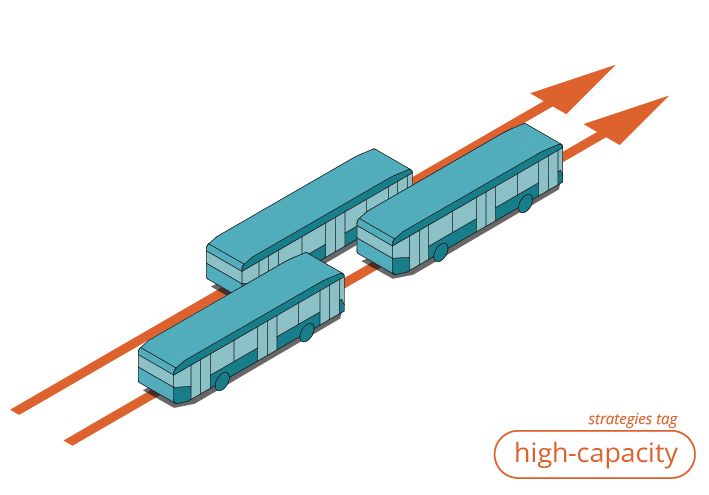
In corridors with heavy bus and tram traffic, transit can become the source of its own delays. To ensure that high throughput doesn’t affect transit speed and reliability, a range of measures can be deployed, from targeted overtaking lanes at stops to skip-stop configurations, to dedicated turn lanes at busy intersections, to providing more than one lane per direction along an entire corridor.
Overtaking lanes can be deployed at stops, especially on busy corridors where omnibus all-stop service coexists with express limited-stop one.

Skip-stop patterns, long continuous boarding platforms, or stops scattered around a major square are common strategies to expand curbside platform capacity in high-volume transit corridors and to prevent delays caused by buses and trams queuing to pick up passengers or by buses laying over at their termini.
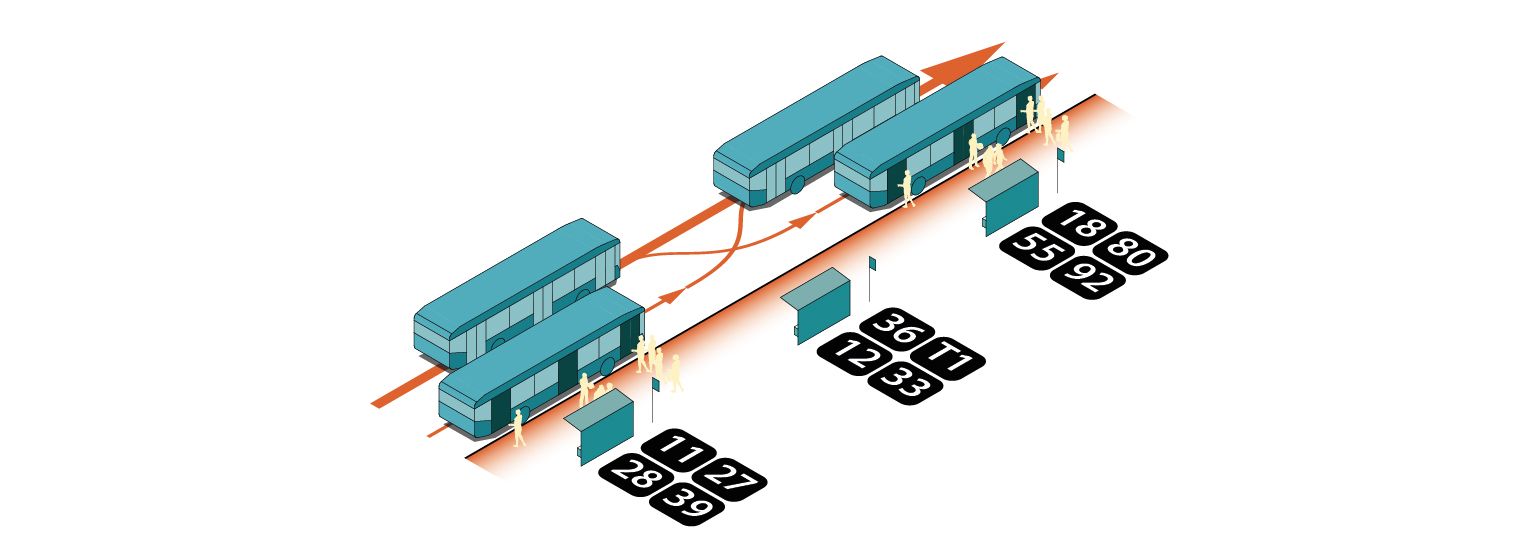
Dedicated turn lanes for transit can be deployed at locations where turning transit vehicles impede the main transit flow, especially at complex transit nodes where multiple routes converge or diverge from a common trunk.

Multi-lane corridors are extremely space-intensive, but they are the ultimate solution for increasing transit capacity. They are found in many heavy-duty BRTs in Latin America, with two or even three lanes per direction, and in Southeast Asia, as well as in some downtown stretches in North America, such as Seattle’s 3rd Street Transit-dedicated Corridor and Minneapolis’s Marq2 Transit Corridor.

Use cases
Most of these solutions are commonly deployed on heavy-duty BRT corridors that handle ridership volumes comparable to rail-based transit, with multiple overlapping routes and extremely short headways, as in Latin America and East Asia. They can also be found on trunk segments shared by multiple lines in conventional bus networks, generally in city centers where multiple lines converge.