Mapping Boarding Policies
The time necessary to complete boarding and alighting at stops can vary widely depending on multiple factors: how many people board and alight, the age and capability of bus users, the boarding practices (single vs. all-doors), the size and number of doors in the bus, the relative horizontal and vertical gap between the internal floor of the vehicle and the stop platform, and the layout of buses, including the location of validators and ticket vending machines [1,2,3].
There is consistent evidence in the literature that allowing boarding through more than one door can significantly reduce dwelling times, all else equal [4,5,6,7]. However, transit operators are reluctant to adopt so-called “all-door” boarding policies due to concerns about fare evasion and safety. Boarding practices vary widely across cities and even within them, depending on the type of service. Most transit agencies globally tend to adopt all-door boarding on tramway vehicles, except for small heritage vehicles (e.g., Lisbon) and on-street boarding in legacy systems (e.g., Philadelphia, Boston). For buses, policies tend to be more diverse, and it is possible to identify typical approaches in some geographic areas.
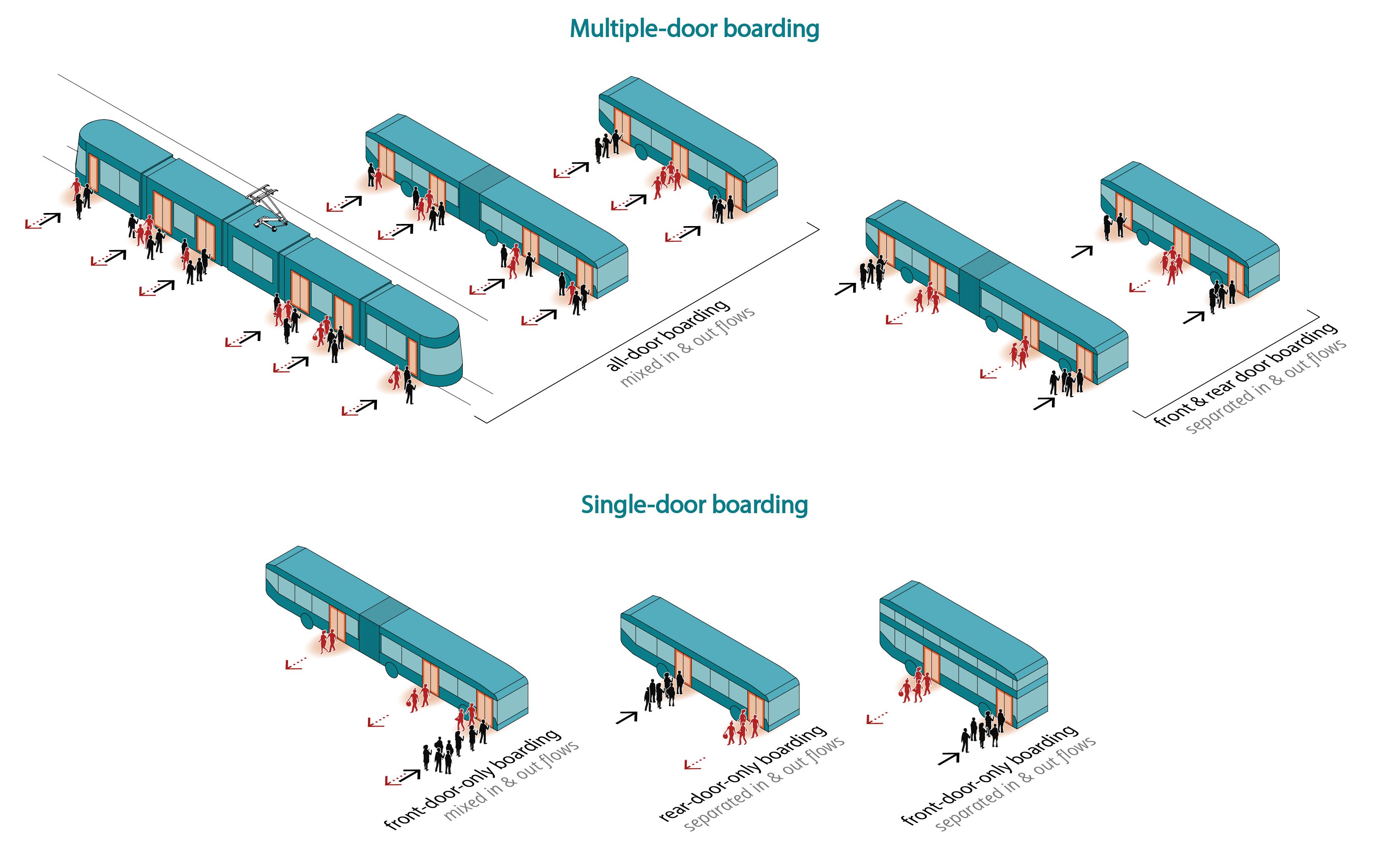
Boarding policies tend to vary by the number of doors (one to four doors for a standard bus or one to five for an articulated one), the type of fare (flat or zone-based), the fare purchase method (off-board or on-board from the driver or a conductor) and the validating and enforcement practice (by the driver, by a conductor or by random inspections). For simplicity, we are mapping them along two broad categories:
- Single-door boarding includes front- and rear-door-only policies, which can be further differentiated by whether the transit operator allows all doors to be used for alighting or separates ingress and egress. Single-door boarding policies are generally coupled with on-board fare purchase or validation by the driver at the front door, or a conductor, more commonly for rear-door boarding.
- Multiple-door boarding encompasses both undifferentiated all-door boarding/alighting approaches and treatments that separate boarding and alighting flows, such as operators that mandate boarding through the front and rear doors and alighting through the middle door(s). This policy is common in systems with off-board fare payment or validation and in proof-of-payment systems, with fare enforcement conducted through random fare inspections.
North America
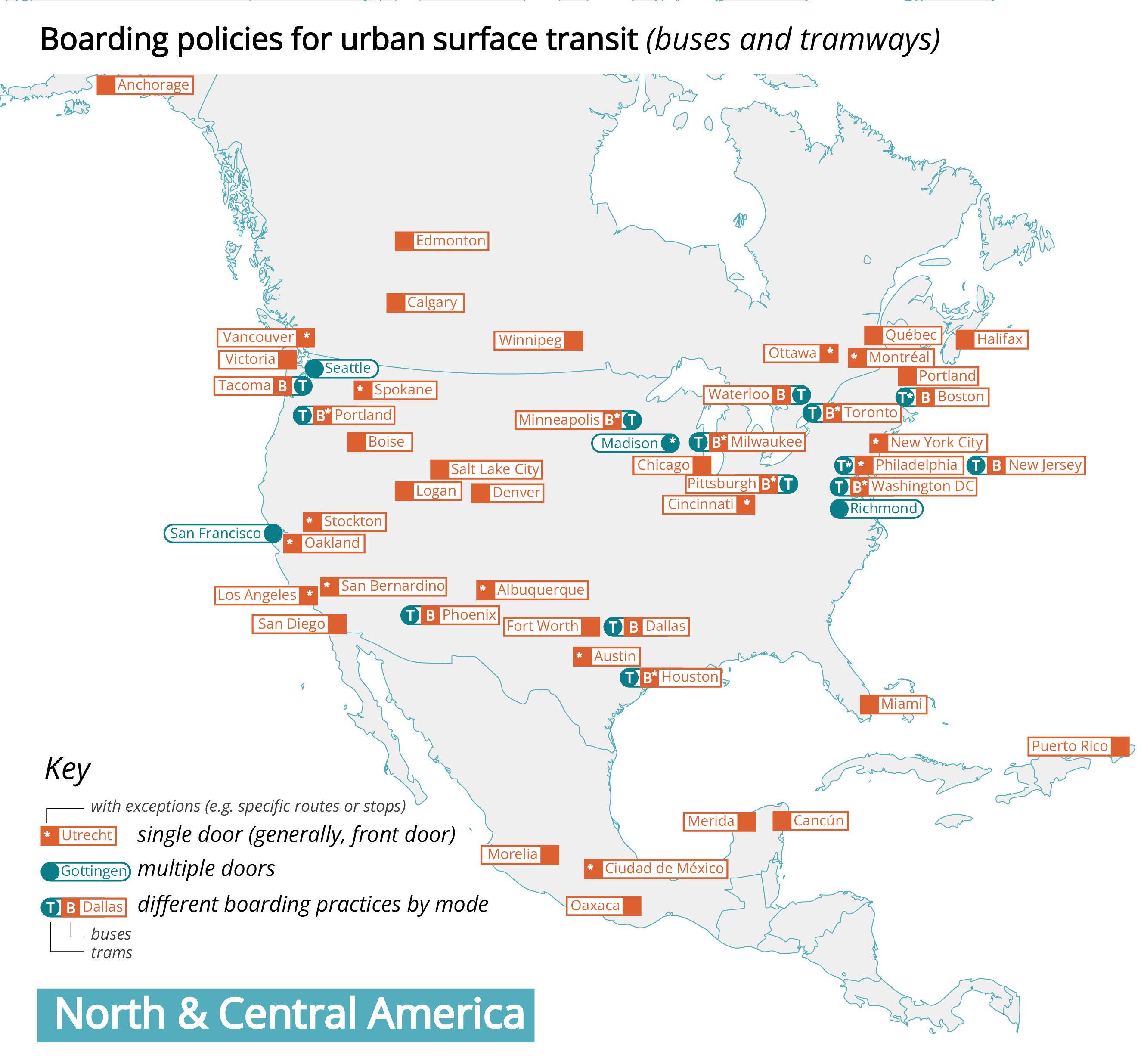
In North America, front-door-only boarding is the dominant policy, with notable exceptions: San Francisco’s MUNI, which adopted a well-established all-door boarding practice in 2012, Madison (WI), which has progressively introduced it across its network in recent years, and Seattle’s King County Metro, which launched a system-wide all-door boarding in March 2026. All-door boarding is also standard in the few agencies that do not charge a fare, like Richmond’s GRTC. Many transit agencies in Canada, the US and Mexico allow multi-door boarding on selected routes, generally on those having “Bus Rapid Transit” characteristics, including off-board fare payment, or in conventional trunk express routes, such as Vancouver's RapidBus routes and 99 B-Line, Portland’s FX green buses, and New York’s Select Bus Service. Other transit agencies limit all-door boarding to specific stops, such as busy rail-to-bus transfers, and sometimes associate it with facility layouts that allow enclosed transfers within the fare-paid area, as in Toronto’s TTC. Other cities allow all-door boarding in specific areas, such as downtown transit malls, sometimes coupled with a fare-free policy (e.g., Pittsburgh, Seattle).
Europe
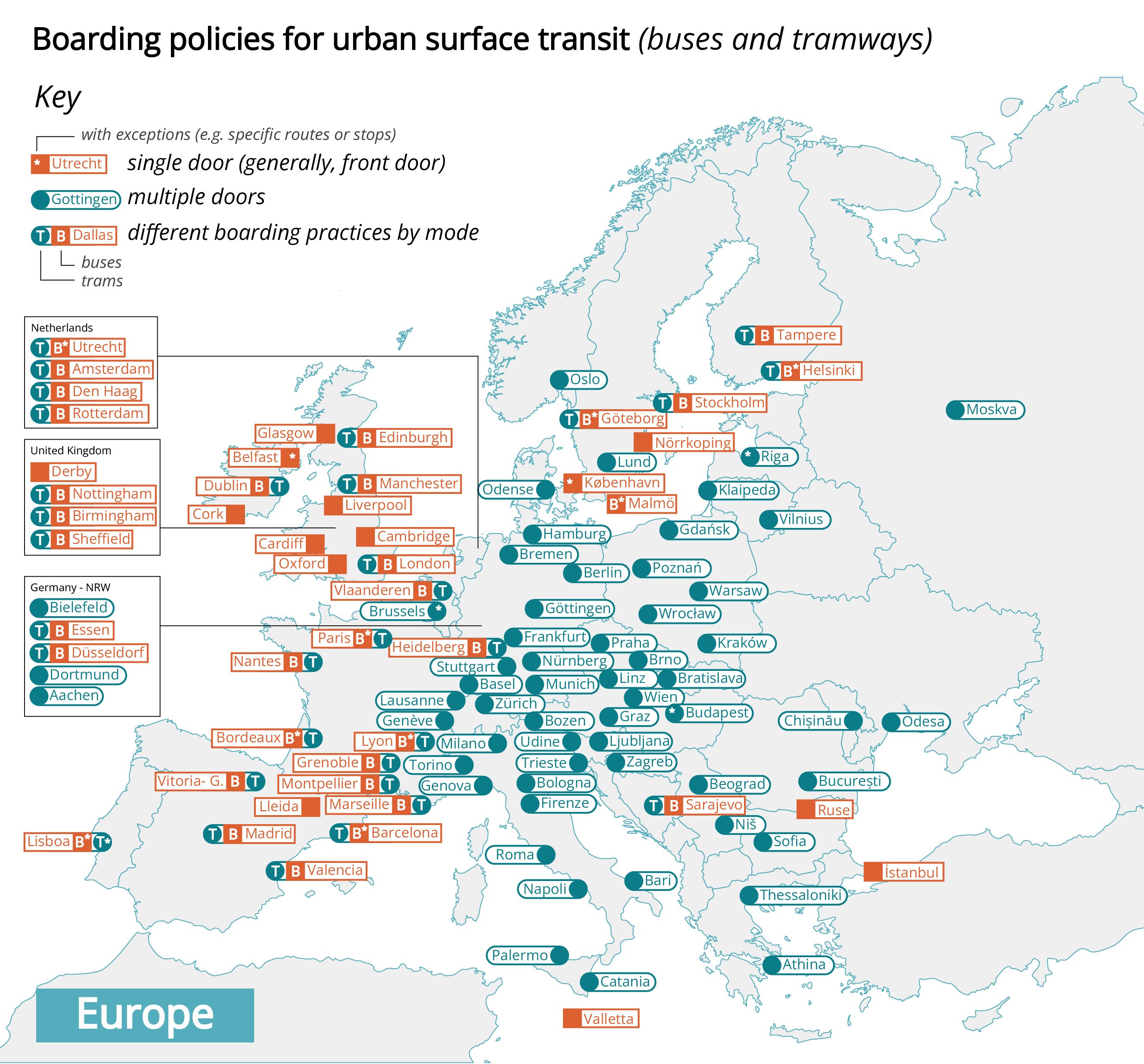
In Europe, boarding practices appear to organize along an East-West divide: In Atlantic Europe (UK, Ireland, France, Spain, and the Netherlands), front-door only boarding is the prevalent policy on buses, with a few exceptions like Barcelona, which is completing its transition to multi-door boarding as it deploys a new bus fleet with more doors. Similar to North America, multi-door boarding is limited to frequent trunk bus routes, such as many “chronolignes” (i.e., frequent bus lines) and BHNS (i.e., BRT) tram-like routes in French cities. In Central and Eastern Europe, the Balkans, the Baltic states, and Italy, multiple-door boarding is the prevalent policy for all urban surface transit, regardless of mode, with front-door-only boarding more common on extra-urban and rural routes. Operators in Scandinavian countries have mixed policies, with both multiple-door generalized policies (Oslo, Lund) and front-door-only ones, with the typical exception for busy routes (e.g. Helsinki’s “orange bus” trunk routes).
South and East Asia
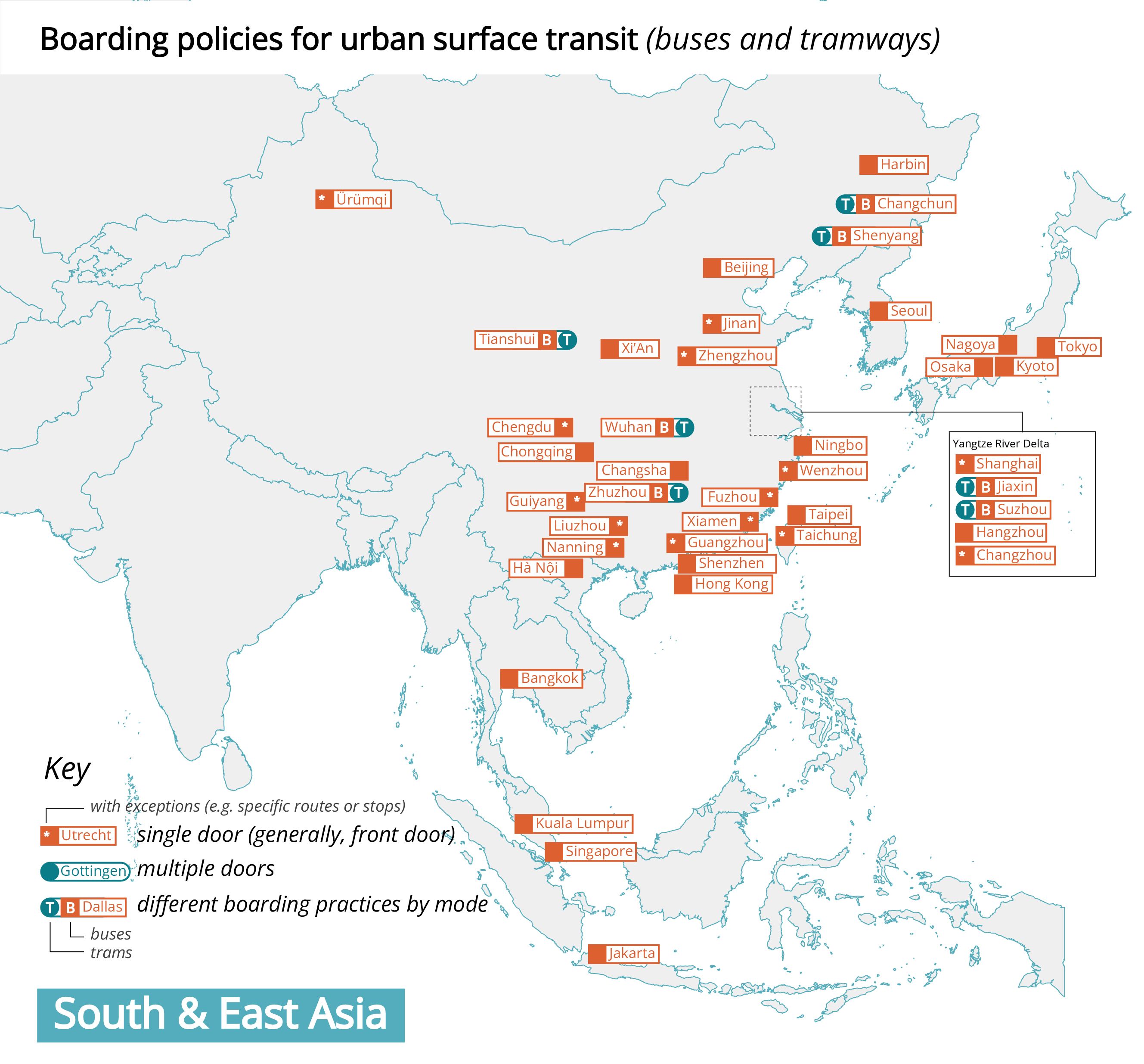
In South and East Asia, single-door boarding is the prevailing policy for buses, with both front- and rear-door-only applications. Typically, rear-door boarding is used when fares are collected by conductors on board, while front-door boarding is more common when fares are paid to a conductor or the driver upon exiting, especially for zone-based fares. On-board conductors remain relatively common in cities in emerging economies, such as Vietnam, Thailand, China and India. Tram or tram-like systems, like the “track-less” optically guided buses used in a few Chinese cities, all use all-door boarding.
Oceania
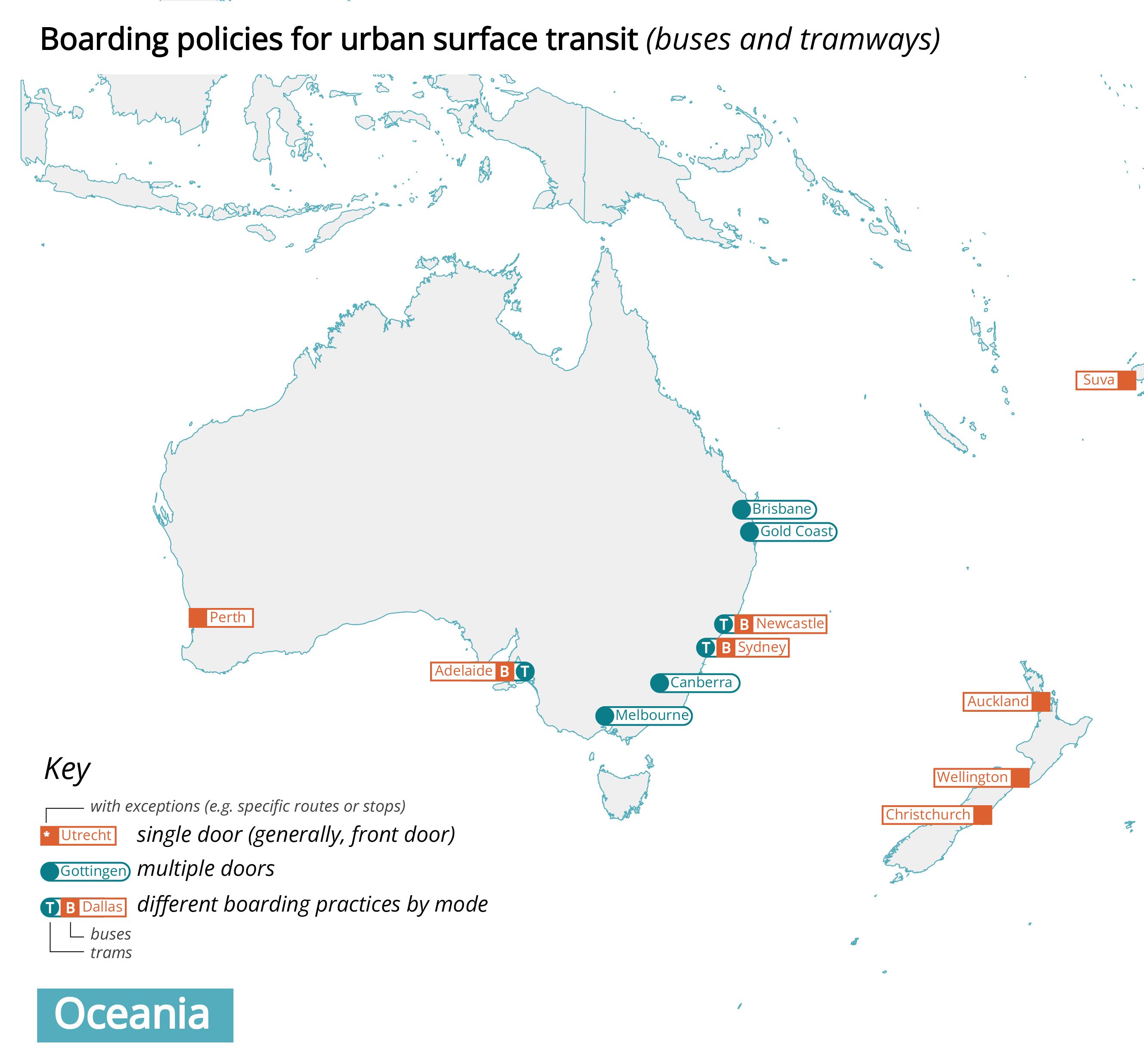
In Oceania, there are both cases of generalized multiple-door boarding across urban buses, such as in Melbourne, Canberra, and Queensland’s Translink, and cities that adopt a single-door-only boarding policy on buses, such as Sydney, Perth, and New Zealand’s three largest urban areas. Adelaide, which features an extensive BRT “guided” system, permits all-door boarding on these routes, similar to most places with premium bus service.
South America
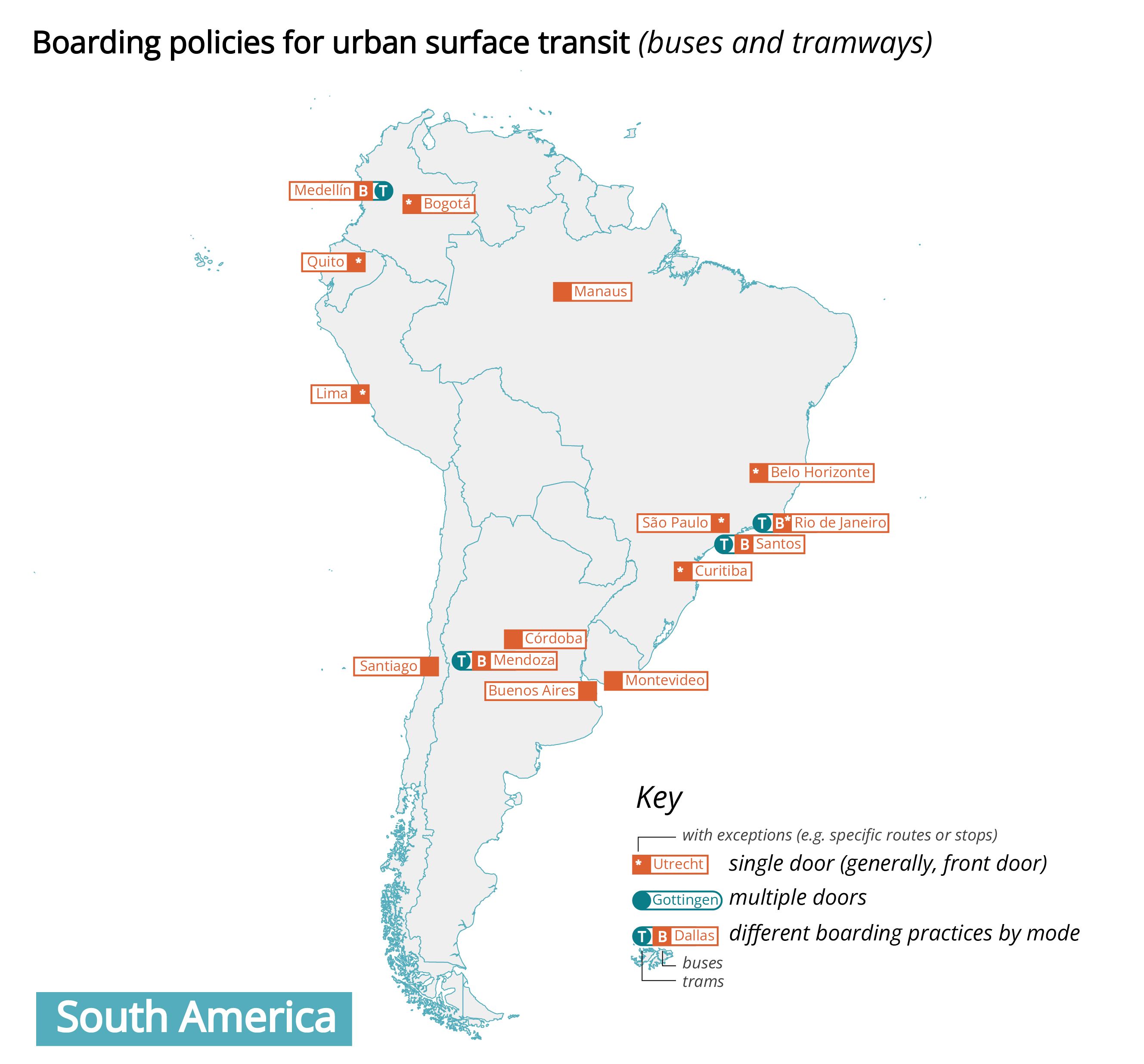
In South America, single-door boarding is the dominant policy for regular buses in the majority of cities, while tramways and BRT systems are generally multiple-door. On the continent that gave rise to the modern Bus Rapid Transit concept, off-vehicle fare collection is the norm in these heavily used systems, typically handled at fare-gate-controlled bus stops, starting with the iconic Estação-Tubo of Curitiba. In the informal or para-formal jitney and mini-bus-based bus systems, which rely on every customer paying the fare to survive, front-door boarding and paying the fare directly to the driver are the norm.
The complete database can be accessed here (last update: May 2026)
Do you have information for other cities, or would you like us to correct a mistake? Write us here!
Bibliography
- Dueker, K. J., Kimpel, T. J., Strathman, J. G., & Callas, S. (2004). Determinants of bus dwell time. Journal of public transportation, 7(1), 21-40.
- Fernandez, R. (2011, October). Experimental study of bus boarding and alighting times. In European Transport Conference (Vol. 32).
- Rashidi, S., Ataeian, S., & Ranjitkar, P. (2023). Estimating bus dwell time: A review of the literature. Transport Reviews, 43(1), 32-61.
- Jara-Díaz, S., & Tirachini, A. (2013). Urban bus transport: open all doors for boarding. Journal of Transport Economics and Policy (JTEP), 47(1), 91-106.
- Lee, J., & Papas, D. (2015). All-door boarding in San Francisco, California. Transportation Research Record, 2538(1), 65-75.
- Murray, A. (2021). Evaluation of All-Door Boarding: Analysis of Dwell Time Performance. UCLA: Institute of Transportation Studies.
- Stewart, C., & El-Geneidy, A. (2014). All aboard at all doors: Route selection and running-time savings estimation for multiscenario all-door bus boarding. Transportation Research Record, 2418(1), 39-48.