Center-running Transit Lanes
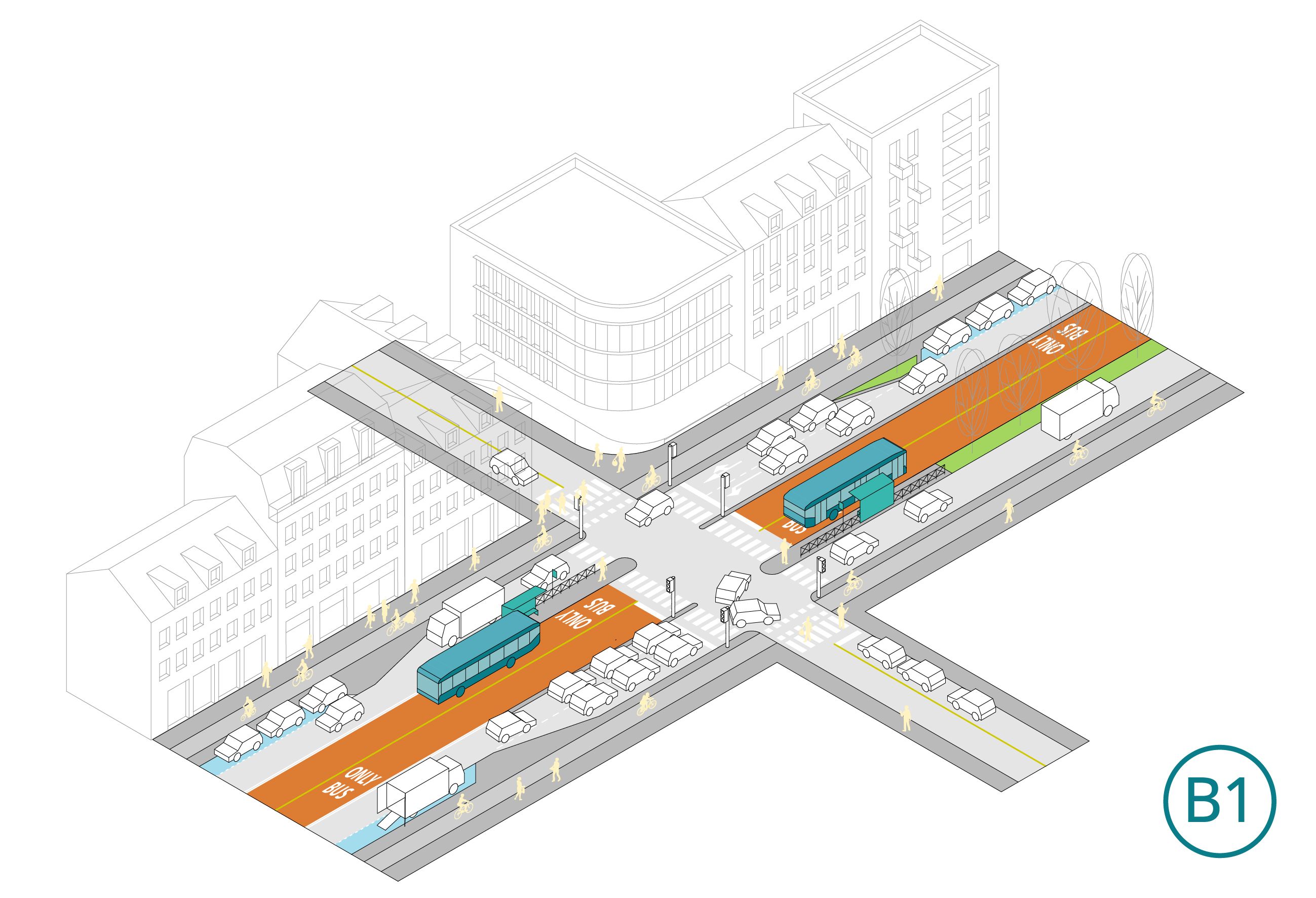
Center-running lanes are transit-dedicated lanes located at the center of the roadway. They are widely recognized as the most effective transit-priority measure for wide arterial streets. Compared to other typologies, they are protected by design from the most common curbside conflicts, such as parking, drop-off and pick-up, right-turns, and driveway access. On the other hand, they require a dedicated in-street boarding island for the safe boarding and alighting of passengers, and they need a more proactive management of conflicting left-turns. They also generally require generous rights-of-way, especially at intersections, to eventually accommodate staging lanes for protected left turns and refuge islands for pedestrians.
Key Facts
- Stops
- Must be located on boarding islands, accessed via pedestrian crossings at signalized intersections, or zebra crossings. Island platforms (i.e., located between the two directions) that can fit in a narrower width are common in modern tramway systems with doors on both sides. However, island platforms serving buses require either special buses with doors on the opposite side or on both sides (if they operate in other settings), or running buses in switched directions.
- Left Turns
- Left-turn maneuvers are the most prominent source of conflicts in center-running lanes. This conflict is normally managed via separate signal phases, or with yields or stops in low-traffic settings with good lateral visibility.
- Right Turns
- N/A
- Parking
- Center-running transit lanes are protected from on-street parking encroachment by design, as they are located far away from the curb.
- Enforcement
- Center-running lanes can be enforced against lateral encroachment using physical separators, ranging from surmountable elements such as armadillos, plastic or bevelled concrete curbs, to non-surmountable hard separators or even landscaped medians. Center-running lanes can also be placed at a slightly higher level than the adjacent roadway, a solution commonly adopted for tramways. Cameras and physical traps can be used to prevent unauthorized vehicles from entering at intersections.
- Transit Signal Priority
- Most TSP strategies can be effectively implemented, including active TSP, notably at intersections with far-side stops (greater certainty on ETAs) and at multi-stage pedestrian crossings (shorter clearance times for anticipated green/truncated red).
- Cost
- Medium to very high, as it can be associated with major reconstruction of the entire roadway and reconfiguration of intersections, drainage or even utilities
Use Cases
Center-running transit lanes are associated with high-performance bus and modern tram service, such as Bus Rapid Transit (BRT), Bus à Haut Niveau de Service (BHNS), also translated in English as BHLS (Bus with High Level of Service), and at-grade high-priority rail-based street-running transit, such as modern tramways and LRTs. However, dedicated center-running transit lanes are possibly the oldest type of transit reserved on-street right-of-way, as they appeared on tram networks already at the end of the 19th century, when rail transit began to be integrated as a standard feature into modern street design, especially in wide urban boulevards of planned greenfield expansion areas.