Center-Running Transit Lanes on Freeway Medians
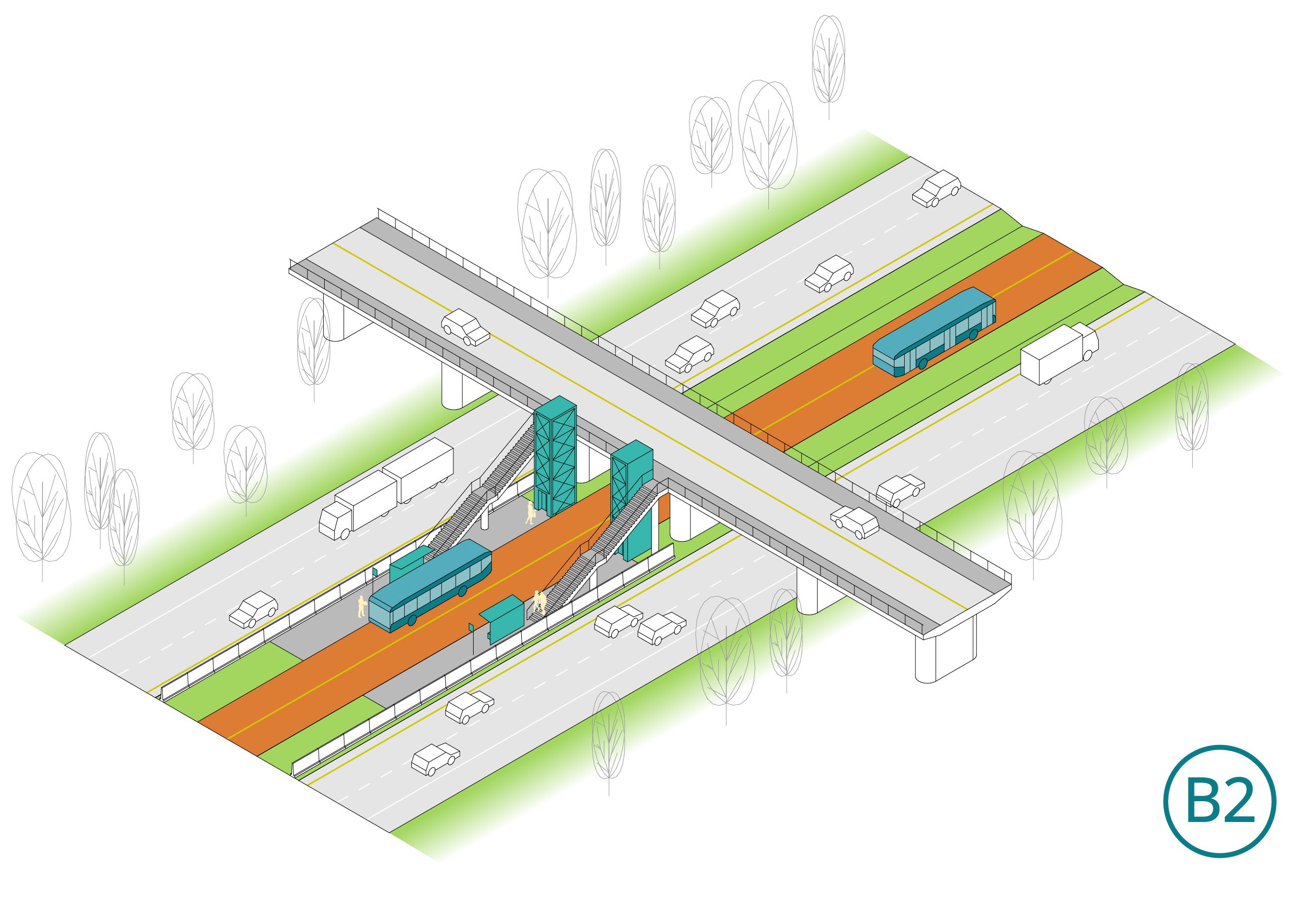
Center-running transit lanes in freeway medians are transit-dedicated lanes located in the median of limited-access highways, i.e. roadways where access is prohibited to pedestrians and non-motorized vehicles, such as expressways, motorways and freeways. This type of roadway normally has grade-separated intersections and no direct access from abutting properties, so the median provides for a fast, grade-separated transit corridor ideal for high-speed express regional routes with few stops and high average speed. They can be separated from general traffic lanes by culverts, Jersey barriers or simply by painted markings. High-Occupancy-Vehicle (HOV) Lanes are a specific application of this concept, extending the use of transit-dedicated lanes to vehicles with more than two or three occupants, and are particularly popular in North America.
Key Facts
- Stops
- In-highway stops normally require extensive infrastructure to shelter passengers from high-speed vehicular traffic and vertical circulation to access the stop from grade-separated urban streets. Platforms can be placed. Island platforms that can fit in a narrower width are common in modern tramway systems with doors on both sides. However, island platforms serving buses require either special buses with doors on the opposite side or on both sides (if they operate in other settings), or running buses in switched directions.
- Left Turns
- N/A
- Right Turns
- N/A
- Parking
- N/A
- Enforcement
- Lateral separation can be enforced through markings or hard, physical separations, such as Jersey barriers or ditches. Access to the reserved lane can be enforced with cameras located at the entrance or the exit.
- Transit Signal Priority
- Intersections are generally grade-separated.
- Cost
- Very high, as it requires extensive reconfiguration of the highway space with major civil interventions for stations.
Use Cases
Center-running transit lanes in freeway medians are commonly used to serve long-distance express buses oriented toward regional travel demand. Their history is embedded in postwar car-oriented suburbanization, and they were first implemented in the U.S. during the late 1960s and early 1970s in response to growing congestion and increasing demand for suburban-to-downtown bus service from areas not served by legacy rail networks [1]. Among the first examples are the Lincoln Tunnel XBL connecting New Jersey and Manhattan in the late 1960s [2], the Shirley Highway Express Bus-on-Freeway pilot project in Virginia [3,4]. and the El Monte Busway in Los Angeles [5], both from the early 1970s. However, over the following decades, the emphasis shifted to HOV (High Occupancy Vehicle) lanes, which became the most common form of transit-priority lanes on limited-access highways, such as Houston's extensive HOV scheme [6]. More recently, transit-dedicated lanes in the median of limited-access highways have become more popular in emerging economies as part of very-high-capacity BRT schemes, such as Istanbul’s Metrobus, which mostly operates in the median of the O-1 “Otoyol” inner-belt motorway, opened in 2007-09 [7].
Bibliography
- Levinson, H. S., Zimmerman, S., Clinger, J., & Rutherford, H. C. S. (2002). Bus rapid transit: An overview. Journal of Public Transportation, 5(2), 1-30.
- Levinson, H. S., Hoey, W. F., Sanders, D. B., & Wynn, F. H. (1973). Bus use of highways: state of the art. NCHRP Report, (143).
- Robertson, R. N. (1973). An evaluation of the Shirley Highway Express-Bus-on-Freeway Demonstration Project.
- NVTC (1976). The Operation and Management of The Shirley Highway Express Bus-On-Freeway Demonstration Project. Final Report.The Northern Virginia Transportation Commission.UMTA-IT-06-0024-76-1.
- SCRTD (1975) - From Dream to Reality: El Monte-Los Angeles Busway. Southern California Rapid Transit District.
- Turnbull, K. F. (2003). Houston managed lanes case study: The evolution of the Houston HOV system.
- Alpkokin, P., & Ergun, M. (2012). Istanbul Metrobüs: first intercontinental bus rapid transit. Journal of transport geography, 24, 58-66.