Static Alternate-Direction Center-Running Transit Lanes
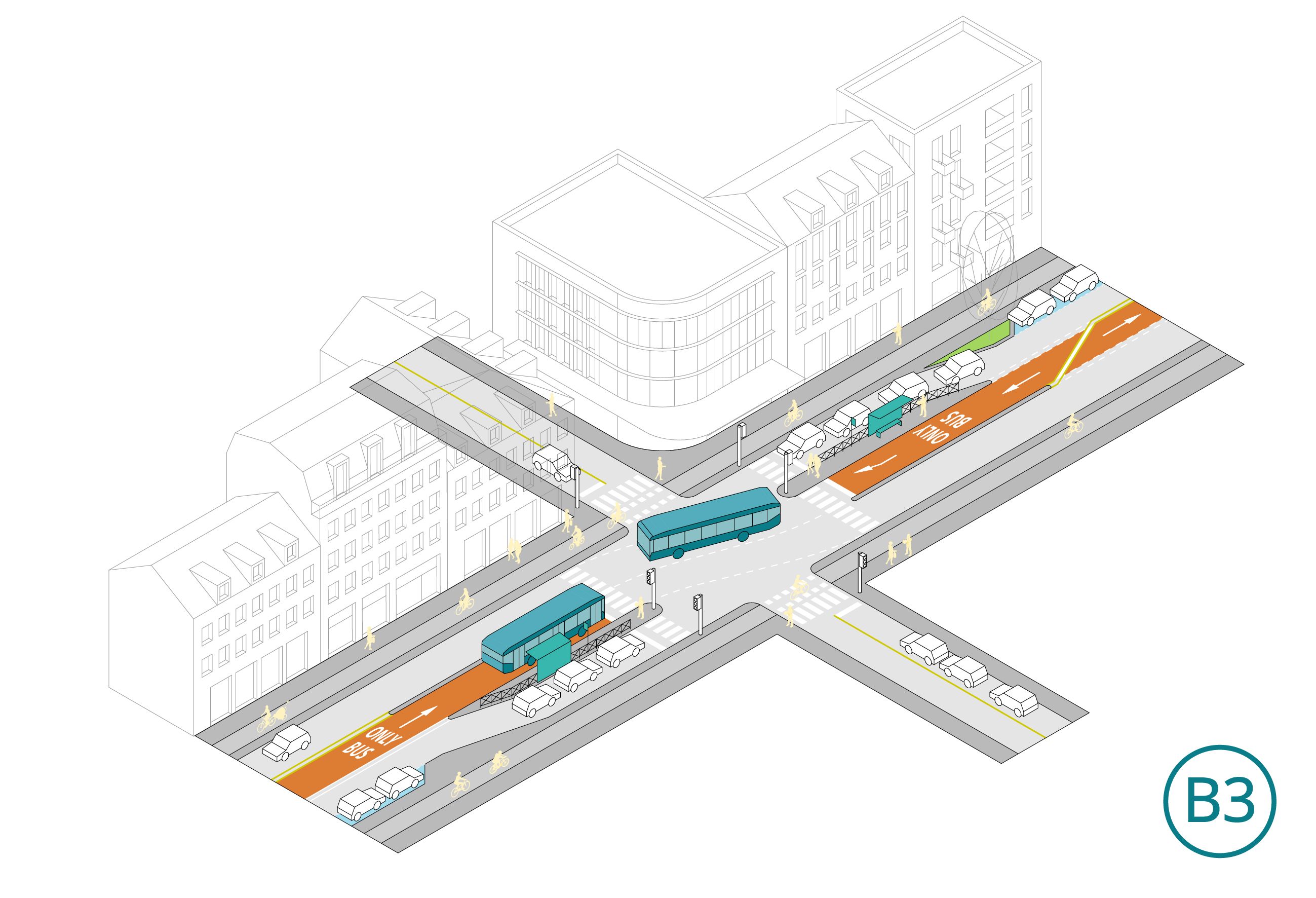
Static Alternate-Direction Center-Running Transit Lanes are an application of center-running lanes for space-constrained settings, in which a single central transit lane changes direction mid-block and at intersections. Transit vehicles can use the lane to bypass queues at signalized intersections and merge back into the general traffic lane afterward, typically during a dedicated phase preceding the general-traffic through phase. It can also be described as a continuous center-running queue-jump lane (G1).
Key Facts
- Stops
- Stops are located on boarding islands, generally before the intersection, though they can be placed mid-block and in short segments where it’s possible to have separate lanes for each direction.
- Left Turns
- Left-turn conflicts are similar to those of standard center-running lanes. This conflict is normally managed via separate signal phases or with yields or stops in low-traffic settings with good lateral visibility.
- Right Turns
- N/A
- Parking
- They are protected from on-street parking encroachment by design, as they are located far away from the curb.
- Enforcement
- Similarly to standard center-running lanes, they can be enforced against lateral encroachment using physical separators, ranging from surmountable elements such as armadillos, plastic or bevelled concrete curbs, to non-surmountable hard separators and mineral or even landscaped medians. Cameras and physical traps can be used to prevent unauthorized vehicles from entering them at intersections.
- Transit Signal Priority
- Most TSP strategies can be effectively implemented, including active TSP, notably at multi-stage pedestrian crossings (shorter clearance times for anticipated green/truncated red).
- Cost
- Medium to very high, as it can be associated with major reconstruction of the entire roadway and reconfiguration of intersections, drainage or even utilities.
Use Cases
Static Alternate-Direction Center-Running Transit Lanes are a relatively recent solution in the transit priority toolbox. Notably, they have been systematically deployed in many BHNS (Bus à Haut Niveau de Service) projects in France, starting with the first extensive implementation on Rouen’s TEOL guided busway project in the early 2000s [1, 2, 3], to provide transit priority on narrow corridors. Another notable example is Lens-Béthune’s BHNS, in Northern France, where the central static alternate-direction lane spans almost 8 km with stops located on the curbs in mixed-traffic segments.
Bibliography
- Fin, B. et al. (ed. 2012). Buses with High Level of Service. Fundamental characteristics and recommendations for decision-making and research. Results from 35 European Cities. COST.
- CEREMA (2024). Les couloirs bus bidirectionnels à voie unique : optimiser le partage de la voirie. Édition | Insertion urbaine des transports collectifs de surface (IUTCS), fiche n° 12.
- CEREMA (2024). Urban insertion of surface public transport (IUTCS). Fact sheet no. 12, Bidirectional single-lane bus lanes: optimising road sharing.