Dynamic Alternate-Direction Center-Running Transit Lanes
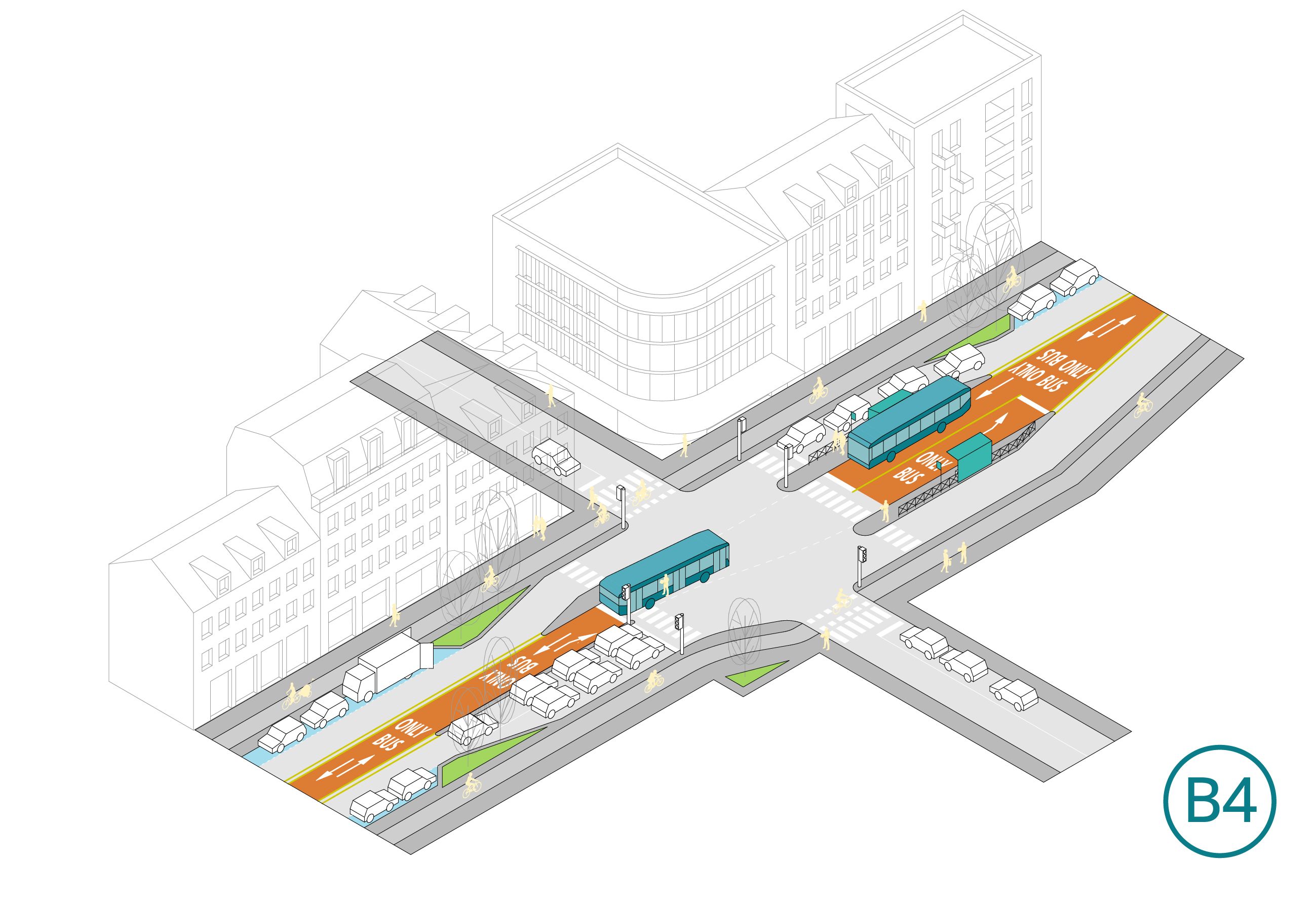
Dynamic alternate-direction center-running lanes are a family of transit priority tools that allow transit vehicles to use a single dedicated transit lane in the center of the roadway in both directions. The separation of opposite-direction flows can generally be achieved with three strategies: i) temporal separation, when, for example, the lane is used in one direction during the AM peak and in the other direction during the PM peak; ii) line-of-sight, when the use of the lane is self-regulated by bus drivers on a direction-first or first-come-first-served basis; iii) signal-controlled, when the occupancy of the alternate-direction lane is regulated by signals.
Key Facts
- Stops
- Stops must generally be located on traffic islands. In North America, there are a few examples of systems with island platforms using special buses.
- Left Turns
- Left-turn conflicts are similar to those of standard center-running lanes. This conflict is normally managed via separate signal phases or, in low-traffic settings with good lateral visibility, with yields or stops.
- Right Turns
- N/A
- Parking
- They are protected from on-street parking encroachment by design, as they are located far away from the curb.
- Enforcement
- Similarly to standard center-running lanes, they can be enforced against lateral encroachment using physical separators, ranging from surmountable elements such as armadillos, plastic or bevelled concrete curbs, to non-surmountable hard separators and mineral or even landscaped medians. Cameras and physical traps can be used to prevent unauthorized vehicles from entering them at intersections.
- Transit Signal Priority
- It can integrate several TSP strategies, but it specifically requires high levels of schedule and signal coordination, especially when the alternate-direction lane is signal-controlled.
- Cost
- Medium to high for long segments with stops at traffic islands, but can be minimal for shorter segments that don’t require extensive road reconfiguration.
Use Cases
Dynamic alternate-direction center-running lanes are used when there isn’t sufficient space to allocate to transit a dedicated lane in each direction. They are generally used over short segments because they limit frequency and impose several operational constraints, notably at stops and for intersections. However, there are examples of longer segments that stretch well beyond a kilometer and are generally controlled by signals, such as Indianapolis’s Purple line, which has double-lane sections for crossing. They have become more popular in France, where several cases have been recorded in the last 20 years, generally as part of BHNS (Buses à Haut Niveau de Service) BRT schemes [1,2,3], but they are also used in Switzerland [4] and increasingly in the U.S., notably in Indianapolis and Eugene.
Bibliography
- Fin, B. et al. (ed. 2012). Buses with High Level of Service. Fundamental characteristics and recommendations for decision-making and research. Results from 35 European Cities. COST.
- CEREMA (2024). Les couloirs bus bidirectionnels à voie unique : optimiser le partage de la voirie. Édition | Insertion urbaine des transports collectifs de surface (IUTCS), fiche n° 12.
- CEREMA (2024). Urban insertion of surface public transport (IUTCS). Fact sheet no. 12, Bidirectional single-lane bus lanes: optimising road sharing.