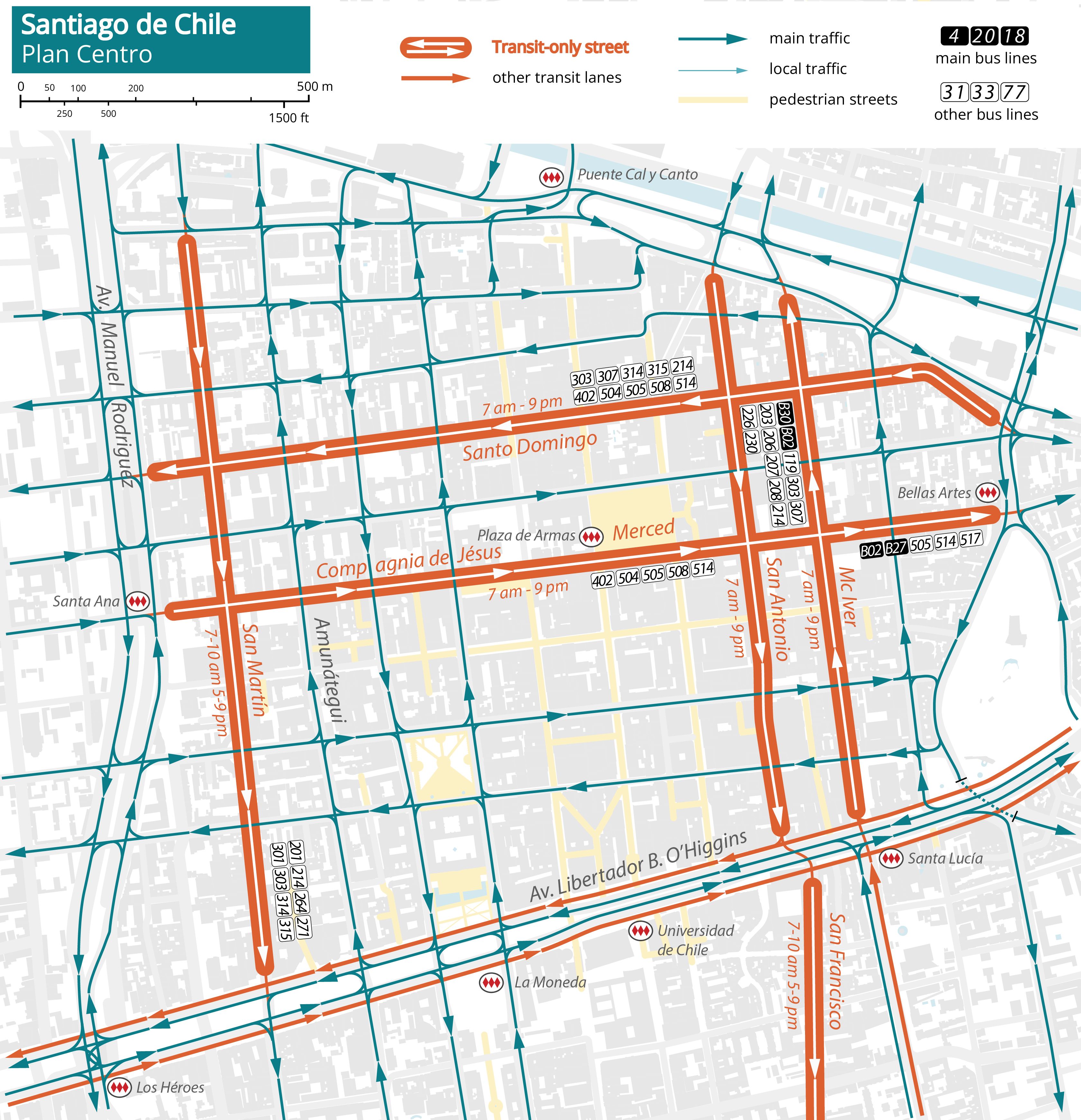
Santiago de Chile: Plan Centro
Tools: a1
Strategies: divert-through-trafficcurb-friction
During the first half of the 2010s, Santiago de Chile implemented a comprehensive plan for its city center to reduce the space dedicated to private vehicles and improve transit, bike and pedestrian accessibility. Alongside extensive pedestrianization, five one-way streets crossing the central district were converted into Vias Exclusivas, that is, streets reserved for transit and taxis during weekday peak times (7-10 am and 5-9 pm), later extended to the entire weekday daytime (7 am - 9 pm) on some streets. The streetscape underwent a redesign to provide additional space for pedestrians, featuring enlarged sidewalks and tabled intersections, as well as improved transit accessibility with high-level bus stop platforms. This scheme, known as “Plan Centro,” is credited with reducing travel times on Transantiago buses by 33% during the AM peak and by 65% during the PM peak, while the number of cars crossing the city’s core fell from 180,000 to 20,000 per day.