Torino: Corsi (multiway boulevards)
Tools: e1l3l2
Strategies: priority-corridorsintersectionscurb-friction
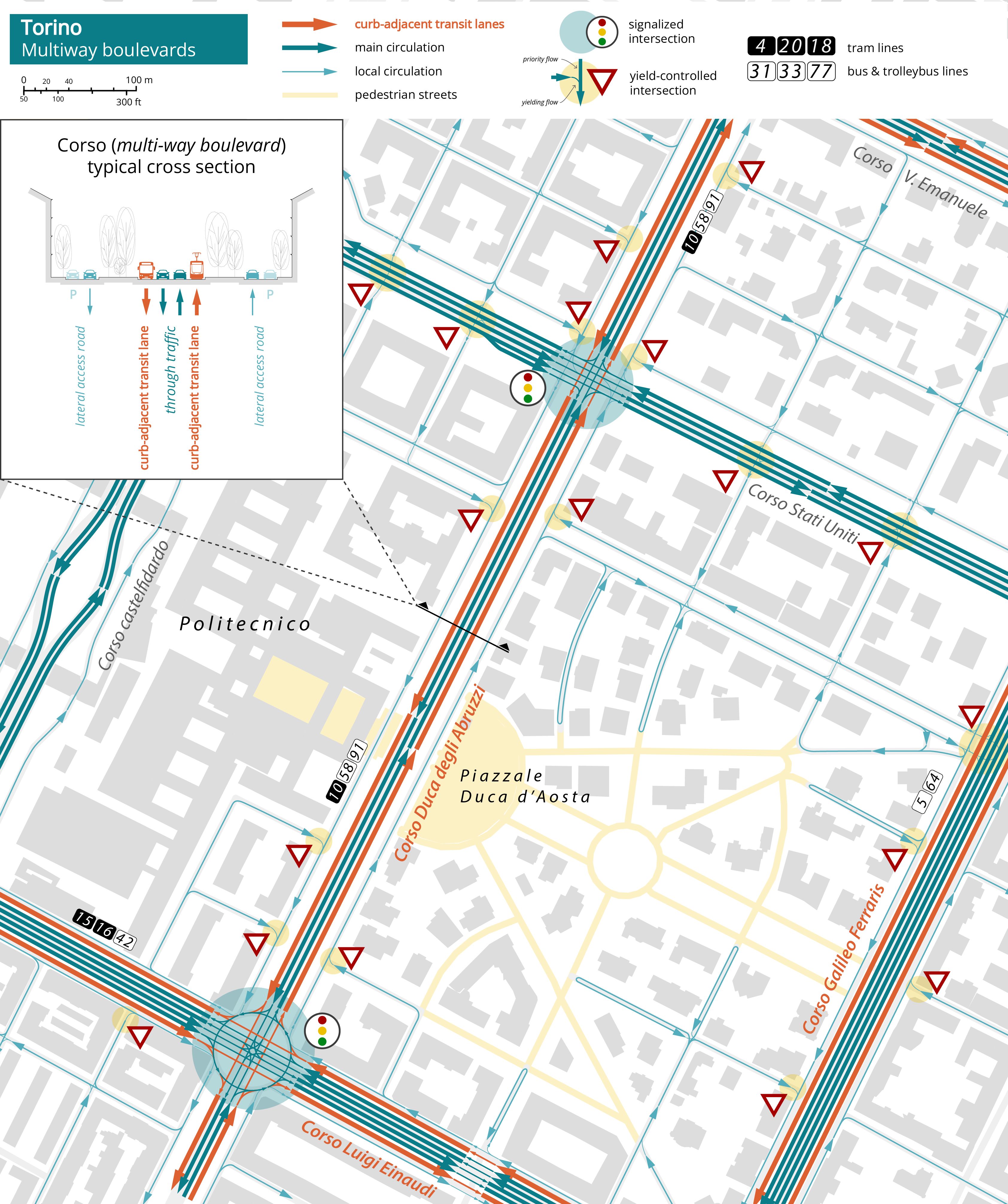
Most of the city of Torino (Turin) is characterized by a 19th-century urban structure organized around multiway boulevards, known as “Corsi”, in which vehicular circulation is functionally divided into a central roadway for through traffic and two side-access streets, generally separated by planted medians. In Torino, the central roadway generally hosts curb-adjacent transit lanes, sometimes exclusively dedicated to trams and unpaved, other times shared by trams, buses and taxis. Side access roads provide curbside access to abutting properties, collect traffic from perpendicular local streets, and occasionally permit indirect left turns (L1) whenever they are prohibited in the main roadway.
This arrangement offers two main advantages over classic curb-adjacent transit lanes. First, it discourages encroachment on the curbside transit lane by deliveries and drop-off/pick-up operations, as the side access road provides more direct access to the sidewalks. Second, it collects traffic from lateral streets, concentrating movements at major intersections, resulting in longer stretches of the central throughway that are uninterrupted by intersections, even in an otherwise heavily gridded city like Torino.