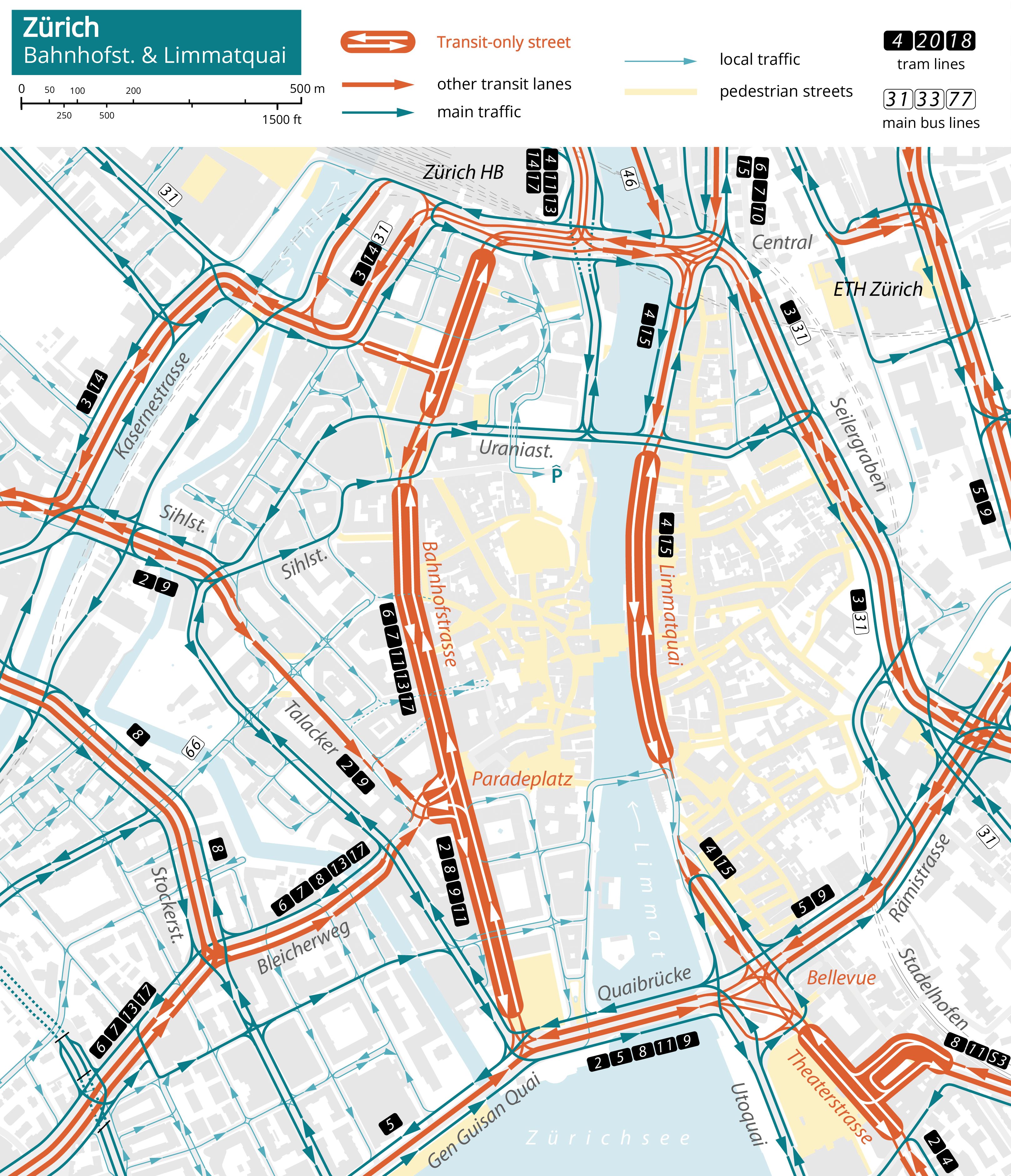
Zürich: Bahnhofstrasse and Limmatquai
Tools: a1l4
Strategies: divert-through-trafficpriority-corridorsintersections
Developed during the second half of the 19th century, Bahnhofstrasse is the major shopping and transit throughfare of Zürich’s city center, connecting the city’s main railway station to the shores of the Zürichsee. Starting from 1966, Banhofstrasse was progressively pedersianized and reserved for trams, initially only for a few blocks, later extended to the entire street and to the major transit node of Paradeplatz during the 1970s and 1980s, as part of a broader effort to prioritize surface transit throughout the city, sanctioned by the 1977 referendum on the “People’s Initiative for the Promotion of Public Transport”. Limmatquai, which cuts through the city’s pedestrian core on both sides of the Limmat river, was dedicated exclusively to trams in 2002 following a city council vote and another referendum. Today, Banhofstrasse carries up to 50 trams per hour in each direction, while Limmatquai hosts two lines for a combined 16 trams per hour in each direction. These tram-only streets are embedded in a broader circulation pattern that pushes vehicular through-traffic to the edges of the historic city’s largely pedestrianized core.