Offset Transit Lanes
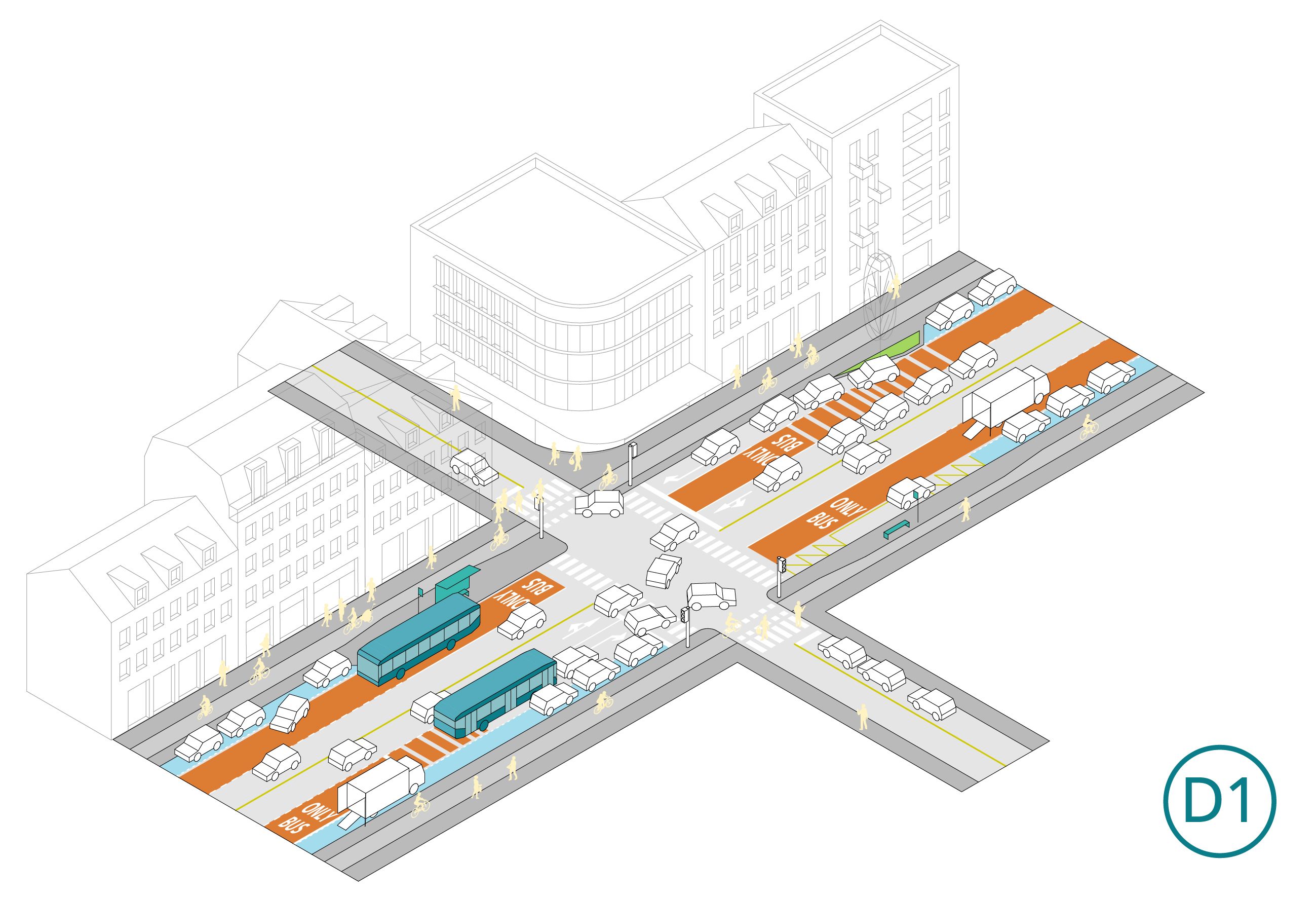
Offset transit lanes, sometimes referred to as parking-adjacent transit lanes, are transit-dedicated lanes located in the rightmost driving lane, next to curbside parking. They are the simplest type of transit lane to implement on multi-lane urban arterials, as they require only repurposing an existing lane for the exclusive use of transit vehicles, often with limited peak-only operating hours. However, they are prone to encroachment and blocking by vehicles reaching curbside parking and to substantial conflicts with right-turning vehicles at intersections and driveways.
Key Facts
- Stops
- Pull-off stops located directly at the curb on sidewalks are the most common type of stop layout in offset transit lanes, but they are prone to encroachment. Bus bulbs can alleviate this issue.
- Left Turns
- N/A
- Right Turns
- Direct conflict with right-turning vehicles can cause delays at intersections with offset transit lanes, as these lanes are typically interrupted a few dozen meters upstream to accommodate turning movements. Mixing with right-turning traffic can be a major source of delay, particularly in areas with high pedestrian volumes, as right-turning vehicles that yield to pedestrians and cyclists block transit vehicles. This can be mitigated through several strategies. A dedicated right-turn lane to the right of the transit lane can be carved out of the parking buffer, moving the point of conflict upstream, but the lane must be long enough to accommodate the expected volume of turning vehicles to avoid blocking the transit lane. Other strategies include prohibiting right turns, reorganizing lateral street circulation into converging one-way streets to reduce right turns, and implementing signal management and intersection design measures that minimize right-turn conflicts, such as permitting right turns from the adjacent general lane during a separated phase. Offset transit lanes are also subject to right-turn conflicts outside the intersection, involving vehicles accessing driveways and properties, with potentially high volumes at off-street parking and commercial areas.
- Parking
- Parking is the single major source of conflicts and potential delays for offset transit lanes. Vehicles maneuvering to enter parallel curbside parking are allowed to occupy the lane legally, and can delay transit vehicles in the process. Double-parking, curbside drop-offs and pickups, and deliveries are all known sources of potential delays in offset setups.
- Enforcement
- Enforcement of offset transit lanes is particularly challenging, as they can be legally accessed at any point to reach curbside parking, making it impossible to implement physical separation to prevent lateral encroachment. Vehicle-mounted cameras are currently used for enforcement, but fines are normally conditional on a vehicle being spotted twice and after a certain lapse of time, to ensure it was not legally using the lane for a short time to reach parking.
- Transit Signal Priority
- Implementing active TSP can be very challenging for offset transit lanes, as right-turn conflicts and legal use by vehicles accessing parking make it more difficult to estimate arrival times at the intersection.
- Cost
- Generally minimal, as they can be implemented with road signs and painted markings. Provisions to reduce the potential for delays at intersections, as described in the “right-turns” section, may require a more expensive redesign of the intersection and its traffic signal configuration.
Use Cases
Offset transit lanes are among the most common forms of transit lanes, as they are extremely simple to roll out on limited budgets and do not require any major rethinking of circulation patterns, only the reallocation of an existing general travel lane. They began to appear in developed countries during the postwar years, notably from the late 1960s, as a transit-priority measure on busy urban corridors, generally deployed for buses, since trams tended to be located in the center of streets [1,2]. They are particularly popular in North America, where banning curbside parking on urban arterial streets, particularly along commercial corridors, has proven politically challenging [3]. For example, they are the dominant form of arterial bus priority lanes in New York City, Boston, and San Francisco. They are often implemented with limited operating hours, i.e. directionally during the morning and afternoon peak hours.
Bibliography
- Ministère des Transports (1972). Directives sur l’amélioration de la circulation des transports collectifs de surface dans les villes. 3 juillet 1972.
- Levinson, H. S., Hoey, W. F., Sanders, D. B., & Wynn, F. H. (1973). Bus use of highways: state of the art. NCHRP Report, (143).
- Norton, P. D. (2011). Fighting traffic: the dawn of the motor age in the American city. Mit Press.