Curb-Adjacent Transit Lanes
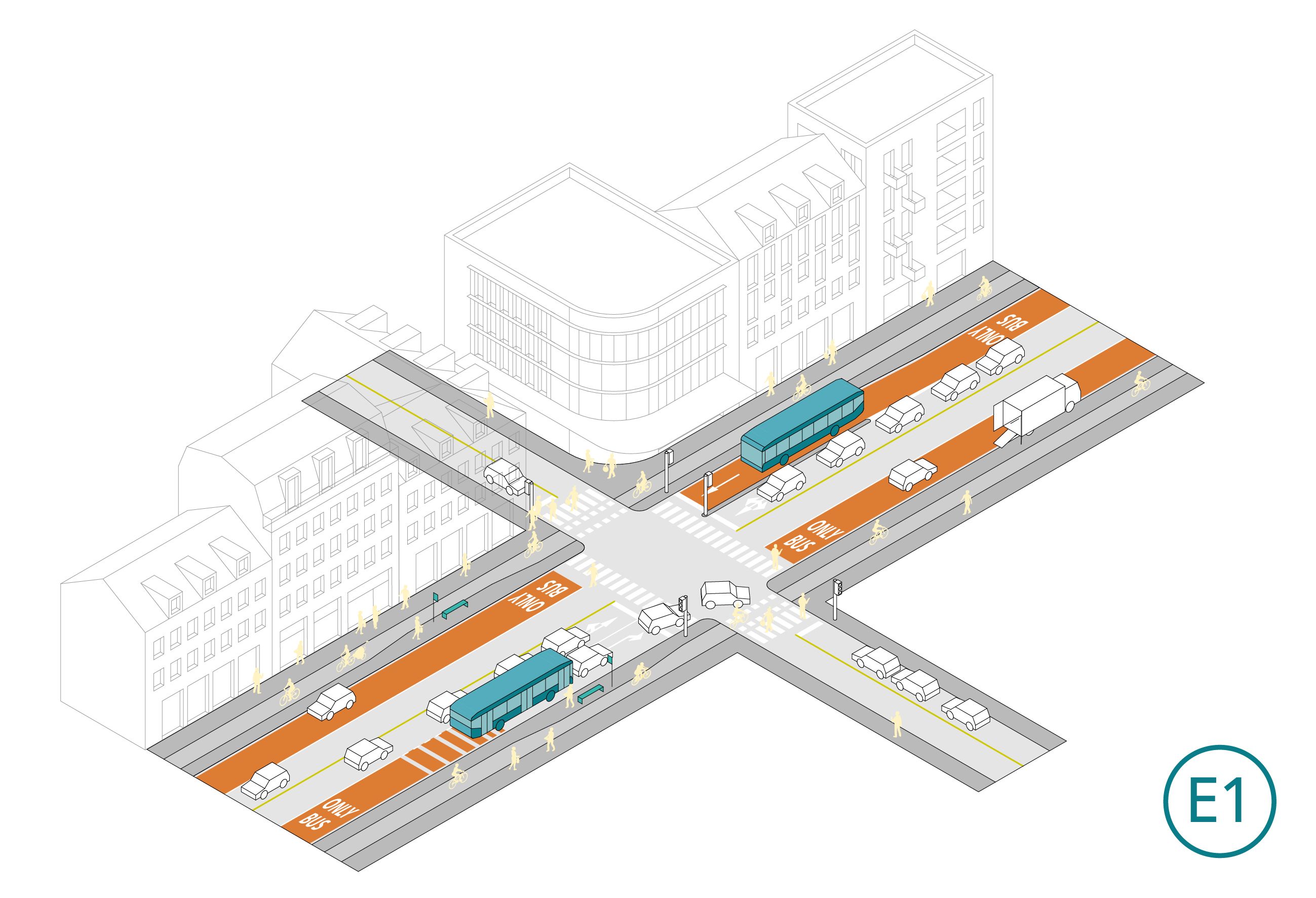
Curb-adjacent (or curbside) transit lanes are among the most common transit-priority measures deployed on streets where curbside parking is banned. They are inexpensive to deploy and provide easy access to transit stops located on sidewalks. As a downside, they are inherently discontinuous because they are frequently interrupted to allow right turns. Additionally, they are prone to curb friction from pickups, drop-offs, and deliveries, which can be especially problematic in areas with high curbside activity, such as commercial corridors.
Key Facts
- Stops
- Located directly at the curb on sidewalks. Overtaking at stops, which can be necessary on busy corridors with skip-stop patterns, can be accommodated by a central overtaking lane or by providing pull-over bays.
- Left Turns
- No particular risk of conflict, as left turns will generally interfere with the general traffic lane
- Right Turns
- The primary limitation of curb-adjacent lanes is the direct conflict with right-turning vehicles, as these lanes are generally interrupted a few dozen meters upstream of an intersection to accommodate turning movements. This can be a major source of delay, particularly in areas with high pedestrian volumes and when combined with near-side stops, as right-turning vehicles that yield to pedestrians and cyclists block transit vehicles. This can be mitigated through several strategies, including prohibiting right turns, reorganizing circulation patterns on lateral streets as converging one-ways to reduce the number of right turns, and signal management measures that minimize right-turn conflicts, such as protected right turns or right turns permitted from the adjacent general lane during a separated phase. Curb-adjacent transit lanes are also subject to right-turn conflicts outside the intersection, involving vehicles accessing driveways and properties, with potentially high volumes at off-street parking and commercial areas.
- Parking
- While curbside parking is prohibited, deliveries may be allowed in dedicated off-street spaces (such as bays or pavement parking) and/or at dedicated times. However, encroachment can be a major problem.
- Enforcement
- Lateral encroachment can be prevented through curbs, both surmountable and non-surmountable, while fixed and onboard cameras can be used to fine vehicles illegally using them.
- Transit Signal Priority
- Actuated signal priority is possible with most strategies, but its effectiveness depends on whether conflicts with right-turning vehicles are properly mitigated to ensure a reliable Estimated Time of Arrival (ETA).
- Cost
- Minimal (road signs, paint) to medium (intersection reconfiguration).
Use Cases
Curb-adjacent lanes are among the simplest and most common types of dedicated transit lanes, particularly for buses. They became common in the postwar years, when curbside parking bans along major arterials were widely adopted in rapidly motorizing countries to facilitate traffic flow. As dedicated bus lanes became more common starting in the 1950s and 1960s, the curb-adjacent configuration was widely adopted along major multi-lane arterial corridors because it required minimal infrastructure [1]. While they can be found across most continents. In North America, they are more common in postwar suburban areas characterized by off-street parking and strip malls, as curbside traffic bans on downtown arterials have proven more difficult to implement. Peak-only operations are also common, especially but not exclusively in North America.
Bibliography
- Levinson, H. S., Hoey, W. F., Sanders, D. B., & Wynn, F. H. (1973). Bus use of highways: state of the art. NCHRP Report, (143).