Queue-Jump Lanes
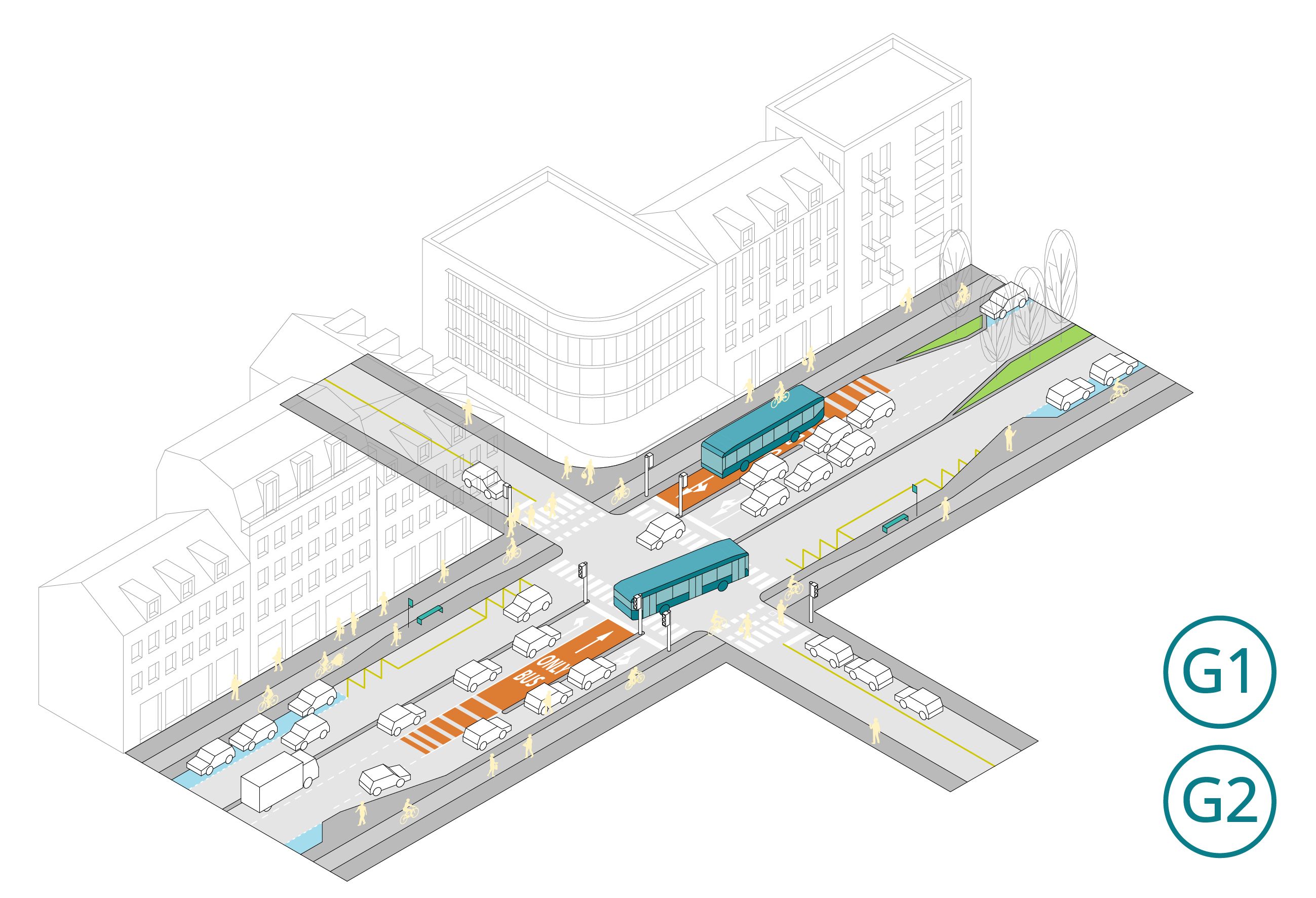
Queue-jump transit lanes (also known as Queue jumpers) are short segments of transit-dedicated lanes that allow transit vehicles to bypass upstream queues at signalized intersections, thereby avoiding delays and enabling more effective TSP strategies. They can be located near the center (G1) or near the curb (G2), depending on the bus movements they target and the associated signal management strategy. They can be located independently or at the beginning of a longer transit-dedicated corridor downstream of the intersection. Queue-jumps can also be deployed upstream of yield- or stop-controlled intersections and roundabouts. A specific category of queue-jumps can be deployed on limited-access highways as a transit-dedicated exit upstream of the general-traffic exit, allowing transit to bypass queues by using an alternative local route.
Key Facts
- Stops
- Queue-jump lanes do not necessarily include transit stops, but there are examples of stops located on the near side of intersections alongside queue jumps: on the sidewalk in the curbside solution, or on traffic islands for offset lanes. Moreover, when combined with a dedicated transit phase or an anticipated green, offset queue-jumps may allow transit vehicles to reach a far-side curbside stop, cutting in front of through traffic.
- Left Turns
- Offset and center-running queue-jumps can conflict with left-turn movements, for example, if transit vehicles are allowed to go straight in a queue-jump lane to the left of a left-turn lane. A dedicated signal phase can solve this conflict.
- Right Turns
- Curbside queue-jump lanes can create conflicts with right-turn movements, for example, if transit vehicles are allowed to go straight or even turn left from this rightmost location. These kinds of conflicts are generally solved with a dedicated transit phase at signalized intersections.
- Parking
- N/A
- Enforcement
- Lateral encroachment can be prevented with curbs and traffic islands. Access can be camera-controlled.
- Transit Signal Priority
- While queue-jumps do not necessarily require active TSP, they are generally deployed in conjunction with some level of active signal priority to maximize their benefits, as skipping queues makes arrival times at intersections more predictable. Additionally, the insertion of a transit-specific phase allows for more "unorthodox" maneuvers, such as turning left from the rightmost lane and viceversa, which helps solve conflicts in specific situations. To optimize TSP, the queue jump must be long enough to prevent cars from backing up into upstream traffic.
- Cost
- Low to medium. Queue-jumps may require the partial or complete redesign of an intersection and its approaches, especially if they require road widening to accommodate an additional transit lane and signal reconfiguration.
Use Cases
Queue-jump lanes are a quintessential example of tactical transit-priority solutions targeting specific delay points, notably queue buildups at busy intersections where transit vehicles may require multiple phases to clear. They have become more common over the last few decades as tools for micro-traffic simulation and management have been refined, notably starting in the late 1980s. Queue-jump lanes are a priority tool that can be adapted to multiple settings and have been deployed in urban, suburban, and even rural areas, as well as on limited-access highways.