Virtual Queue-Jump Lanes
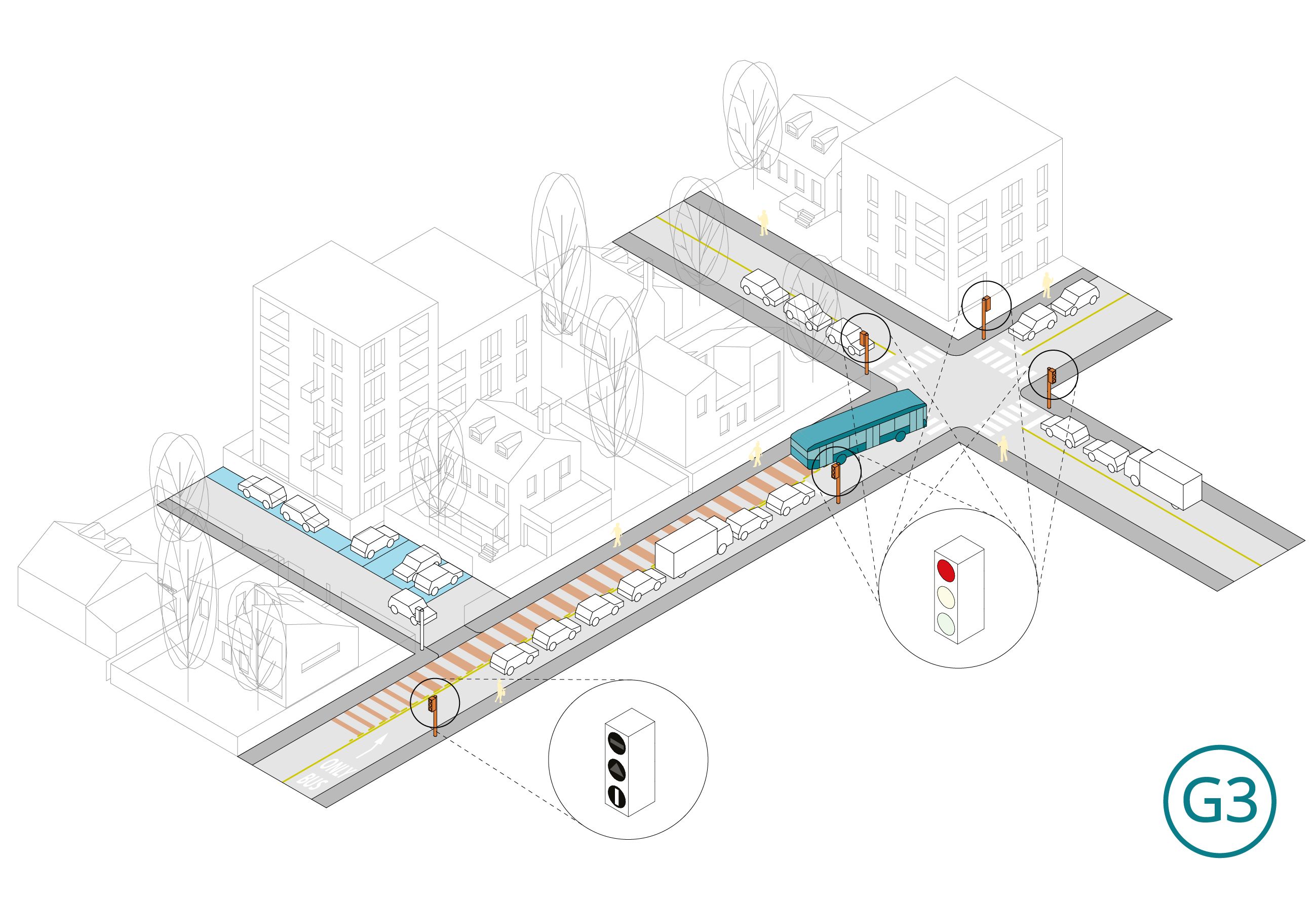
Virtual queue-jump lanes are a family of transit priority tools that generally deploy pre-signals (i.e., signals localized upstream of the intersection) to allow transit vehicles to use a general traffic lane, including opposite-direction ones, as a temporary “virtual” queue-jumper after it’s cleared by all other traffic, for example by metering traffic upstream and blocking all traffic converging on the intersection until the transit vehicle has cleared it. They can be used in contexts with limited space to carve out a physical queue-jump lane or as a low-cost measure on corridors with moderate volumes of transit vehicles. They are better suited to road segments with limited curb activity, no parking, and no property access.
Key Facts
- Stops
- They generally do not include stops, as the transit vehicle is supposed to cler the virtual lane as quickly as possible.
- Left Turns
- N/A
- Right Turns
- N/A
- Parking
- Virtual queue-jumps are generally deployed in segments with no curbside parking.
- Enforcement
- Enforcement relies entirely on compliance with traffic signals.
- Transit Signal Priority
- Virtual queue-jumps rely on active transit signal priority, as vehicle detection of both transit vehicles and queue length ensures that the way is clear for the transit vehicle to occupy the opposite-direction lane.
- Cost
- Minimal to medium, depending on whether it requires only the installation of traffic signals and detectors or also the reconfiguration of part of the roadway.
Use Cases
Virtual Queue-jump lanes are a niche application with a limited number of examples worldwide. Contraflow ones are even rarer: there are only a few examples, all located in Switzerland [1] on stretches of road outside denser urban areas, as their application requires clear lines of sight and a low risk of pedestrians and vehicles entering the virtual lane from curbside parking or driveways while in use by the transit vehicle in the opposite direction. They require good traffic discipline, mastery of signal priority technology, and a legal and regulatory framework that permits this kind of “unconventional” use of traffic lanes.
Bibliography
- Harder, F., Mohr, M., Koy, T., Gasser, Y., & Christen, C. (2012). Möglichkeiten und Grenzen von elektronischen Busspuren. Bundesamt Fuer Strassenbau (ASTRA)/Office Federal Des Routes (OFROU), (1388).