Transit Gates
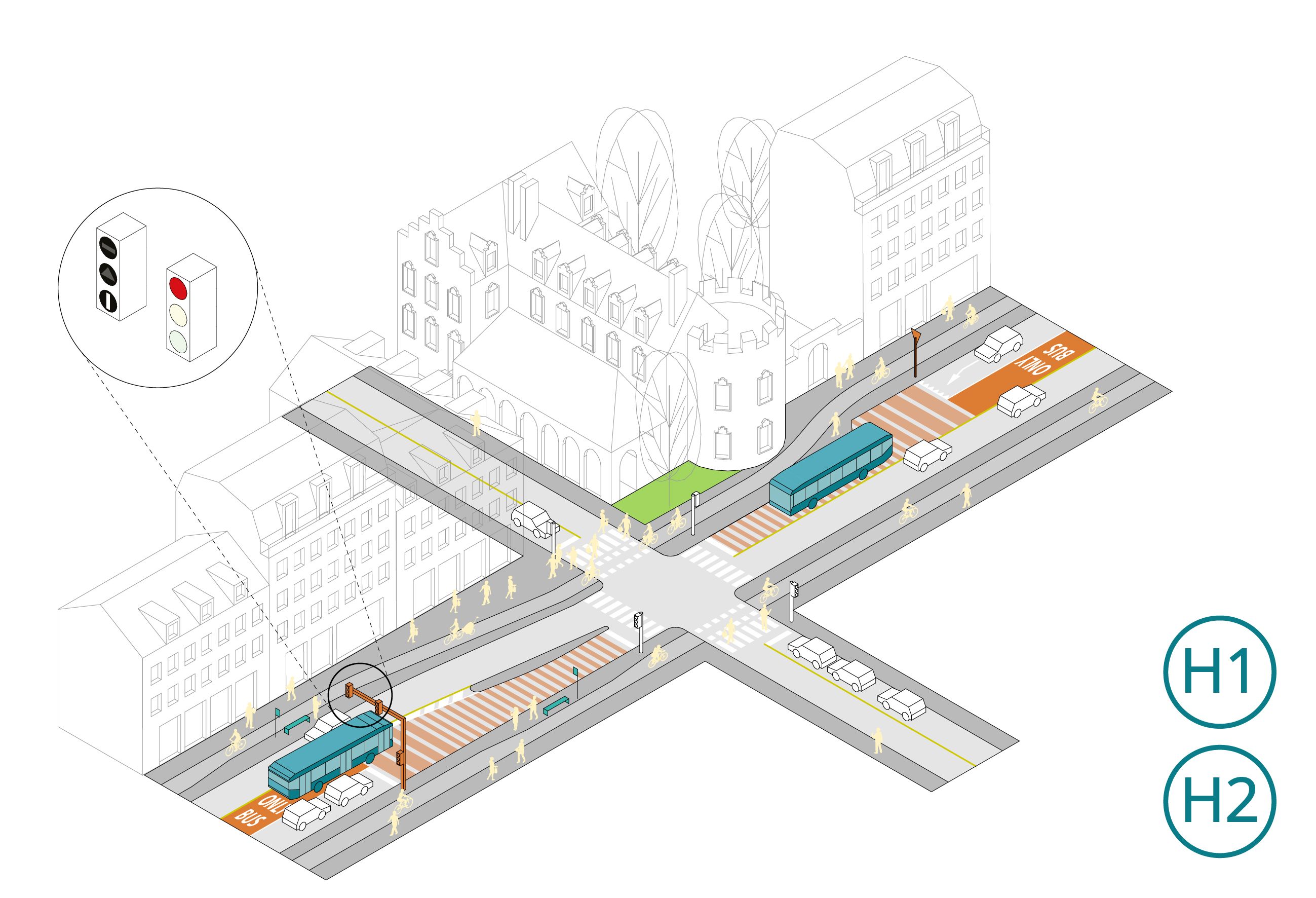
Transit Gates are traffic management devices that give priority to transit vehicles over other vehicular traffic at specific locations, notably, where a dedicated transit lane ends and buses or trams merge into a shared segment. Priority control can be enforced through actuated traffic signals (H1) or a simpler stop or yield sign (H2). Transit Gates are also known as pre-signals when used upstream of a signalized intersection to regulate a shared transit/turn lane or to allow buses to cross through multiple lanes, for example, moving from a curbside stop to the left-turn lane across multiple lanes [1, 2].
Key Facts
- Stops
- Transit gates can be deployed in conjunction with bus stops, for example, to allow transit vehicles to re-enter traffic when pulling out of an off-street stop or to clear the shared segment of the street where a transit stop is located.
- Left Turns
- Transit gates can be used to solve a conflict with left-turning vehicles, for example, a pre-signal application where traffic is held upstream of the intersection, so that buses exiting a curbside lane can cross through several traffic lanes to reach the left-turn lane
- Right Turns
- Similar to left turns, transit gates can be deployed to allow transit vehicles to transition from a center-running dedicated lane to the rightmost lane for right turns.
- Parking
- N/A
- Enforcement
- Enforcement relies entirely on compliance with traffic signals and road signs.
- Transit Signal Priority
- Signal-based transit gates rely on active TSP to work properly.
- Cost
- Low to moderate, as they may require changes to the road geometry and deployment of signals and detection loops.
Use Cases
Like most “surgical” transit priority tools targeting specific bottlenecks and points of conflict, transit gates belong to the second generation of transit priority measures that emerged in the late 1980s as responsive traffic management tools, such as actuated traffic signals, and traffic modelling became more sophisticated. They have been deployed in many contexts, but more systematically in jurisdictions that approach transit priority by identifying and targeting points of delay rather than by planning and applying priority measures along entire corridors. Notable examples can be found in multiple cities across Europe and North America.
Bibliography
- Wu, J., & Hounsell, N. (1998). Bus priority using pre-signals. Transportation research part A: Policy and practice, 32(8), 563-583.
- Guler, S. I., & Menendez, M. (2015). Pre-signals for bus priority: basic guidelines for implementation. Public Transport, 7(3), 339-354.