Indirect Turns
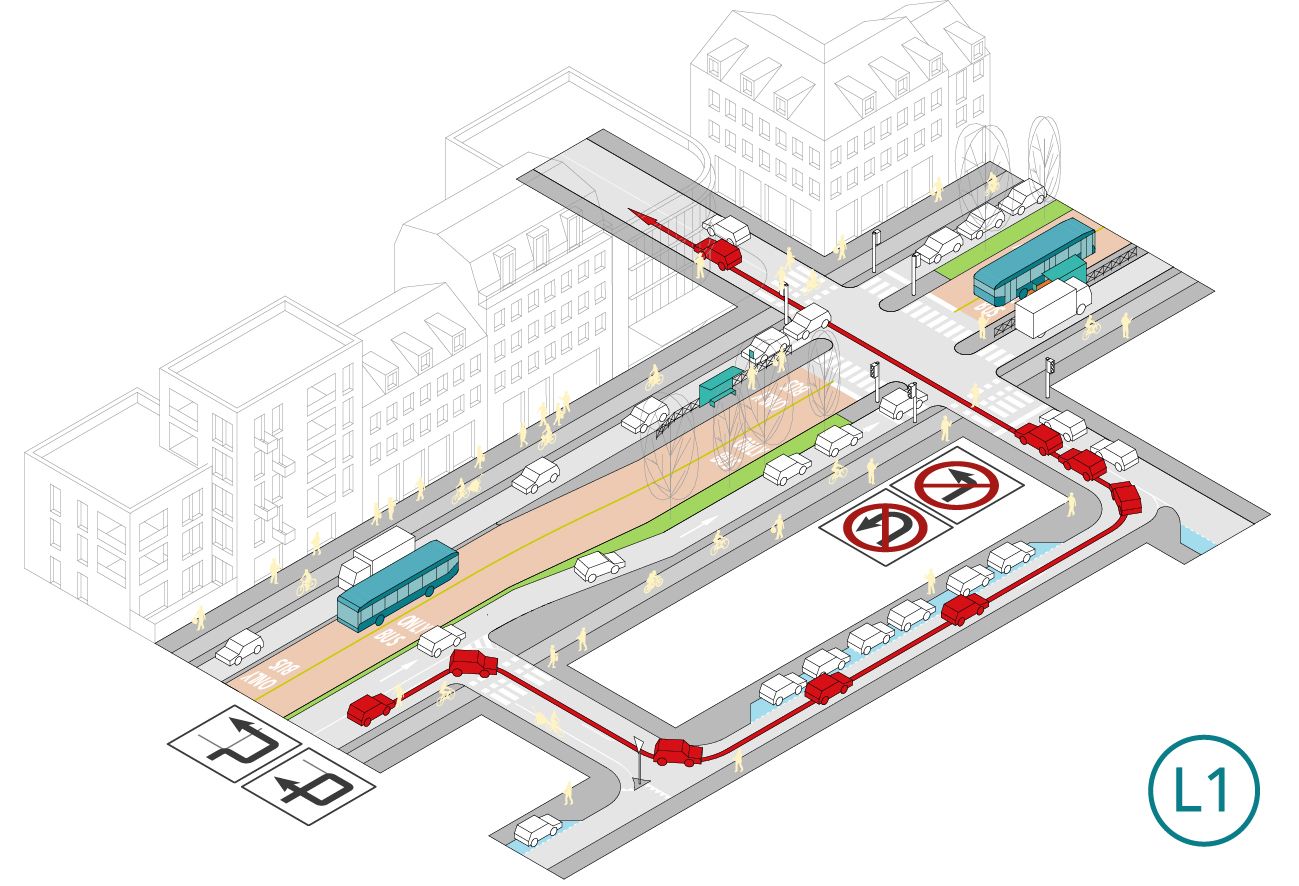
Left and right turns can delay transit vehicles by blocking center-running and curbside-running services respectively. In constrained rights-of-way, it can be difficult or impossible to provide dedicated left- or right-turn lanes for cars queuing at intersections. Even when there is sufficient space to provide queuing capacity for conflicting turns, left turns can indirectly increase transit delays by reducing an intersection's through capacity because a separate protected left-turn phase is required. Banning left or, ore rarely, right turns is a common strategy to resolve delay-inducing conflicts at intersections. This ban can be compensated for by an explicitly organized alternative route, such as a right-right-right sequence, right-left-left, or even more complex circulation arrangements at the neighborhood or city scale. A similar strategy can be applied to conflicting right turns.
Key Facts
- Stops
- N/A
- Left Turns
- N/A
- Right Turns
- N/A
- Parking
- N/A
- Enforcement
- Enforcement generally relies on respect for road signs, although physical barriers such as traffic islands can discourage prohibited turns and increase compliance. Road signs indicating the alternative indirect left- or right-turn route can help with compliance, too.
- Transit Signal Priority
- Diverting conflicting turns along alternative routes is an important support measure for effective active TSP, as it simplifies intersection management by eliminating conflicting movements and can reduce the signal cycle length and complexity by removing or shortening conflicting phases, especially when there is no physical space to provide a dedicated turning lane.
- Cost
- Minimal to medium, as it can be implemented with road signs and paint, though it might require some changes to road infrastructure.
Use Cases
Indirect left- and right-turns are a quintessential circulation-based transit-priority tool, as their main goal is to shape traffic flows in ways that favour transit. They can be deployed tactically on a per-intersection basis, sometimes without providing a clearly marked alternative but simply by banning turns and letting drivers figure out the alternative, or they can be embedded in more complex rearrangements of circulation patterns at the neighborhood or city scales, where they can be embedded in coordinated strategies to simplify and rationalize traffic management, for example, by separating transit and general traffic corridors and defining clear through routes for vehicular traffic independent from transit main routes.