Indirect Left Turns (within the intersection)
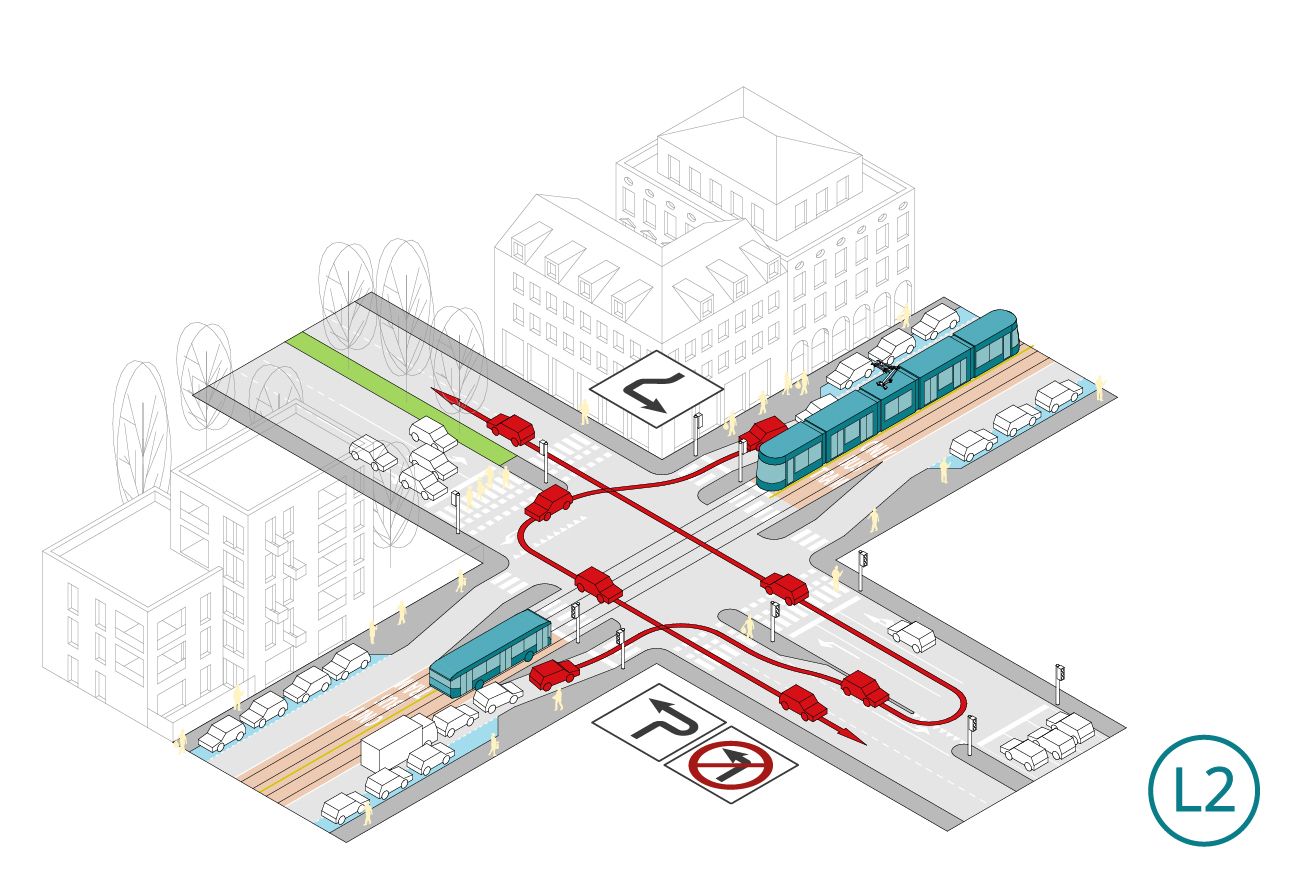
An indirect left-turns within the intersection helps mitigate conflicts between left-turning vehicular movements and transit vehicles, notably in space-constrained settings, by allowing left turns via a sequence of maneuvers that generally starts with a right turn or a diverging maneuver. Functionally, it is equivalent to Indirect left turns via alternative routes (L1), but they are resolved within the intersection space. It can assume various configurations, such as a jug-handle (right diverging, then left turn upstream of the main intersection), a turnaround on the intersecting street (a right turn followed by a U-turn on the intersecting street, also known as a P-turn or a Michigan Left in the U.S.), or a hook turn (left-turning cars stage in a pocket to the right of through traffic, then turn left on an anticipated green for the lateral street). In the left-hand driving context, the corresponding solution is an indirect right turn.
Key Facts
- Stops
- N/A
- Left Turns
- Indirect left turns are an effective way to address conflicts between transit and left-turning vehicles.
- Right Turns
- N/A
- Parking
- N/A
- Enforcement
- Left-turn restrictions are generally enforced via road signs (no left turn or permitted movements signs, depending on the jurisdiction), relying on road users' compliance. In some settings, curbs can be used to physically prevent left turns.
- Transit Signal Priority
- By restricting direct left-turn movements from the left-most lane, indirect left-turn setups are a key strategy for more effective TSP. It can be used to avoid mixing through transit left-turn vehicular staging lanes when center-running transit lanes are in place, thereby providing more certain estimated times of arrival for active TSP. It can be similarly deployed to prevent delays caused by left-turning cars in mixed traffic, making green extension strategies more likely to be effective. It can also be leveraged to shorten the traffic signal cycle by suppressing the need for a dedicated protected left-turn phase.
- Cost
- Minimal for hook turns, medium to high for setups requiring a substantial redesign of the intersection.
Use Cases
Indirect left-turns within intersections are a strategy to mitigate the potential delay induced by left-turning vehicles on transit operating in the left-most lane, whether on a dedicated median alignment or in mixed traffic. They can be used when it’s difficult or impossible to provide a dedicated left-turn staging lane upstream of the intersection, separate from the transit lane, or to suppress the left-turn phase, thereby simplifying and shortening signal cycles and potentially facilitating the implementation of effective TSP. A classic example is the hook right turn (which is the equivalent of a hook left turn for left-hand driving in Australia), common in Melbourne along tram routes, where right-turning cars are required to stage on the left of through traffic during the green phase within the intersection and can then proceed to complete the right turn in the clearance time before the lateral street phase.