Right-In/Right-Out
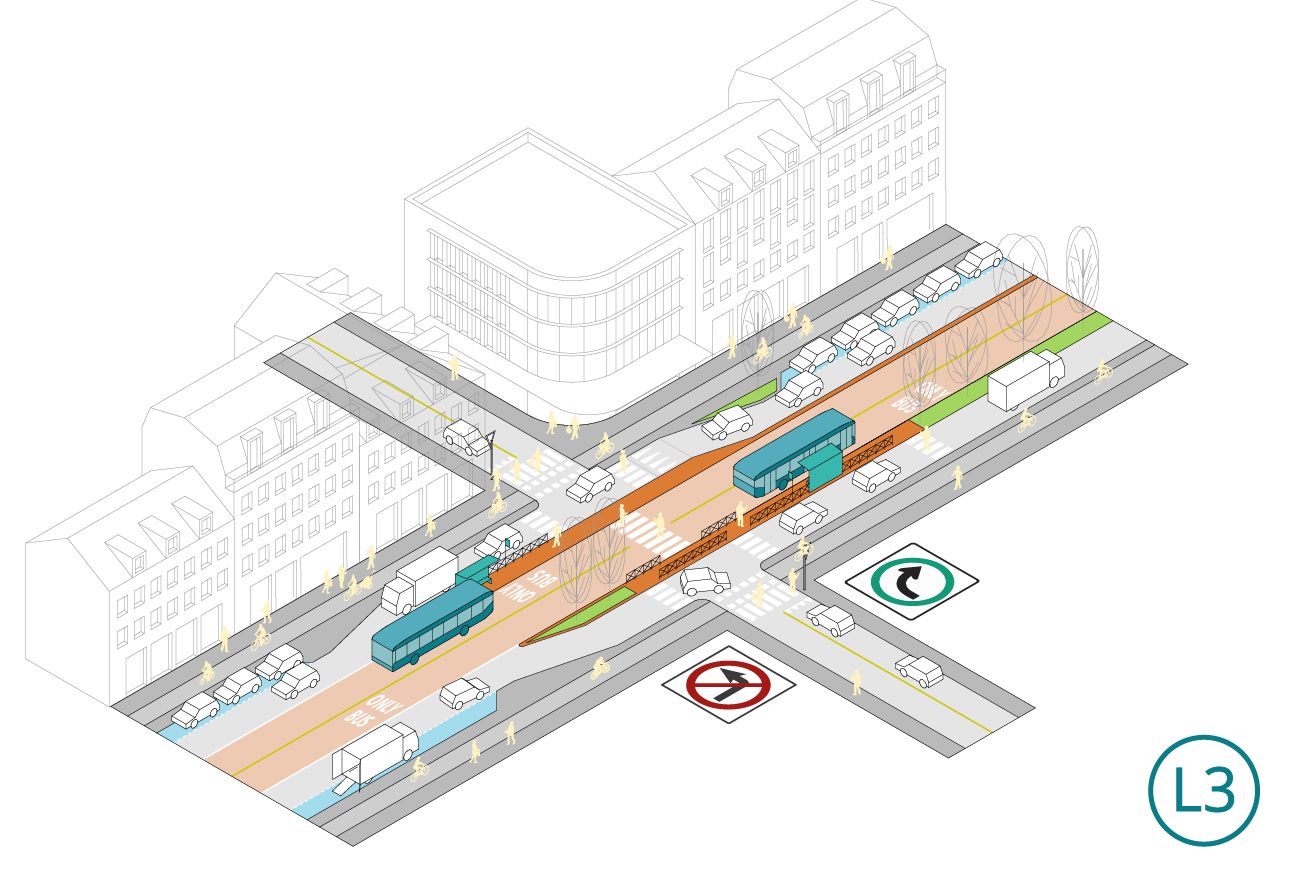
Right-in/right-out (RIRO) is a type of intersection management that suppresses all left turns from and into lateral streets, as well as through movements between lateral streets in intersections with more than three legs. As a consequence, access to the lateral streets from the main street is possible only by turning right from the nearest direction and traffic entering the main street via the lateral street can only turn right. RIRO greatly simplifies intersection management and completely eliminates conflicts and the need for a signalized intersection in center-running transit-priority configurations. To ensure differentiated permeability, RIRO can be coupled with modal filters for pedestrians and/or bikes.
Key Facts
- Left Turns
- Left turns are prevented
- Right Turns
- Right turns are the only movement allowed. For that reason, they aren’t particularly effective when deployed with curb-adjacent and offset transit lane configurations.
- Parking
- N/A
- Enforcement
- Right-in/Right-outcan be enforced simply with road signs, however physical barriers such as traffic islands on the median or bollards are more effective.
- Transit Signal Priority
- N/A
- Cost
- Minimal to medium, if it requires hard infrastructure such as the installation of a curb or the remodeling of the entire intersection.
Use Cases
Right-ins/Right-outs are essential traffic management tools for lateral streets. They simplify intersection management and create a hierarchical street network that prioritizes transit corridor flows at the expense of lateral streets. Together with dead-ending, they have been used since the 1960s to retrofit and organize traffic flows in pre-car parts of cities.