Transit Streets
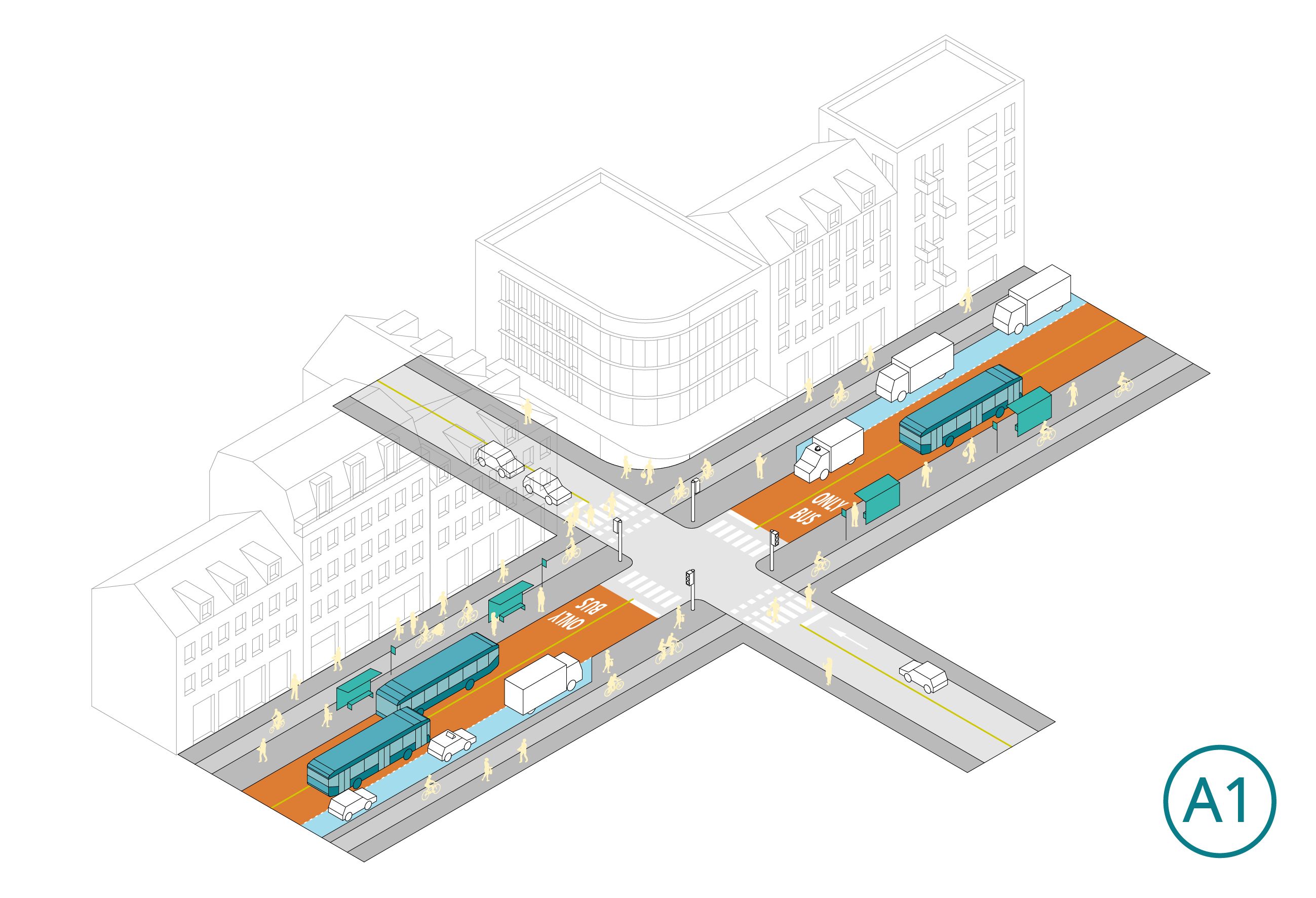
Transit-only streets are segments of urban streets that allow only transit vehicles. Typically, other categories of motorized vehicles, such as deliveries and residents, are also permitted to access the street at all times or at specified times of day. Streets reserved for pedestrians and tramways only—a particular application of this typology—have become common throughout Europe since the 1970s. Access can be regulated via a permitting system and enforced with cameras or physical barriers, such as retractable bollards.
Key Facts
- Stops
- They can be located directly at the curb on existing sidewalks. Overtaking at stops, which can be necessary on busy corridors with stacked stop patterns, can be accommodated by a central overtaking lane or by providing pull-over bays.
- Left Turns
- N/A
- Right Turns
- N/A
- Parking
- Parking and deliveries may be permitted in designated curbside spaces, on sidewalks, and/or at designated times. In some cases, lateral streets can be used for deliveries and pick-up/drop-off.
- Enforcement
- Access may be regulated by physical barriers, such as retractable bollards, or by camera-based enforcement. Aside from transit vehicles, other vehicles, such as property owners, maintenance, etc., can be permitted through a ‘white list ’ system.
- Transit Signal Priority
- Active signal priority is possible.
- Cost
- Minimal, as it can be implemented with painted markings and road signs. However, it is not uncommon for it to be associated with an extensive public realm redesign, notably to improve pedestrian experience and safety on busy commercial corridors.
Use Cases
Transit streets are commonly deployed in city centers and other dense urban nodes, notably on trunk corridors with high transit volumes or, more rarely, in transit malls with dedicated circulators. They are found across most continents, including North America, where they gained some popularity in the 1970s and 80s through the downtown Transit Mall concept, though they are particularly prevalent in Europe. In a gridded street layout, longer street segments can be transformed into transit streets by simply shifting through traffic on parallel streets, while maintaining most or all crossings with intersecting streets, a strategy commonly adopted in most North American transit malls. However, transit streets can also be leveraged as part of a broader circulation strategy at the neighborhood level that includes pedestrian streets, looping circulation patterns, and modal filters to divert through traffic away from larger portions of an area, a common strategy applied in many European city centers. They are sometimes used in conjunction with alternating contraflow bus lanes (F1 & F2) to balance the need to allow local access with the need to prevent through traffic. Transit streets can also be used tactically to provide a more direct transit route through a complex traffic node, functioning as transit modal filters (N1).