Contraflow Transit Lanes
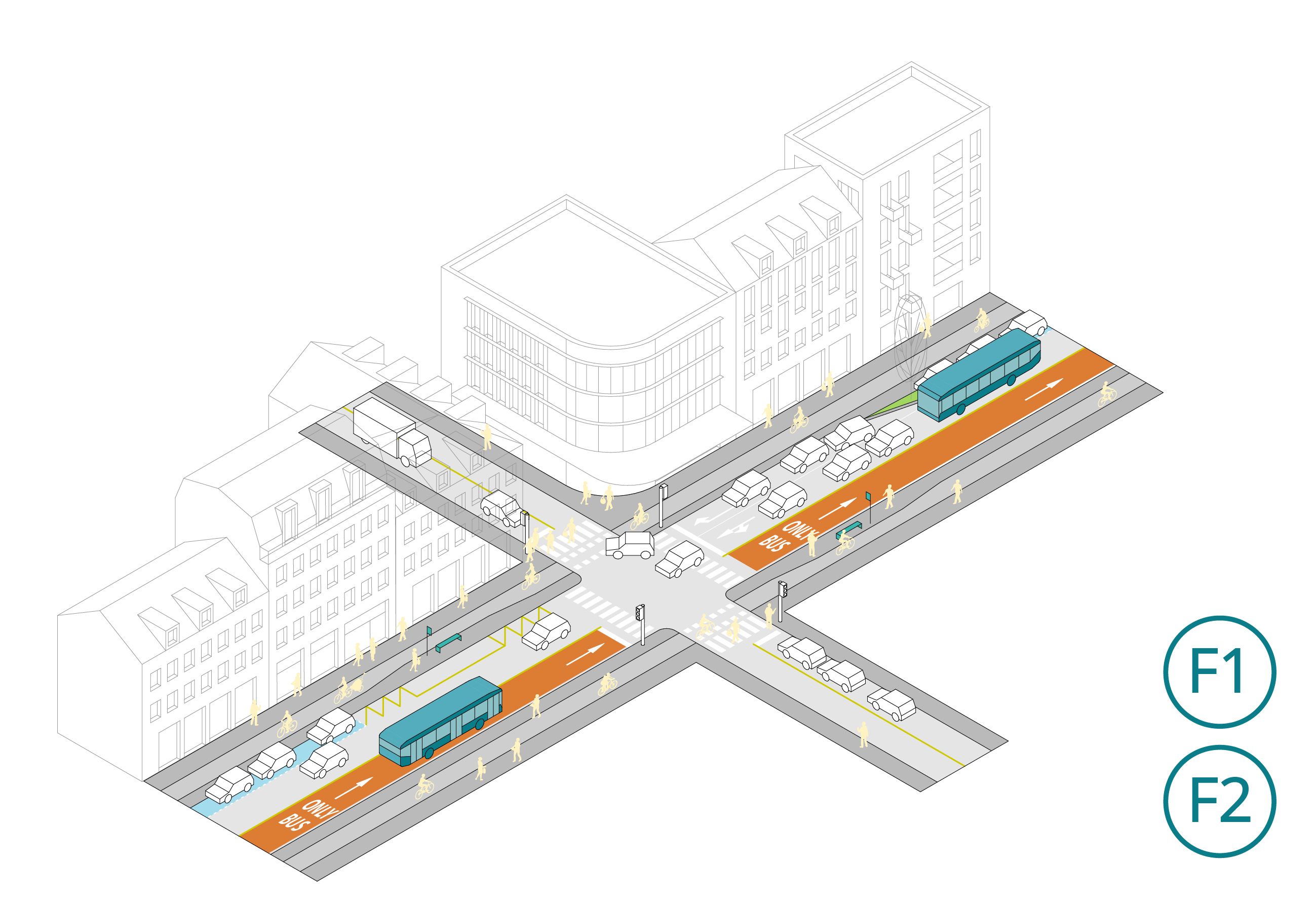
Contraflow transit lanes are unidirectional transit lanes that go against the main direction of general traffic on one-way streets. They can also be described as a two-way street, with one direction reserved for transit. They emerged during the 1950s and 1960s, in conjunction with the extensive deployment of one-way streets, as a way to leverage the well-known advantages of one-way traffic (notably, simplified intersection management) while maintaining two-way bus traffic on key corridors [1,2]. Contraflow bus lanes offer several advantages, including easier self-enforcement, lower curb friction than same-direction curbside or offset lanes, and simplified intersection management.
Key Facts
- Stops
- They can be located directly at the curb on sidewalks. Overtaking at stops, which can be necessary on busy corridors with stacked stop patterns, can be accommodated by a central overtaking lane or by providing pull-over bays.
- Left Turns
- N/A
- Right Turns
- N/A
- Parking
- Parking and deliveries are generally not allowed by definition, but there are rare examples of offset contraflow transit lanes (F2) that allow parallel or diagonal parking between the curb and the transit lane, typically in the opposite direction (similar to contraflow bike lanes).
- Enforcement
- Access can be regulated with physical barriers, such as retractable bollards, or with camera enforcement. Aside from transit vehicles, other vehicles, such as property owners, maintenance, etc., can be permitted through a white list.
- Transit Signal Priority
- Active signal priority is possible, as the estimated time of arrival (ETA) can generally be determined accurately.
- Cost
- Minimal to medium, as they can be implemented with just road markings and signs, but they may require reconfiguring traffic lights (for example, when implemented on a currently one-way street).
Use Cases
The use of contraflow transit lanes varies significantly between countries. They are relatively rare in North America and Asia. They are more common in France, Italy and the Netherlands, where they are deployed as part of broader circulation plans, as a strategic or tactical tool to achieve broader traffic management goals, such as simplified intersection management along a corridor, the creation of shortcuts or bypasses for transit, or diverting through traffic away from a specific corridor or node. Use cases show that they are often deployed in combination with other types of transit lanes, notably transit-only streets (A1), to implement transit-first corridors in space-constrained setups, while allowing local accessibility through indirect itineraries, similar to Transit and Direct Access Streets (A3), but more effectively.
Bibliography
- Ministère des Transports (1972). Directives sur l’amélioration de la circulation des transports collectifs de surface dans les villes. 3 juillet 1972.
- Levinson, H. S., Hoey, W. F., Sanders, D. B., & Wynn, F. H. (1973). Bus use of highways: state of the art. NCHRP Report, (143).