Transit Ways
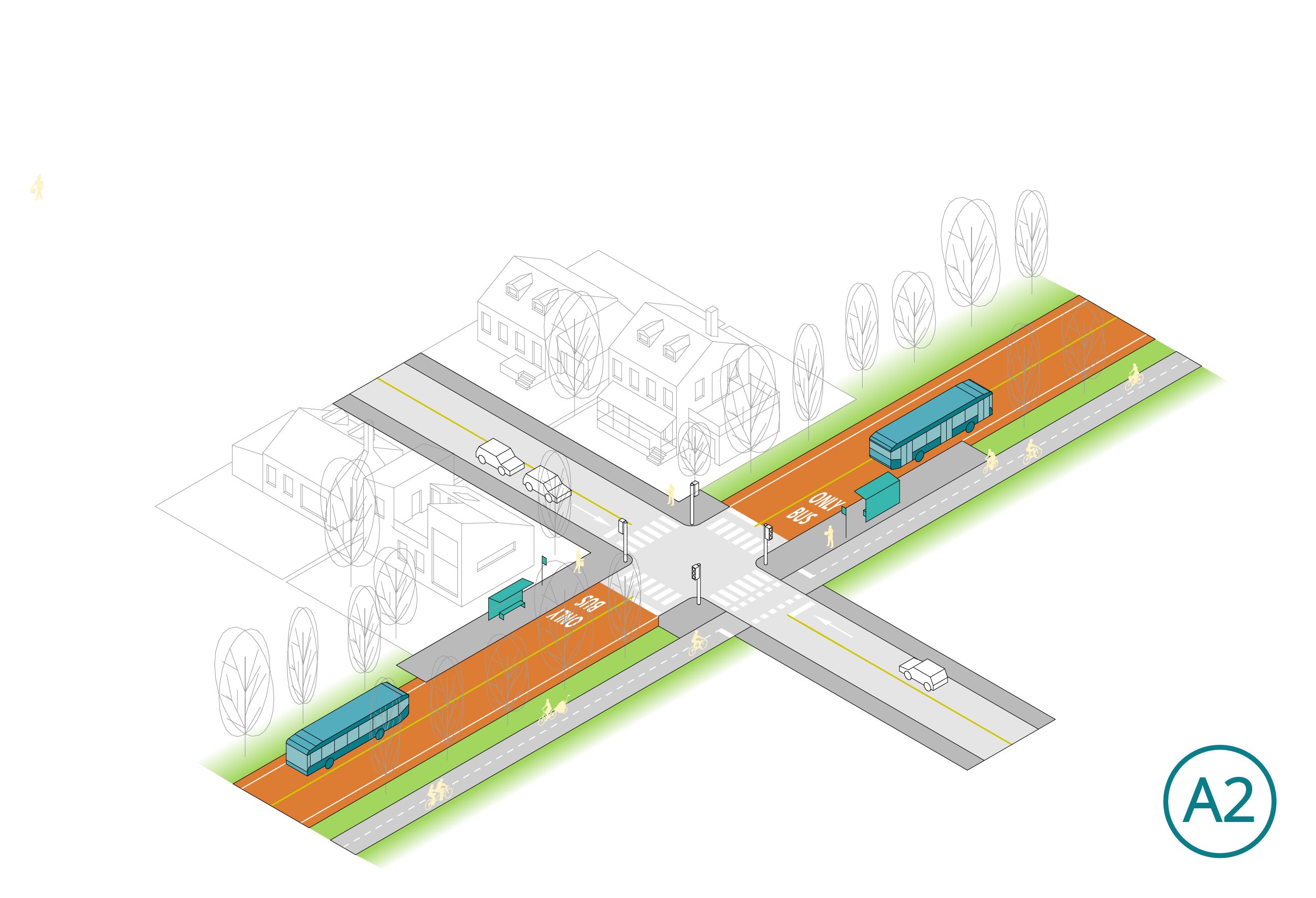
Transit Ways are segments of roads, generally independent from the rest of vehicular circulation, that are fully reserved for transit vehicles. Transit Ways are also called busways in English. While they are similar in function to transit-only streets (A1), they typically lack sidewalks and curb activity. Bus Rapid Transit systems in suburban, periurban, and even rural contexts are typical applications of this typology, using rights-of-way that parallel major infrastructure or old railway alignments. Intersections can be at-grade, typically controlled by signals, or grade-separated. In a few rare cases, a Transit Way can integrate specific infrastructure that makes it akin to fixed-guideway transit, such as O-Bahn curb-guided systems in Essen, Mannheim, Adelaide, and Cambridge.
Key Facts
- Stops
- Can range from simple roadside platforms with basic provisions to metro-like stations with enclosed platforms and vertical circulation via escalators and elevators, as in “heavy-duty” BRT corridors and transitways.
- Left Turns
- N/A
- Right Turns
- N/A
- Parking
- N/A
- Enforcement
- It can be enforced with cameras and physical obstacles, such as movable barriers, retractable bollards, and car traps.
- Transit Signal Priority
- All levels of TSP can be implemented relatively easily, including full preemption. In a limited number of cases, rail-like barriers are used.
- Cost
- Medium to very high, depending on the availability of a suitable corridor and the required infrastructure, especially for grade separation at junctions and for rail-like stop facilities.
Use Cases
Transit Ways are commonly deployed in suburban or peri-urban contexts and along linear corridors with no property frontage and minimal interference from intersecting infrastructure. They can be found across most continents and became popular in the 1970s and 1980s in parts of Europe, Oceania, and North America as a way to provide fast, non-railway bus transit in rapidly sprawling cities on a budget, similar to dedicated freeway-median lanes (B2) from the same era. Pittsburgh’s South (1977) and East (1983) Busways, Almere’s first busbaan (1980), Ottawa’s Transitways (1983), and Adelaide’s O-bahn (1986) are among the early examples of purpose-built bus-only roads spanning long stretches [1,2,3,4,5]. More recent examples include the Los Angeles Orange Line BRT (2005), which reuses a former interurban railway right-of-way and Amsterdam’s Zuidtangent (2002). Bus-only roads have also been used more selectively over short distances, to provide transit shortcuts in areas with fragmented suburban road patterns, notably in Sweden and the Netherlands. Transit Ways are very effective for rapid bus transit, especially grade-separated ones, but they require consistent upfront investment to acquire the right-of-way and build grade separations, or a high level of forward-looking urban planning to preserve alignment in greenfield developments.
Bibliography
- Beaudet, G., & Lewis, P. (2019). Ottawa-Gatineau: bus rapid transit and metropolitan planning. In Developing Bus Rapid Transit (pp. 32-48). Edward Elgar Publishing.
- Bray, D., & Scrafton, D. (2019). The Adelaide O-Bahn: evolution, operation and lessons. In Developing Bus Rapid Transit (pp. 14-31). Edward Elgar Publishing.
- TRB (unknown). Pittsburgh, Pennsylvania South, East, and West Busways. Transportation Research Board.
- TRB (unknown). Ottawa, Ontario. BRT Case Study. Transportation Research Board.
- TRB (unknown). Adelaide, Australia. O-Bahn Guided Busway. Transportation Research Board.