Edge-Running Bidirectional Transit Lanes
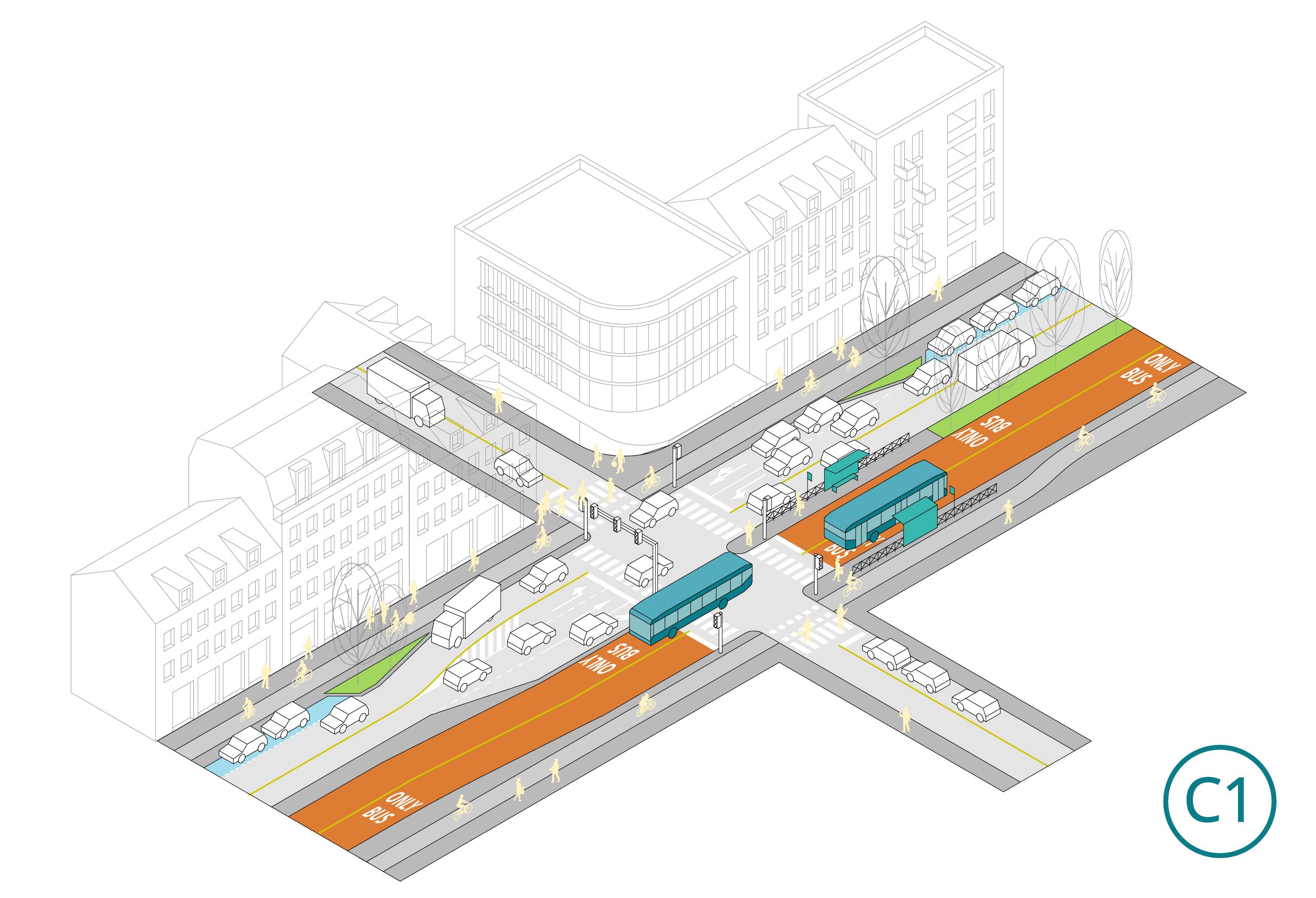
Edge-running transit lanes are a configuration in which both directions are located on one edge of the roadway. They are subject to conflicts from both right- and left-turning movements, as well as access to properties. For this reason, they are particularly well-suited to urban settings where one side of the road has limited potential for conflicts at intersections and access to abutting properties, such as along parks, waterfronts, or campuses. They are also commonly deployed on narrow streets alongside one-way general traffic, which makes conflict management at intersections relatively simpler.
Key Facts
- Stops
- On one side, stops can be located on sidewalks, but on the opposite side, adjacent to general traffic lanes, they require boarding islands.
- Left Turns
- Left turns may require a separate signal phase and, eventually, a staging lane. They can also be managed with yield in low-speed environments with adequate visibility, especially on one-way streets, where same-direction transit vehicles can fall into the blind spot of left-turning vehicles.
- Right Turns
- Right turns may require a separate signal phase and, eventually, a staging lane. They can also be managed with yield in low-speed environments with adequate visibility.
- Parking
- N/A
- Enforcement
- Lateral enforcement is relatively easy, as most types of physical separations can be used, from surmountable curbs to full-sized landscaped medians. Access can be controlled with cameras.
- Transit Signal Priority
- Most active TSP strategies can be deployed, as ETA are relatively easy to establish, especially with far-side stops. Edge-running settings are also particularly well-suited to implementing full-preemption TSP strategies, including the use of physical barriers, in settings with widely spaced intersections, such as on arterials embedded in highly hierarchical suburban street layouts, as they conflict with movements to and from a single lateral street.
- Cost
- Medium to high, as they generally require a major reconfiguration of the existing street space, including intersections. However, they can be relatively lower-cost than other solutions when an existing off-street right-of-way is available, as they can be implemented as a parallel greenfield project with minor changes to the main adjacent roadway and limited need for utility relocation
Use Cases
Edge-running alignments are relatively rare compared to other transit priority solutions, but they are particularly well-suited in two contexts: where one side of the street has fewer points of conflict such as intersections, driveway access and curbside activity, or where the right of way is particularly narrow, allowing just one single one-way lane for general traffic, or when it is wider but is managed as a multi-lane one-way street. Edge-running solutions are particularly popular in modern European tramways in France and Italy, as well as BHNS projects in France, both countries with generally narrow streets outside of major cities. Some edge-running transit corridors, such as Miami’s South Dade TransitWay, inaugurated in 2025, reuse a former railway alignment that once ran alongside a major arterial, a common feature of both mainline and interurban rights-of-way.