Reduce Delays at Intersections
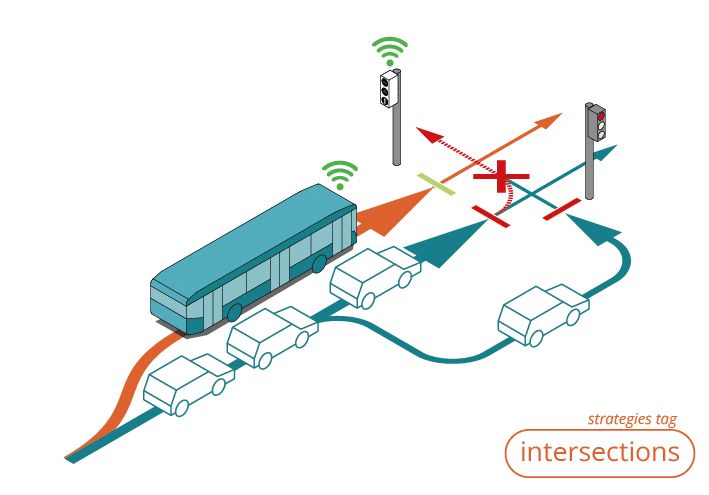
Strategies to reduce transit delays at intersections exist on a spectrum ranging from tweaks to the layout and operation of existing signalized intersections to broader circulation strategies that extend along and beyond a transit corridor. Ultimately, a successful transit priority strategy targets multiple intersections along a corridor, prioritizing transit movements at the expense of conflicting movements, and systematically deprioritizing movements from and into lateral streets to create Priority Corridors for Transit.
Reducing queue delays at signalized intersections
At signalized intersections, delays occur for two main reasons: waiting for the light to turn green and waiting for the queue ahead of the transit vehicle to clear.
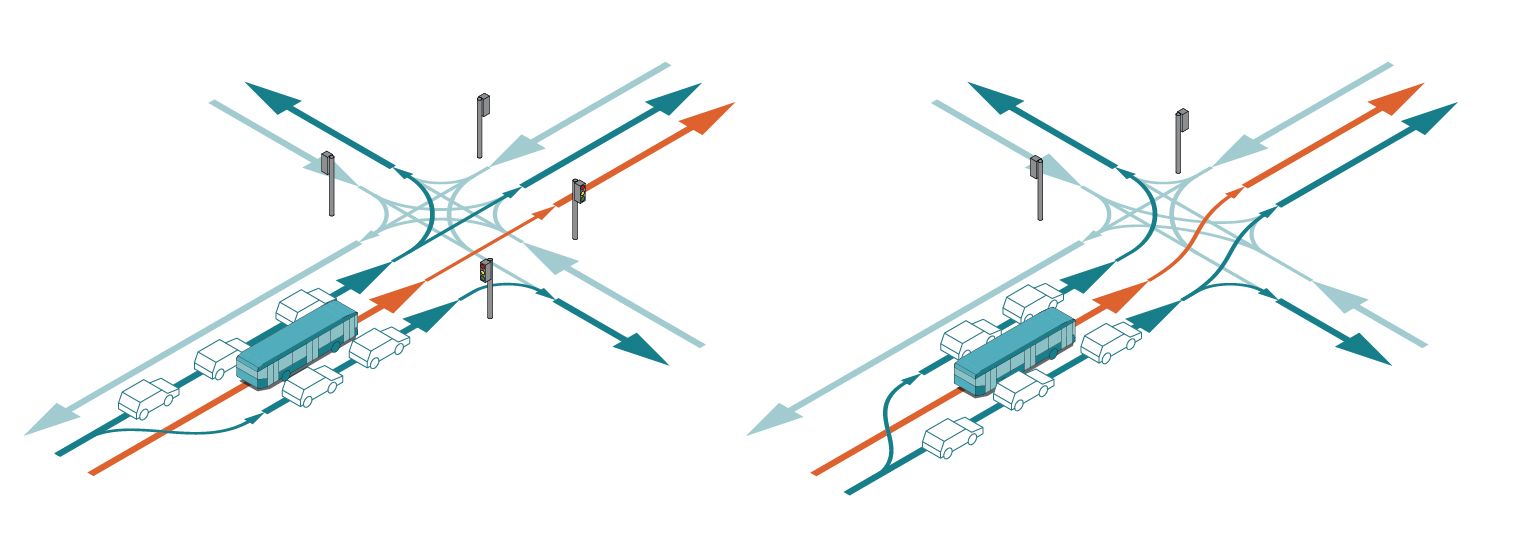
At signalized intersections, delays occur for two main reasons: waiting for the light to turn green and waiting for the queue ahead of the transit vehicle to clear. Queue delay can be reduced to zero by providing a transit queue jump (G1 & G2) of sufficient length to accommodate queue buildup during peak hours, or by having uninterrupted transit-dedicated lanes upstream of the stop line. If there isn’t sufficient space for a queue jump, more sophisticated solutions, such as virtual queue jumps (G3), can be deployed. However, simpler traffic management solutions, such as prohibiting left and right turns in two-way streets without dedicated left- and right-turn lanes, can also result in faster queue discharge, reducing transit delays.
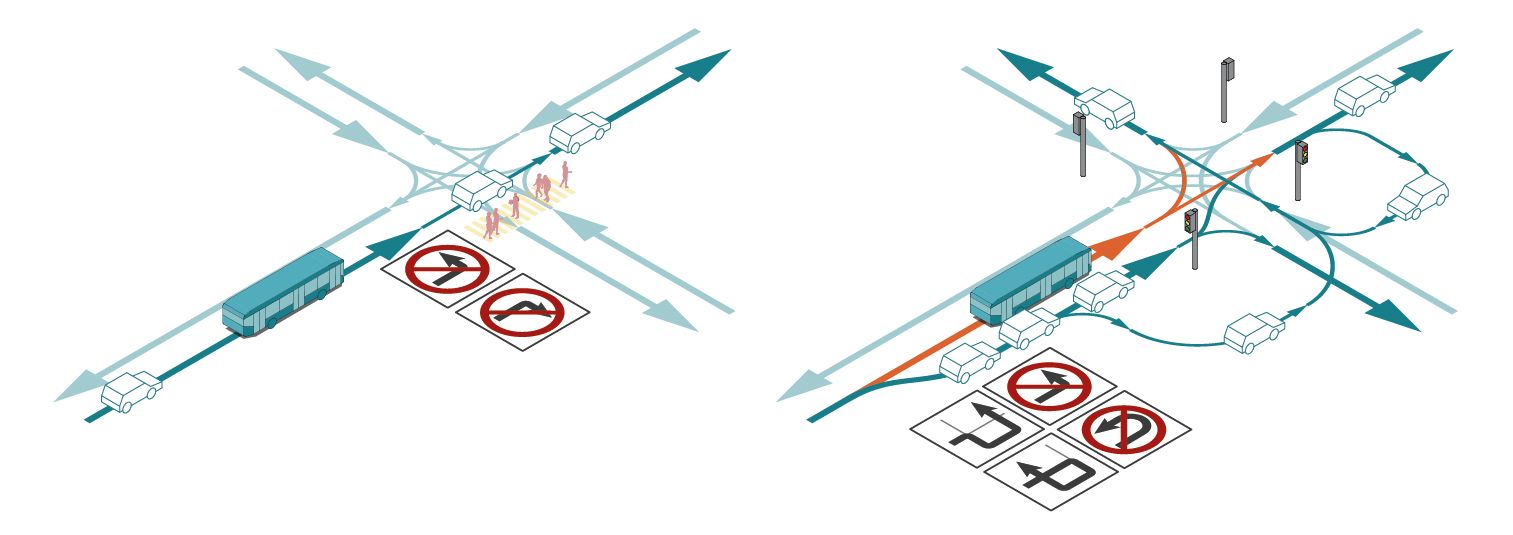
To accommodate different transit movements, queue-jumps can be associated with solutions such as a left turn from the rightmost lane during a transit-dedicated phase.
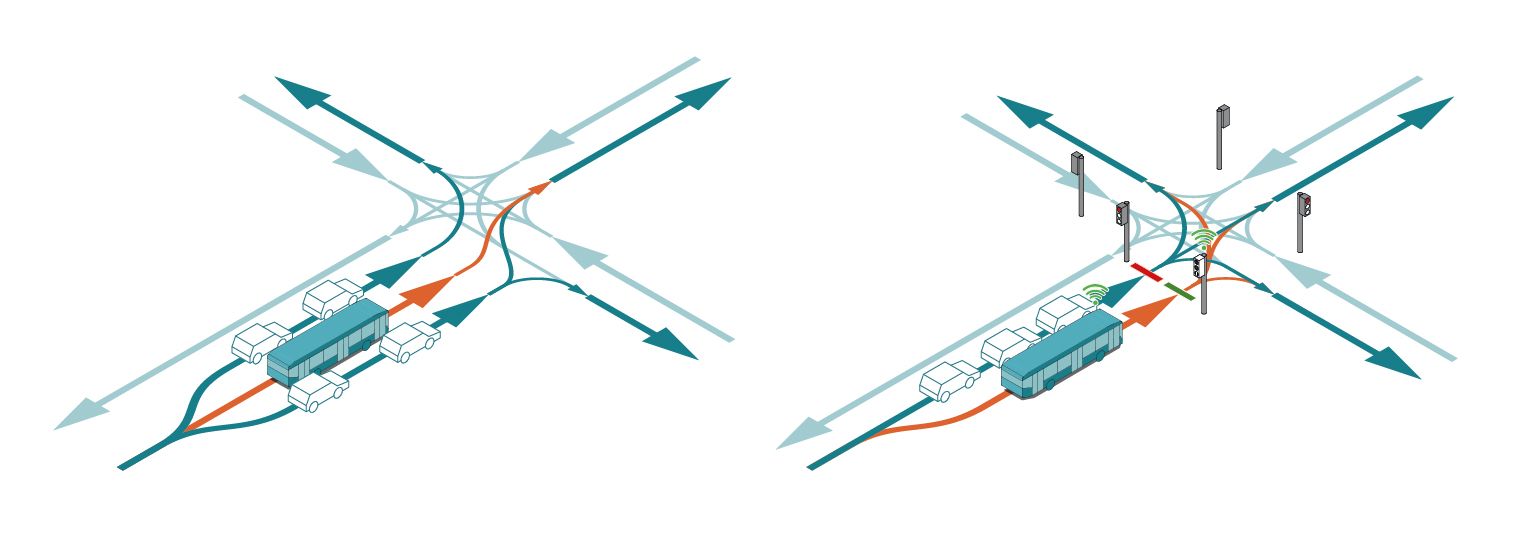
When continuous transit-dedicated lanes are interrupted upstream of the intersection to merge left-turn traffic (for center-running lanes) or right-turn (for curb-adjacent or offset lanes), this can cause significant delays, undercutting the dedicated lanes’ utility.
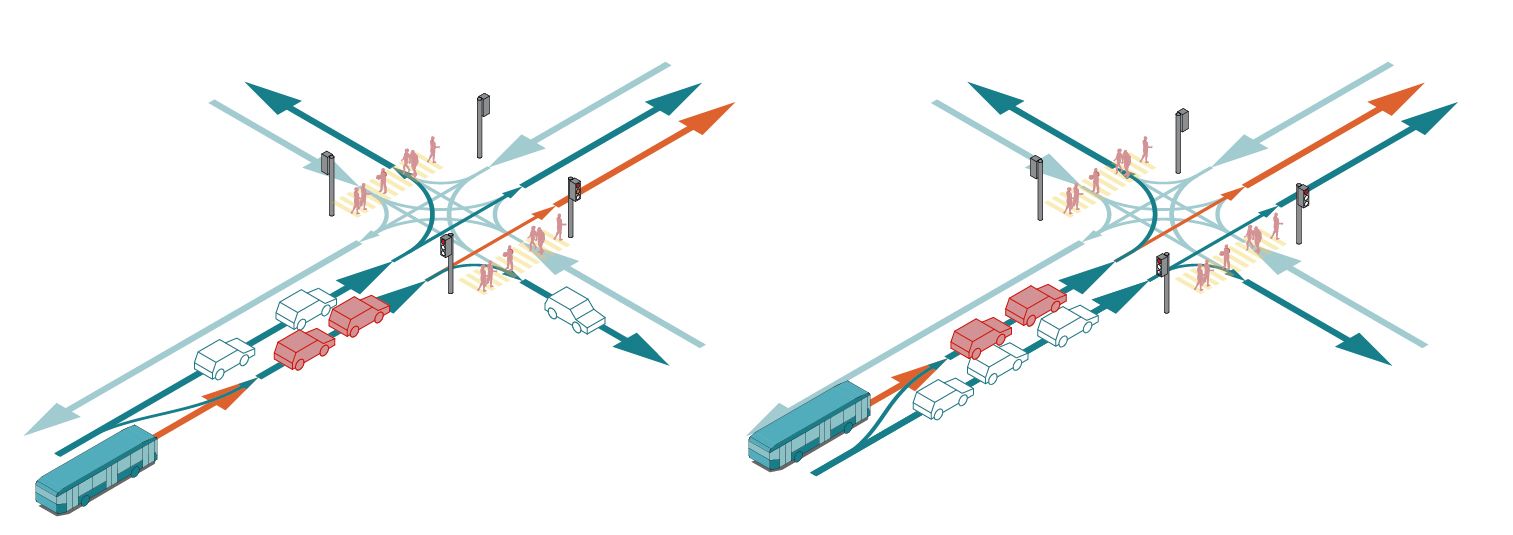
In this context, several solutions can be deployed to minimize queue delay, from prohibiting left and right turns to providing offset turn lanes. However, they must be sufficiently long to avoid queue overflow during peak periods, and they require wide cross sections. As with any other setup, it is possible to have right and left turns crossing the dedicated transit lane, but that requires a signal cycle arrangement designed to resolve those conflicts while minimizing transit delay.
Addressing complex traffic nodes
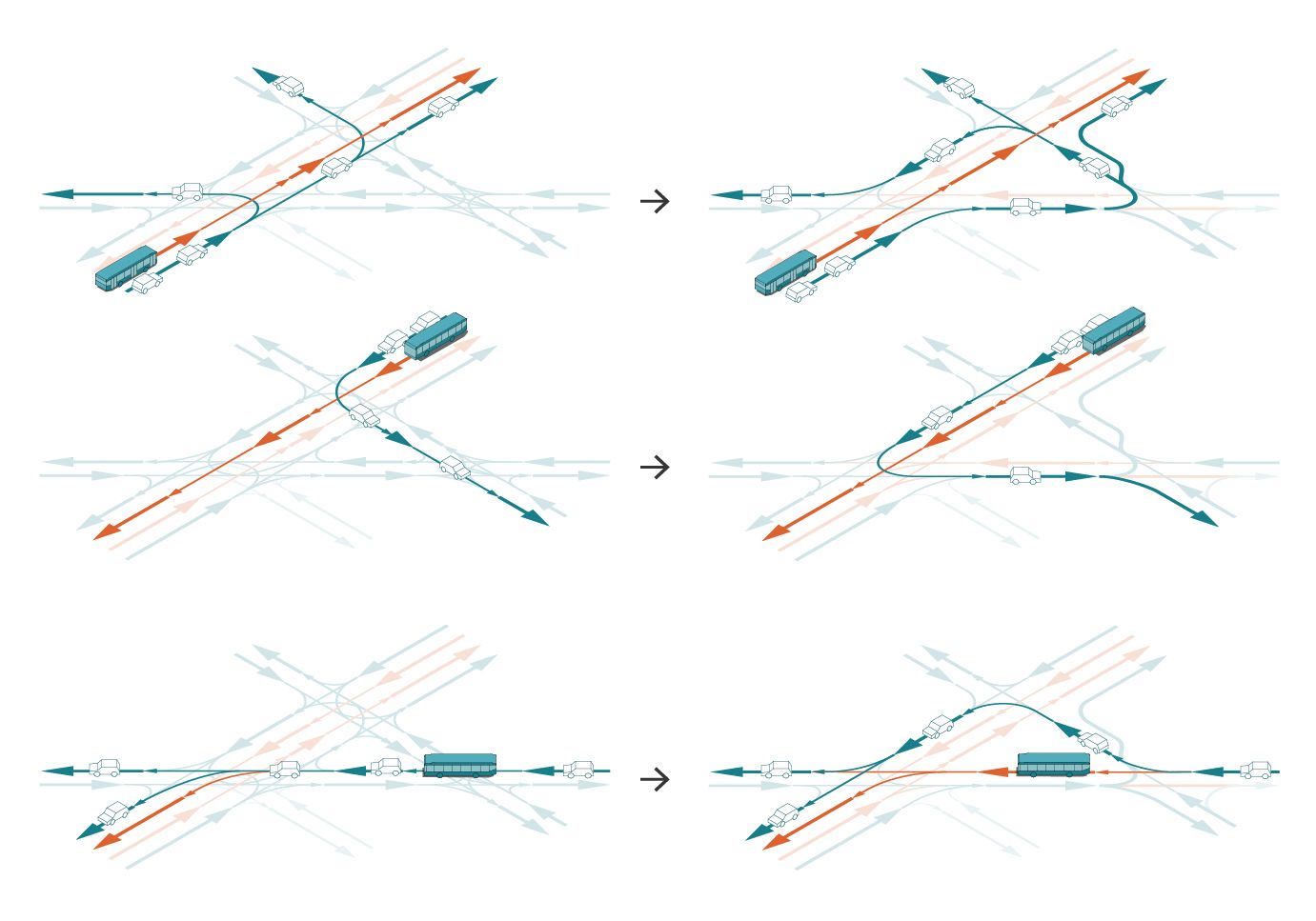
Complex nodes, where multiple traffic flows and transit routes intersect, generate conflicts that are difficult to manage. Permitting all movements everywhere is likely to delay both transit vehicles and general traffic due to long, complex signal cycles, and there may be insufficient space to provide left-turn lanes with adequate capacity. Many use cases in the Atlas illustrate how traffic flows can be rearranged throughout the node to simplify their management, notably by removing or shifting elsewhere some conflicting movements, by reserving some movements to transit only, thus, providing a more direct path through the node while diverting other traffic, and by using looping patterns to transform most conflicts into simpler merges that can be managed with lateral-street-only stops. These strategies require rethinking circulation patterns in the broader node. The most effective arrangement depends on the specific characteristics of the node.
Reducing signal delay: Transit Signal Priority and intersection design
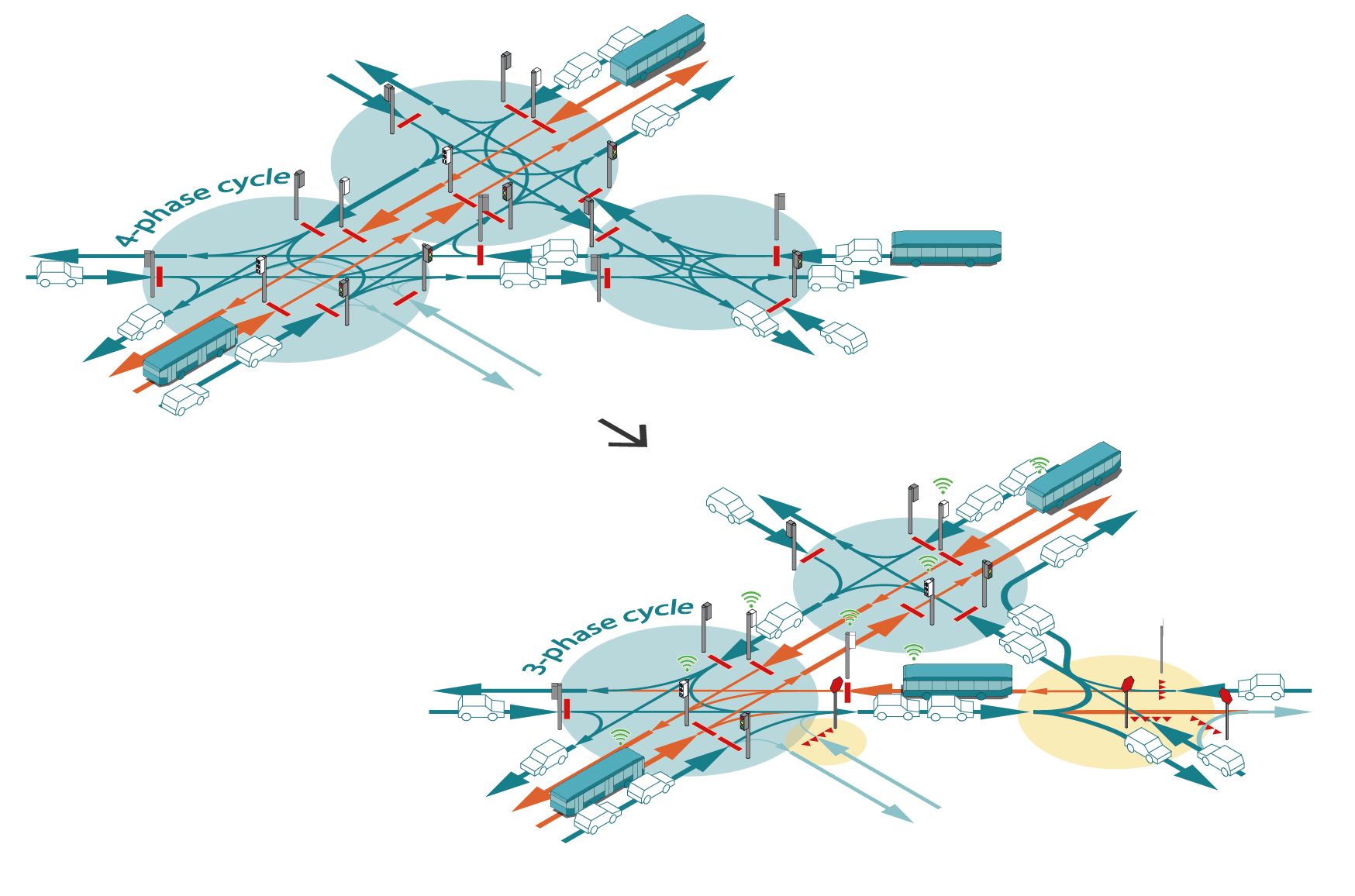
Active Transit Signal Priority (TSP) reduces the time a transit vehicle spends waiting at a red light by modifying the normal signal cycle based on real-time data about the transit vehicle's position and expected time of arrival. However, TSP effectiveness depends on intersection spacing, design, and complexity. Simplifying major intersections, for example, by prohibiting or shifting conflicting left-turns and introducing a multi-stage crossing for conflicting pedestrian movements, helps create the conditions for a more effective deployment of TSP. Similarly, because transit signal priority (TSP) is more difficult to implement effectively along corridors with closely spaced signalized intersections—where strong signal coordination is required—converting some intersections to side-street stop control can facilitate more effective TSP operation in the remaining signalized intersections.
Transit priority at roundabouts
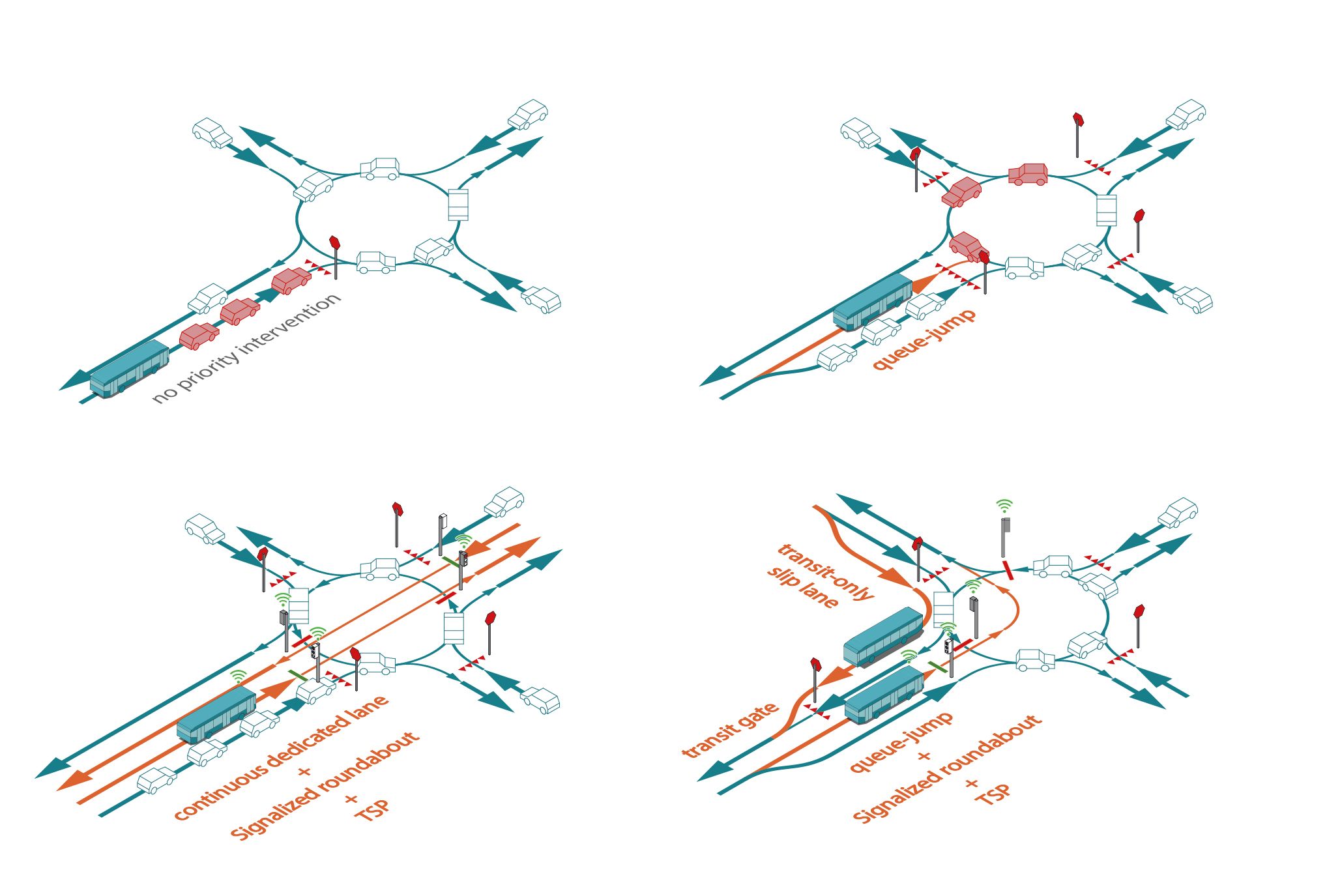
Roundabouts, also known as traffic circles or rotaries, can be designed in order to minimize transit delay. In a free-flow setup, the most common source of delay for transit is queue buildup and waiting for a traffic gap to enter the circle. The first can be addressed by having queue jumps or continuous dedicated transit lanes up to the roundabout. The latter can be overcome with signalized roundabouts combined with TSP, a solution frequently used for trams and BHNS high-level-of-service buses in France.
Switching to lateral-street-only stops/yields
Giving priority to the main street where transit runs and opting for lateral street-only stops whenever possible is an even more effective way to reduce transit delays at intersections. However, the possibility of managing an intersection with a lateral-street-only stop depends on the intersection's complexity. As a simple heuristic, the complexity of an intersection navigated by a transit vehicle is directly determined by the circulation setup of the lateral streets. As the matrix below shows, the number of conflict points, i.e. the points where vehicular movements cross or merge that need to be managed, shrinks dramatically for diverging or converging one-way configurations and for right-in/right-out ones.
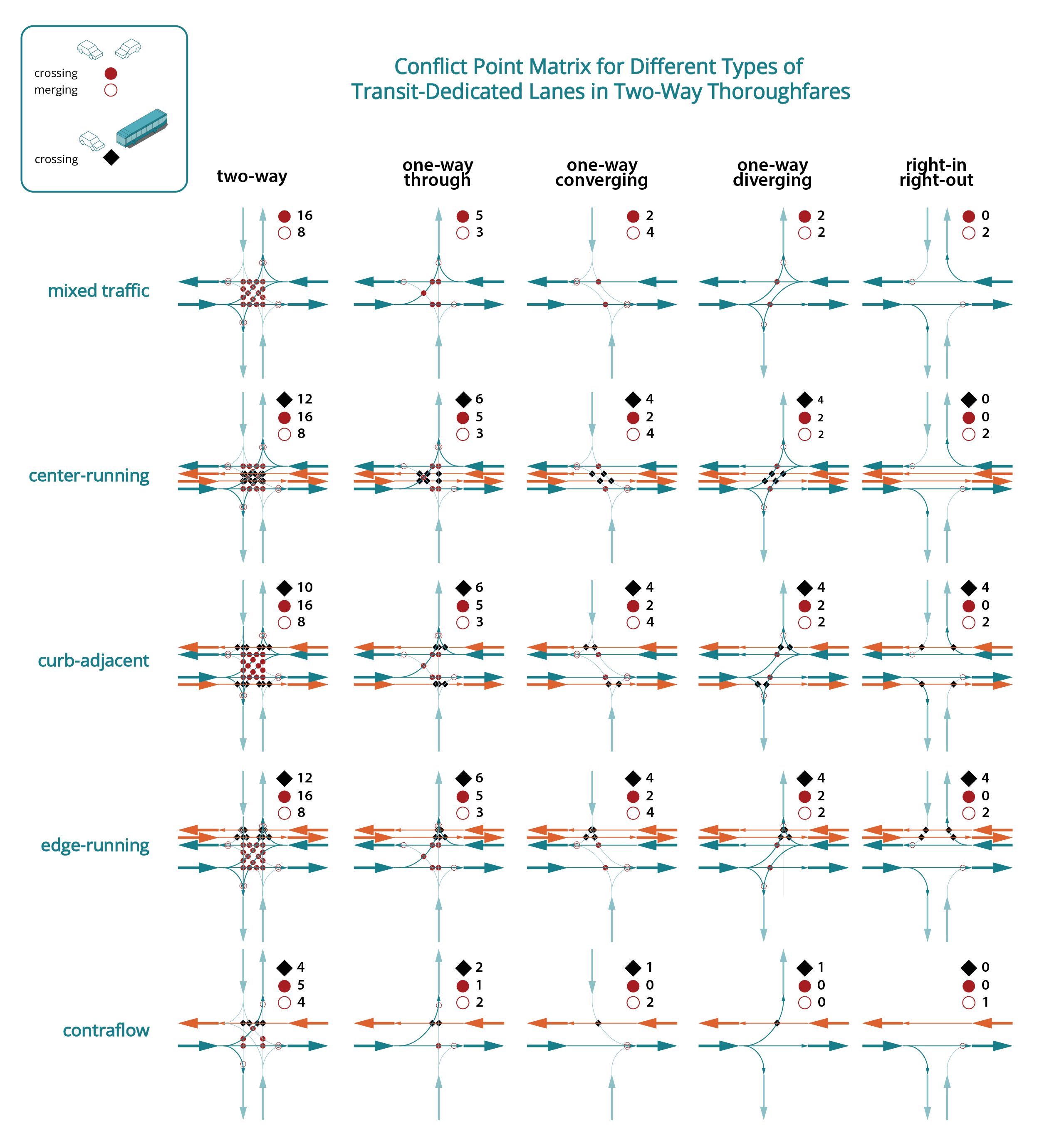
The best way to safely manage conflicts depends on many factors, including physical design, the number of lanes on the main street, throughput, and driving speed. More complex intersections generally require traffic signals, which separate conflicting flows temporally in phases. On the other hand, simpler intersections with fewer conflict points are more likely to be safely managed with lateral-street-only stops or yields, giving full priority to the flow of traffic in the thoroughfare, including transit. Contraflow Transit Lanes (F1 & F2) can also help reduce delays at intersections by making intersection management in the transit corridor similar to that of a one-way street.
Thinking beyond the single intersection
Beyond the tactical deployment of measures to reduce delays at individual intersections, the most effective strategies combine measures along the transit corridor with a broader rethinking of circulation patterns beyond the corridor to resolve conflicts elsewhere, with the goal of defining a Priority Corridor for Transit.