Besançon: La Boucle
Tools: a1f1-f2z1
Strategies: divert-through-trafficreduce-background-traffic
In 1974, Besançon implemented a pioneering circulation plan for its historic core (la Boucle) to divert through traffic away from it. The key elements of the strategy were a large pedestrian zone and a Transit Street (A1) semi-loop formed by rue de la République, Grande Rue, and rue des Granges, all of which are among the most important commercial streets in the center. A circular route for through traffic bypassing the city center was identified, using pre-existing streets and new arterials built along the Battant’s city walls, later completed with a new tunnel under the Citadelle. Local circulation patterns were reorganized into looping configurations, redirecting local traffic back to the main thoroughfares to reduce congestion while maintaining local accessibility within the Boucle. At the same time, a zone-based access restriction system (Z1) was implemented in 1974, initially covering four colour-coded areas within the Boucle. Over time, it has been extended to the Battant area, evolving into the current system of “secteurs réglémentés“, which divides the center into seven micro areas controlled by retractable bollards to which only residents and owners of off-street parking are allowed. Deliveries are allowed between 6 and 11 am without a permit.
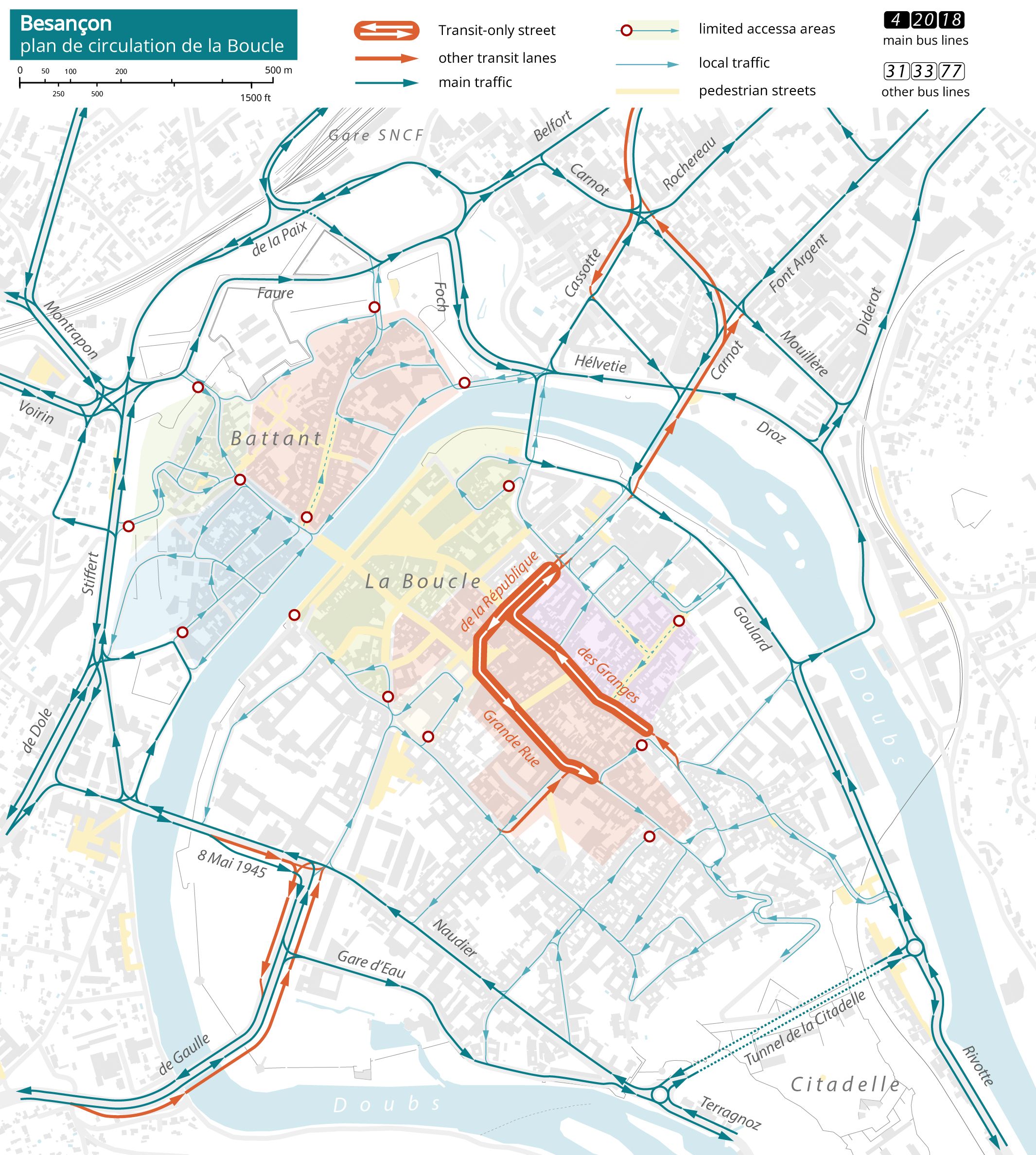
The transit-only corridor was used by most trunk bus lines passing through the city center until the opening of the tramway in 2014, and today it’s still used by three trunk and two minor bus lines, with up to 24 buses per hour during peak. Access to the transit loop is protected by retractable bollards that serve a dual function: preventing unauthorized access and metering bus access to avoid buses queuing in the narrow streets. During the 2010s, the streets were redesigned to favour a shared-street approach for buses and pedestrians. Deliveries are permitted to use the bus-only loop at certain times, parking on sidewalks.
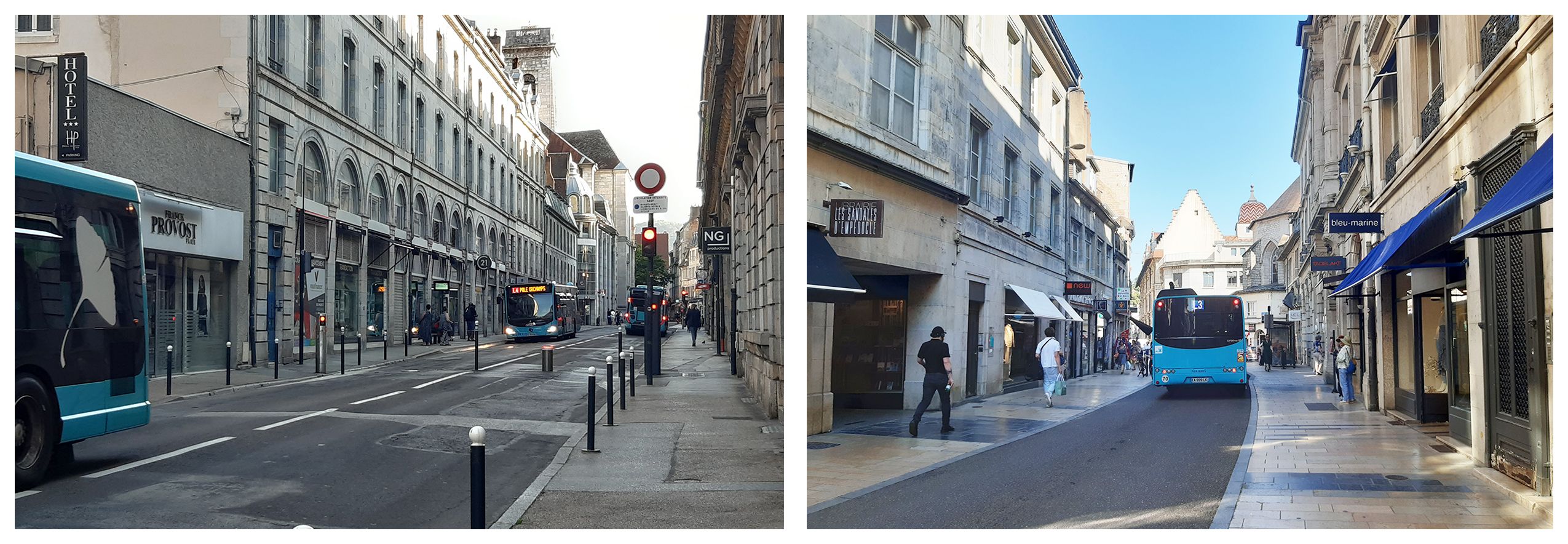
In the late 1970s, a system of contraflow transit lanes was established in the northern faubourgs to cater for the lines accessing the city center from rue de Belfort and rue Canot via the Pont de la République. This traffic setup was maintained until the early 2000s, when the construction of the tramway and the implementation of the BHNS line L3 induced a major redesign of the traffic flows in most of the inner faubourgs.