Curb-Adjacent Reversible Parking & Transit Lanes
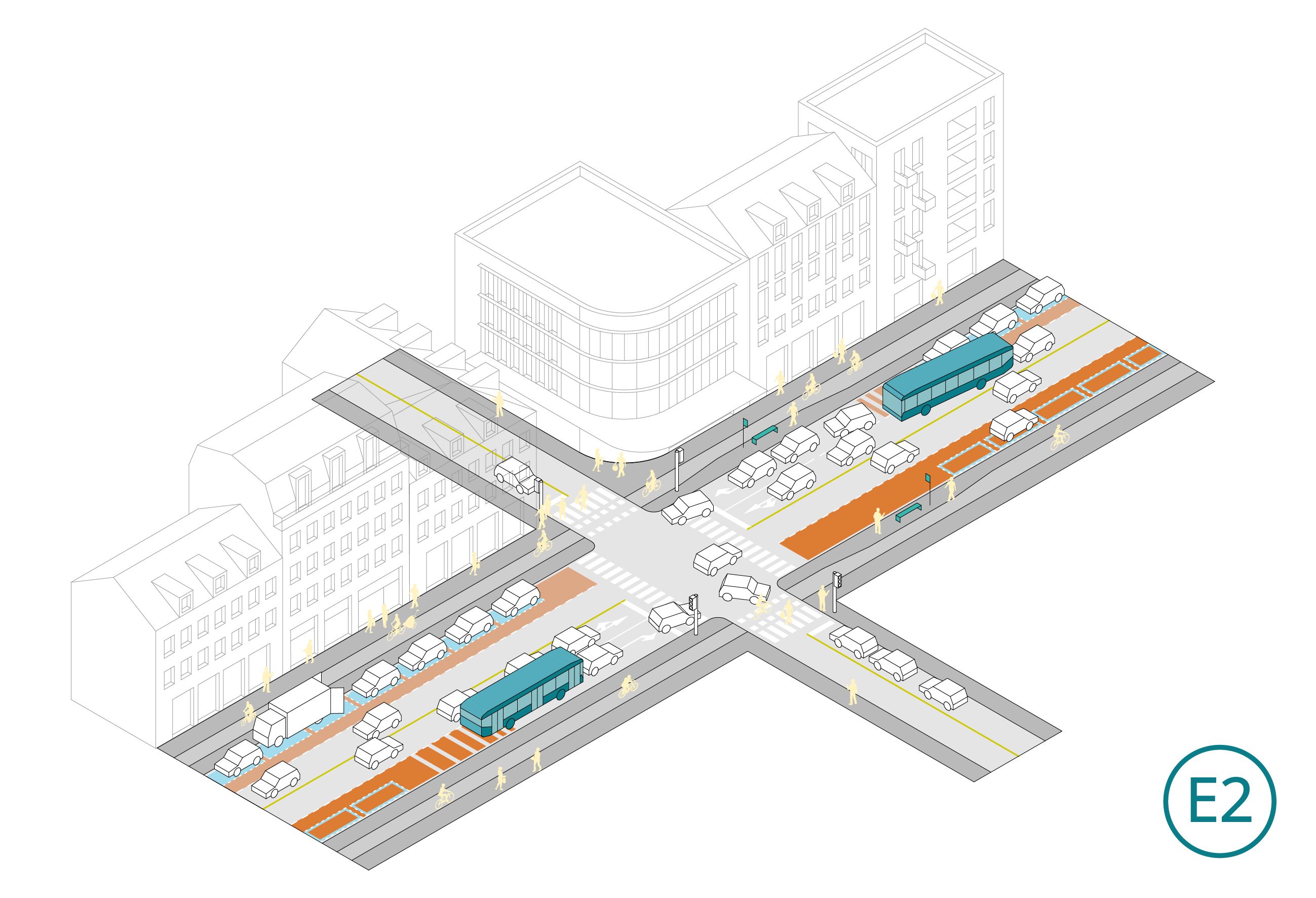
Curb-adjacent reversible parking & transit lanes, also known as “rush regs”, “clearways” or “axes rouges” in France, are a specific application of the curb-adjacent lane treatment that operates only during set hours, normally rush hours in the peak direction, while they are used for curbside parallel parking during off hours. They are a compromise solution that balances the need for dedicated lanes, especially to mitigate delays during peak periods, with the need to keep curb-side parking along major urban corridors during off-peak hours. They have the same characteristics and conflict points as regular curb-adjacent lanes (e1), especially with right-turning vehicles at intersections.
Key Facts
- Stops
- Generally located directly at the curb on sidewalks.
- Left Turns
- No particular risk of conflict, as left turns will generally interfere with the general traffic lane.
- Right Turns
- The primary limitation of curb-adjacent reversible parking & transit lanes is the direct conflict with right-turning vehicles, as these lanes are generally interrupted a few dozen meters upstream of an intersection to accommodate turning movements. This can be a major source of delays, particularly in areas with high pedestrian volumes and when combined with near-side stops, as right-turning vehicles that yield to pedestrians and cyclists block transit vehicles. This can be mitigated through several strategies, including prohibiting right turns, reorganizing circulation patterns on lateral streets as converging one-way streets to reduce the number of right turns, and signal management measures that minimize right-turn conflicts, such as protected right turns. Curb-adjacent transit lanes are also subject to right-turn conflicts outside the intersection, involving vehicles accessing driveways and properties, with potentially high volumes at off-street parking and commercial areas.
- Parking
- Legally parked vehicles remaining in the lane after the start time and encroachment by deliveries and pick-up/drop-off are common problems on this type of lane and require constant enforcement.
- Enforcement
- Enforcement of this type of lane is particularly challenging because it can’t be protected by physical separation to prevent lateral encroachment. Vehicle-mounted cameras can be used for enforcement, but fines are normally conditional on a vehicle being spotted twice and after a certain lapse of time, to ensure it was not legally using the lane for a short time to reach parking.
- Transit Signal Priority
- Actuated signal priority is possible with most strategies, but its effectiveness depends on whether conflicts with right-turning vehicles are properly mitigated to ensure a reliable Estimated Time of Arrival (ETA).
- Cost
- Generally minimal (road signs, painted markings).
Use Cases
The origin of curb-adjacent reversible parking & transit lanes can be traced back to the interwar and postwar years as part of the “low-cost” rudimentary transit-priority and traffic-fluidity toolbox of the dawn of mass motorization, which included permanent and peak-only curbside parking bans along major traffic arterials in the rapidly motorizing developed countries of the Americas, Europe, Oceania and East Asia [1,2,3]. However, like most “peak-only” transit priority measures, they have been most popular in a few jurisdictions in North America and Oceania. For example, they represent the dominant form of bus lanes in cities like Montréal, where they have been extensively deployed as part of the MPB (Mésures Préférentielles pour Bus) scheme, especially since the late 2000s [4], and in Melbourne, where they are known as ‘clearways’.
Bibliography
- Ministère des Transports (1972). Directives sur l’amélioration de la circulation des transports collectifs de surface dans les villes. 3 juillet 1972.
- Levinson, H. S., Hoey, W. F., Sanders, D. B., & Wynn, F. H. (1973). Bus use of highways: state of the art. NCHRP Report, (143).
- Norton, P. D. (2011). Fighting traffic: the dawn of the motor age in the American city. Mit Press.