Reduce Delays From Transit Stops
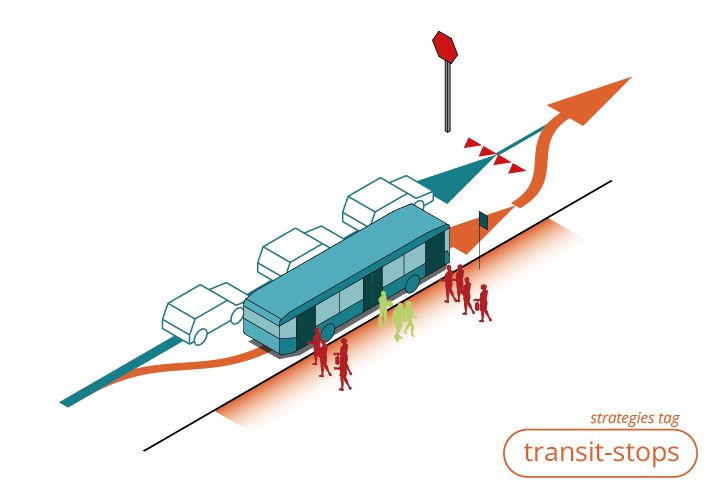
Dwelling at transit stops to board and alight passengers, and exiting and re-entering traffic, are the two major sources of delay for transit vehicles at transit stops.
Reducing boarding-related delays
Dwell times are affected by non-physical factors, such as boarding policies and related fare collection and enforcement, as well as by transit vehicle design (e.g., the number and size of doors and the internal layout).
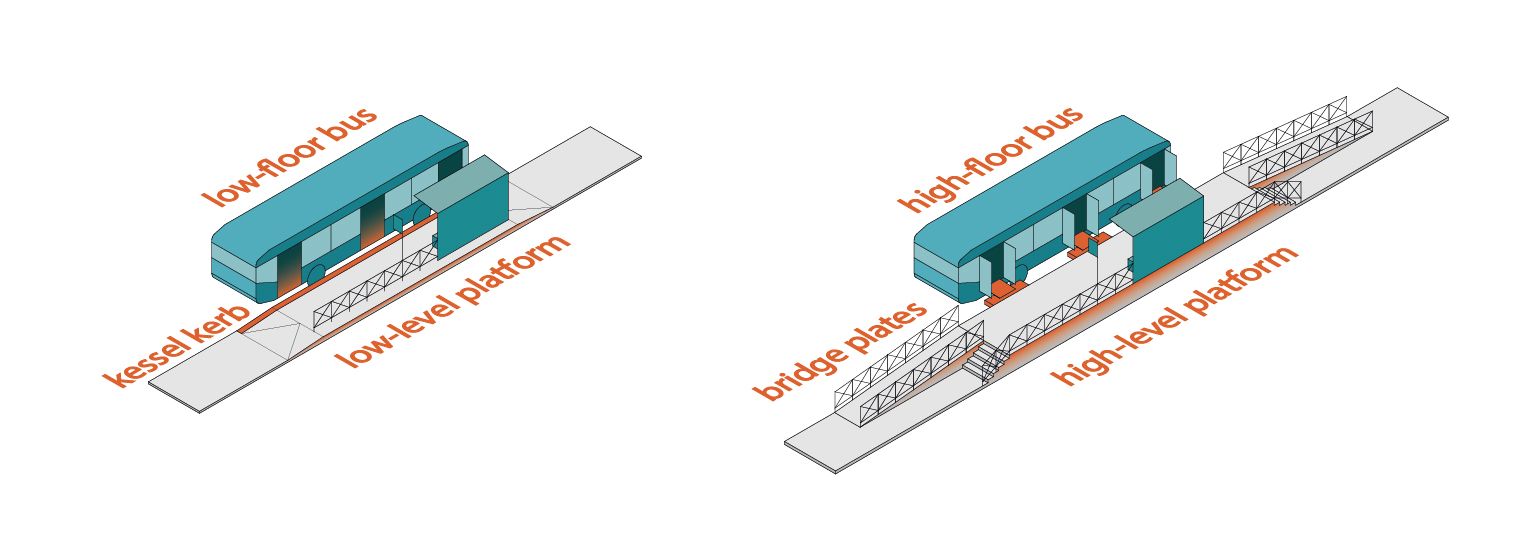
With regard to platform and vehicle design, a key element in reducing boarding times and increasing universal accessibility is minimizing or eliminating the horizontal and vertical gaps between the platform and the vehicle's interior floor. For trams, this has been achieved by lowering part or all of the vehicle floor to 30-35 cm (11.8 to 13.8 inches) above the track, with low-floor trams developed starting in the 1980s, and/or by raising the curb above the sidewalk's regular height to match high-floor vehicles with floors between 60-100 cm.
For buses, low-floor and kneeling buses reduce the vertical and horizontal gaps between the platform and vehicles by using platform edges that facilitate a safe approach with minimal gaps, such as the Kessel Kerb, a solution developed in Germany in the late 1970s. Optically guided systems represent an alternative, but remain a niche application. Many heavy-duty Bus Rapid Transit (BRT) systems in South America, Asia and the Middle East have taken the opposite approach, combining high-floor buses with high platforms and fixed or deployable bridging plates to fill the horizontal gap. This solution requires expensive, space-intensive stop infrastructure, but it has the advantage of making the internal layout of buses better suited to handle high ridership.
Reducing traffic-related delays
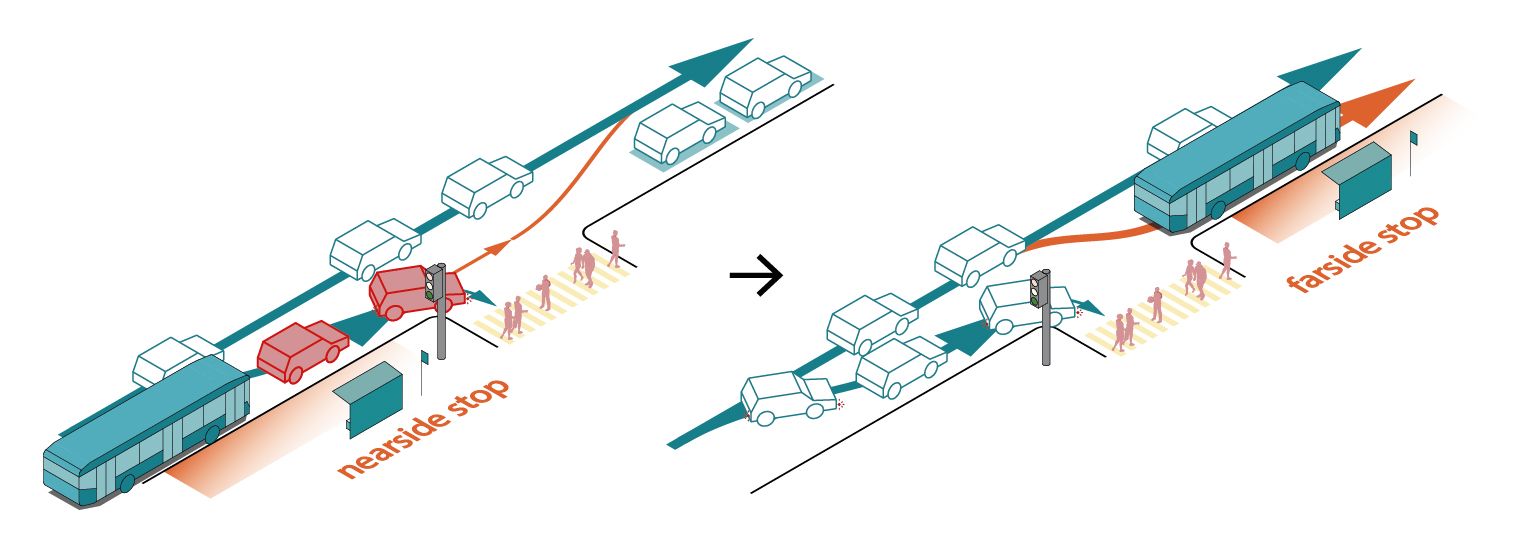
To reduce the delay caused by exiting and re-entering traffic when accessing a stop, several solutions can be implemented. One of the simplest actions is to move the stop “farside,” i.e., after the intersection. Moving to a farside stop can reduce delay at signalized intersections where the right-turning lane doubles as a bus bay (a common legacy setup in many North American jurisdictions), because right-turning vehicles yielding to pedestrians or bikes block access to the stop and can cause buses to lose one or more signal cycles. Farside stops also reduce signal delays by enabling a more effective implementation of Signal Priority and facilitating merging back into traffic after the intersection rather than at the most congested point, where turning vehicles impede the flow of traffic. Farside stops also offer a few safety advantages for pedestrians.
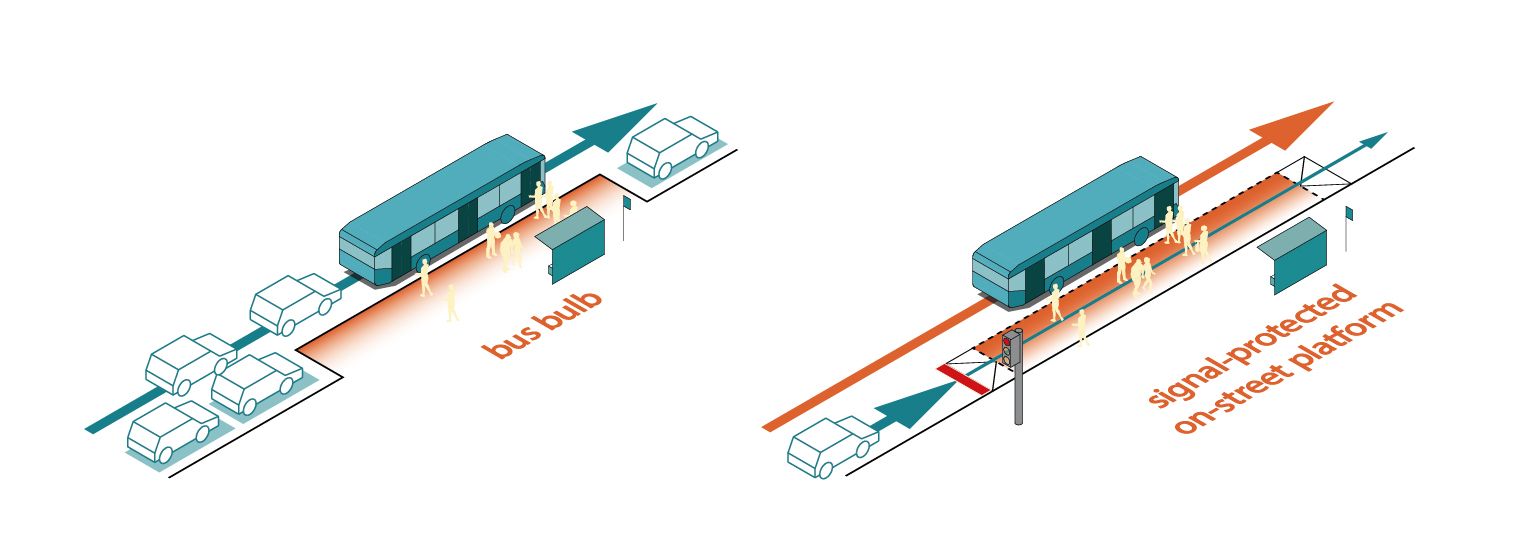
Bus bulbs (M1) are a common solution deployed on corridors with curbside parking to allow for in-flow boarding. Signal-protected on-street platforms (M2) are a more specific application that provides safe and quick boarding of center-running transit, especially trams, when there is insufficient space for a boarding island, a solution popular in Austria and Germany, for example.
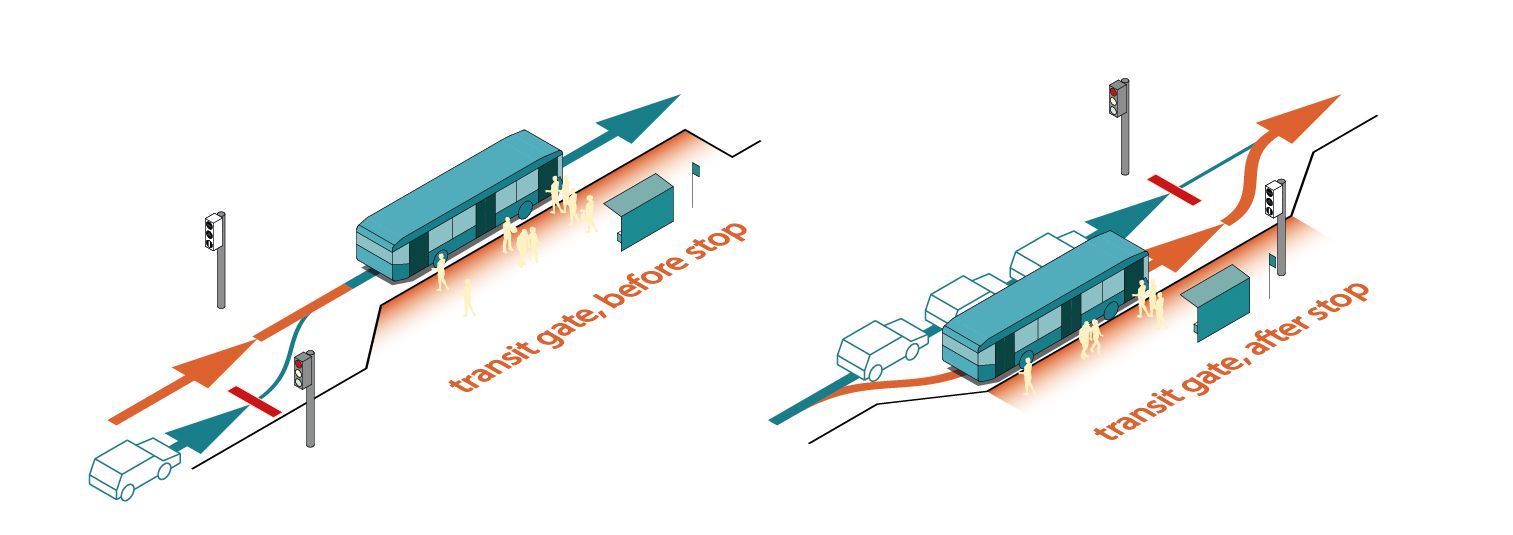
Transit gates (H1 & H2), either signal or yield-protected, can be placed after a stop to reduce or even eliminate the penalty for re-entering the traffic flow, or before it to give priority to transit entering a shared pinchpoint segment at the transit stop, a solution frequently used in Zürich to locate transit platforms in constrained rights-of-way while maintaining full transit priority.
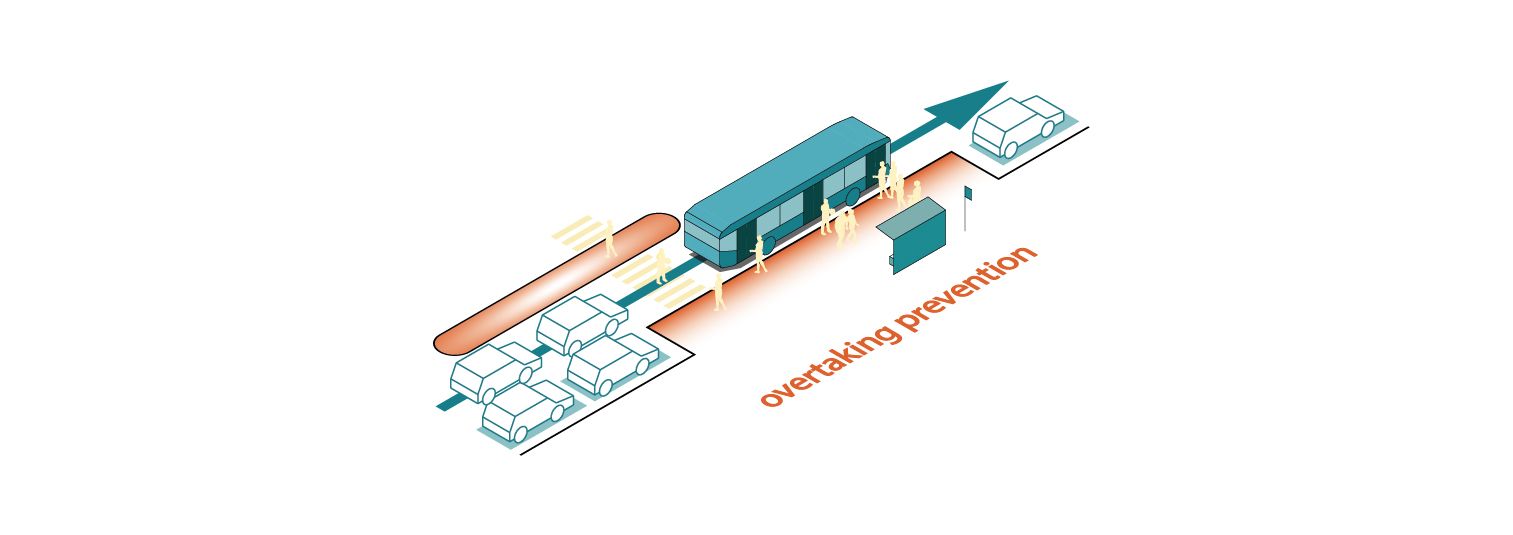
Physical obstacles to prevent overtaking (M1), such as short median curbs or traffic islands that create a pinch point, can be deployed to reduce queue buildup at downstream intersections and improve safety for crossing pedestrians, especially on mixed-traffic two-lane streets.