München: Müllerstraße, Rumfordstraße and Thierschstraße
Tools: n1f1-f2c1g1-g2
Strategies: divert-through-trafficpriority-corridorsIntersections
Tram lines 16, 17, and 18 form a tangential route along the southern and eastern edges of Munich’s city center along three 2-lane neighbourhood streets—Müllerstraße, Rumfordstraße and Thierschstraße— running almost entirely in mixed traffic. However, four transit piority setups are strategically located at four main intersections with radial throughfares to prevent through traffic in one or both directions from using this route except to access the local inner-neighbourhood network. Additionally, left turns are prohibited at most signalized intersections along the route. This way, the main tangential through-traffic flows are redirected to Blumenstraße and the Thomas-Winner-Ring, part of the ring road around the Old City, and along the Isar river shores (e.g., Erhardtstrasse and Steinsdorfstrasse).
This setup is the materialization of the concept of “traffic-calmed urban cells” (verkehrsberuhigte Zelle) outlined in the 1973 document “Building Blocks for Munich's Transport Policy Concept” (Bausteine für das verkehrspolitische Konzept), which builds upon Buchanan’s “environmental area” concept to outline a traffic management strategy functionally separating main transit and car routes, notably within the Inner city, with car traffic pushed to the edges of the “traffic-calmed urban cells” while transit would serve their core.
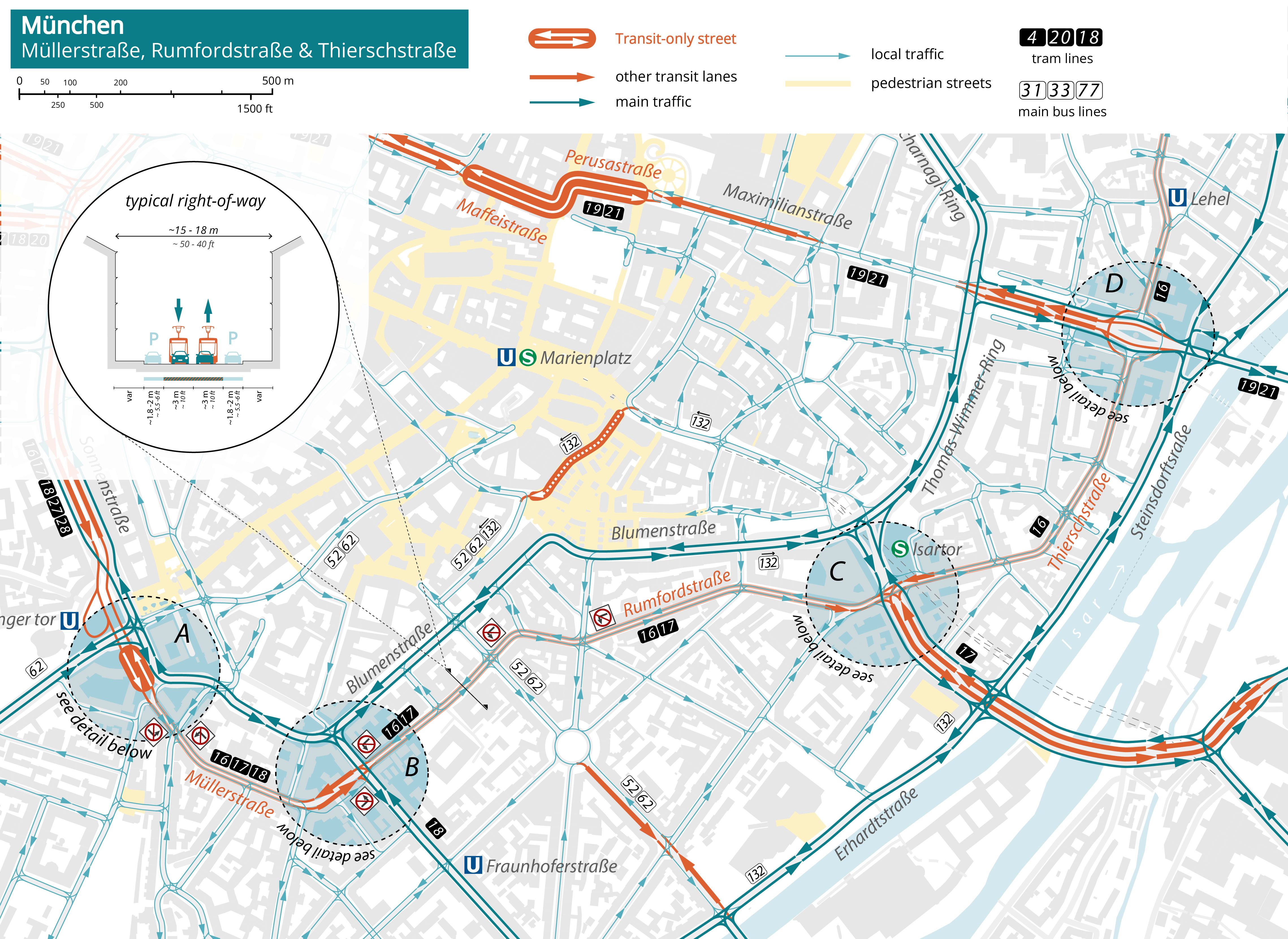
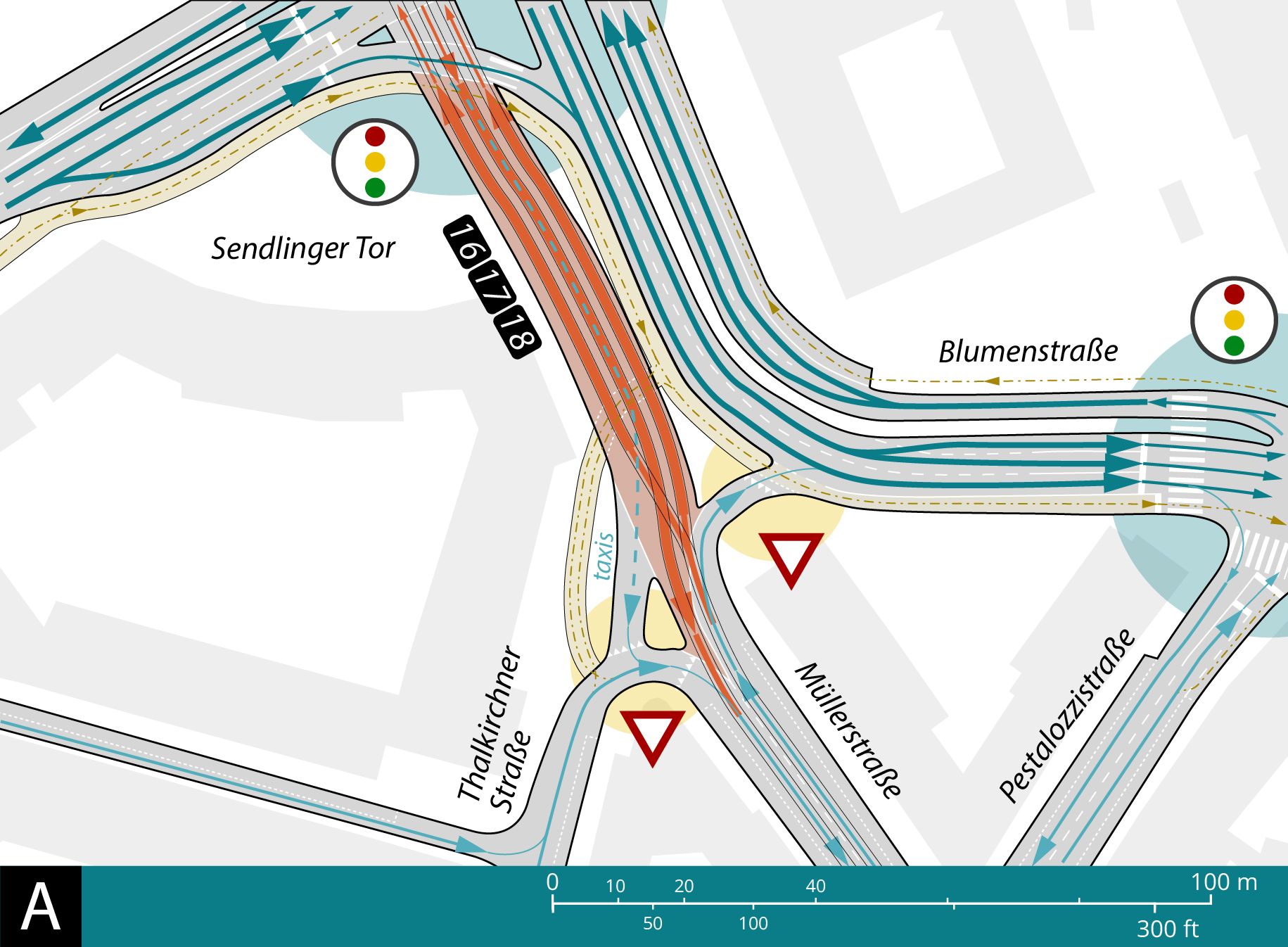
In practice, this strategy is implemented with minimal infrastructure and basic arrangements that prevent through-traffic in both directions (A) or in a single direction (B, C, D). At the western end of Müllerstraße (detail A), only trams are allowed to enter or exit the street directly into the main intersection of Sendlinger Tor, via a Transit Modal Filter (N1). Local westbound traffic is diverted onto Blumestraße, while regular traffic can access the street only indirectly, via Thalkirchner Straße. Taxis are allowed to use the transit-only section in one direction, while bikes can use the filter in both directions.
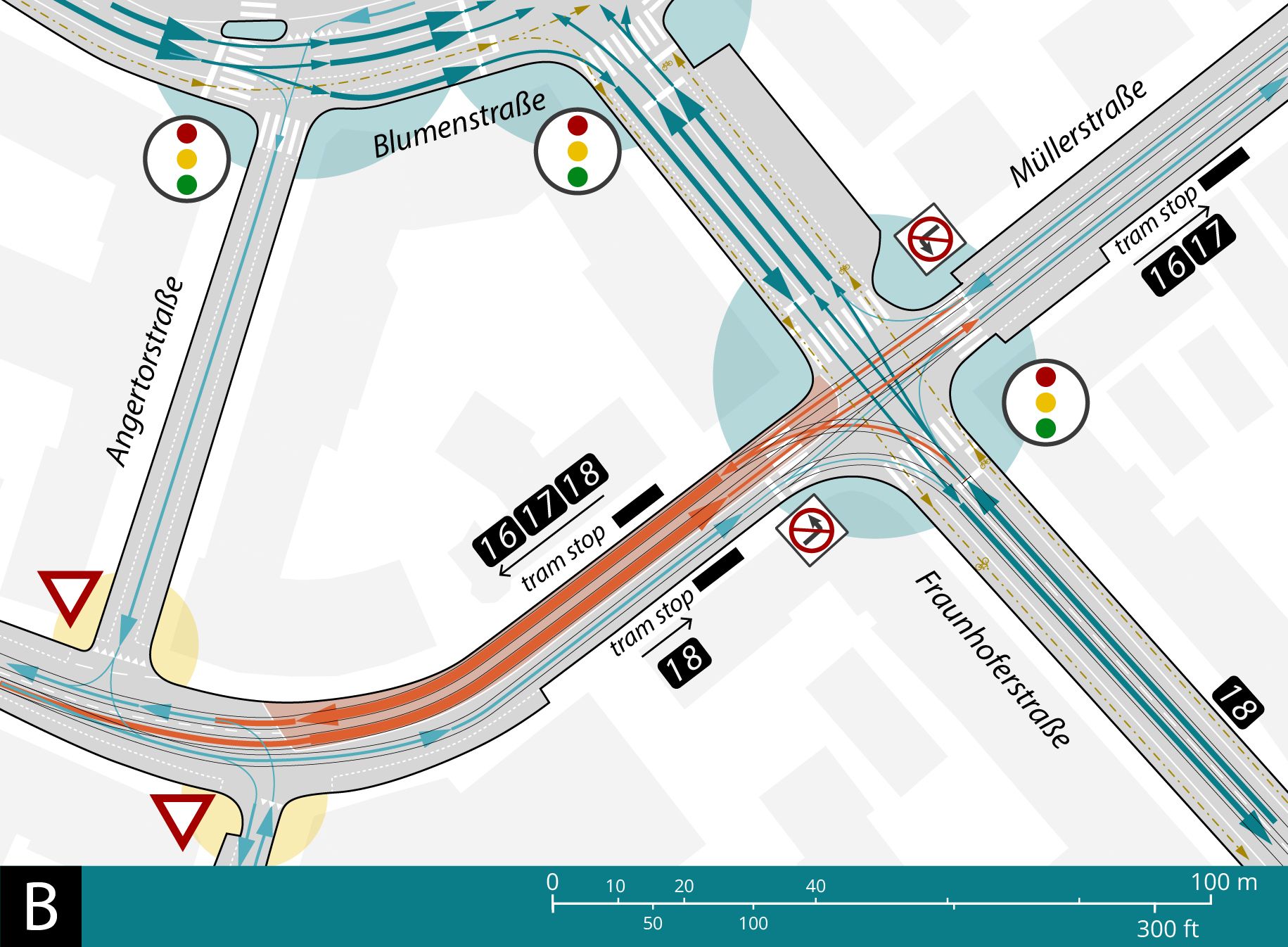
At the intersection of Müllerstraße and Fraunhoferstraße (detail B), where tram line 18 join the main tangential tram route, a one-direction model filter is implemented by deploying a short edge-running transit lanes setup (C1) and by forcing westbound private traffic along Müllerstraße to turn right into Fraunhoferstraße. In the eastward direction, private traffic can continue through and turn right, while tram tracks are split between through tracks on a dedicated lane and a turn track for line 18 on the mixed-traffic lane.
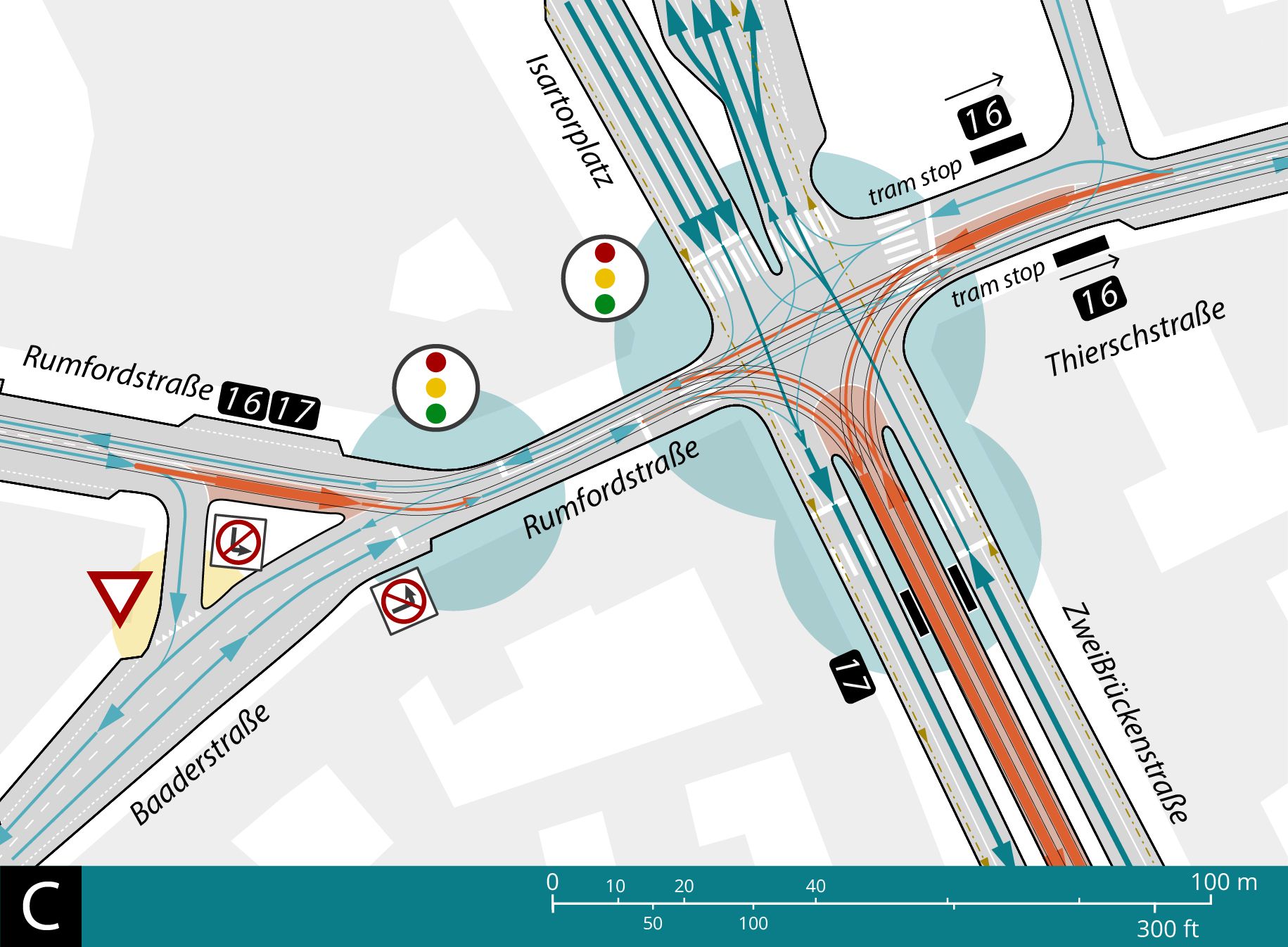
Where Rumfordstraße intersects Baaderstraße (detail C), near the intersection with Zweibrückstraße, a major throughfare leading to the inner ring road, a short unidirectional modal filter, equivalent typologically to a very short contraflow transit lane (F1), forces traffic going east to turn right into Baaderstraße. Together with two no left-turns, this setup prevents through traffic from continuing east along the transit corridor.
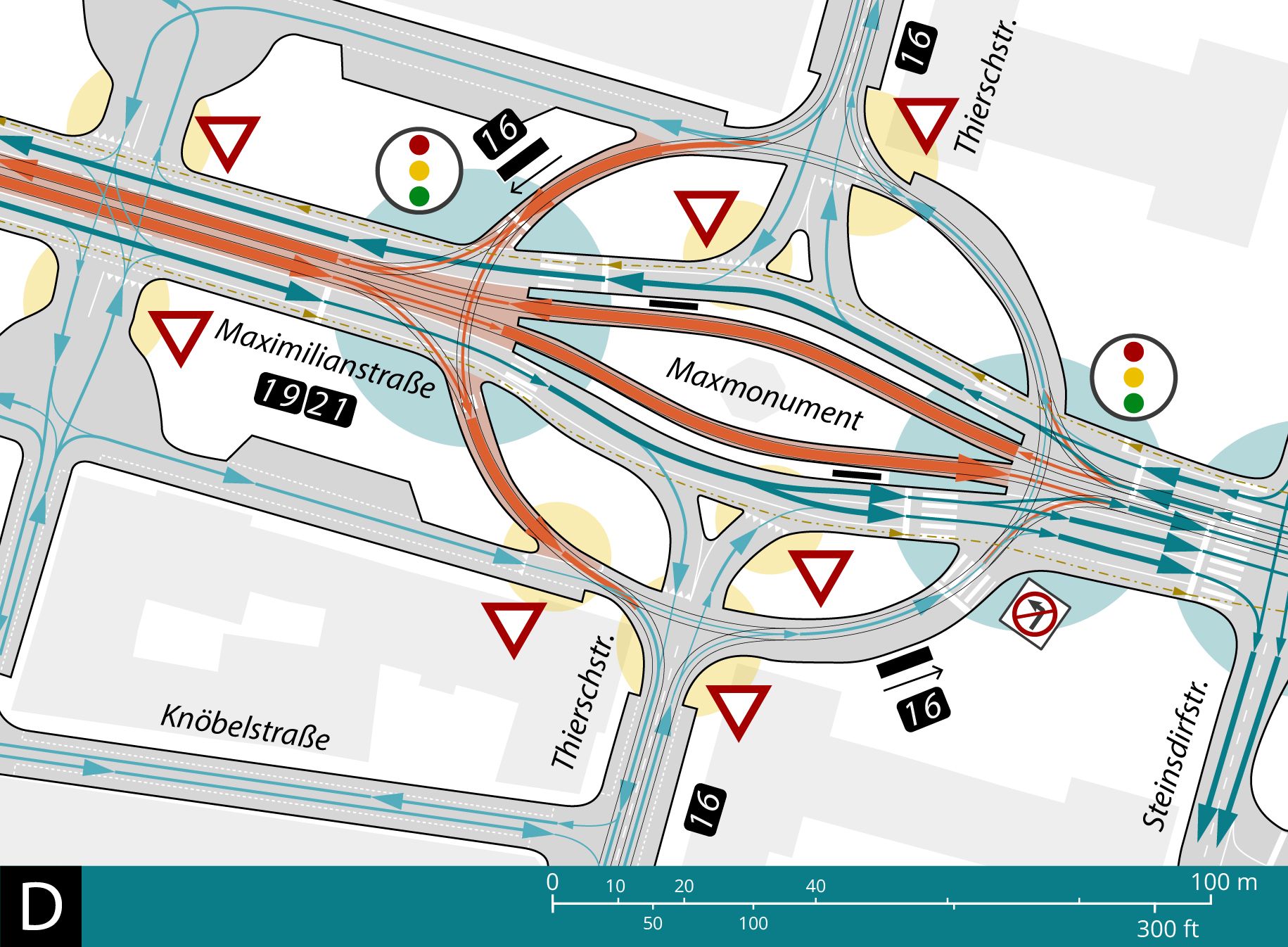
Finally, at the Maxmonument, where Thierschstraße intersects the 19th-century monumental axis of München, Maximilianstraße (detail C), two short legs of the elliptical square are reserved for transit vehicles, preventing south-west-bound traffic from continuing along the route of tram line 16.