Divert Through Traffic
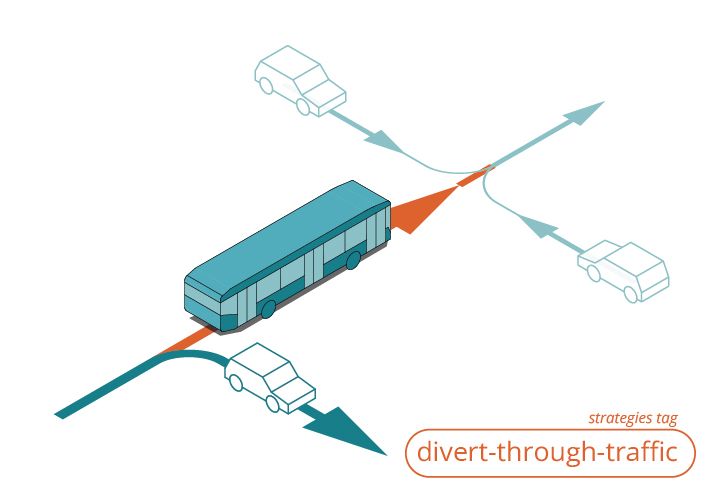
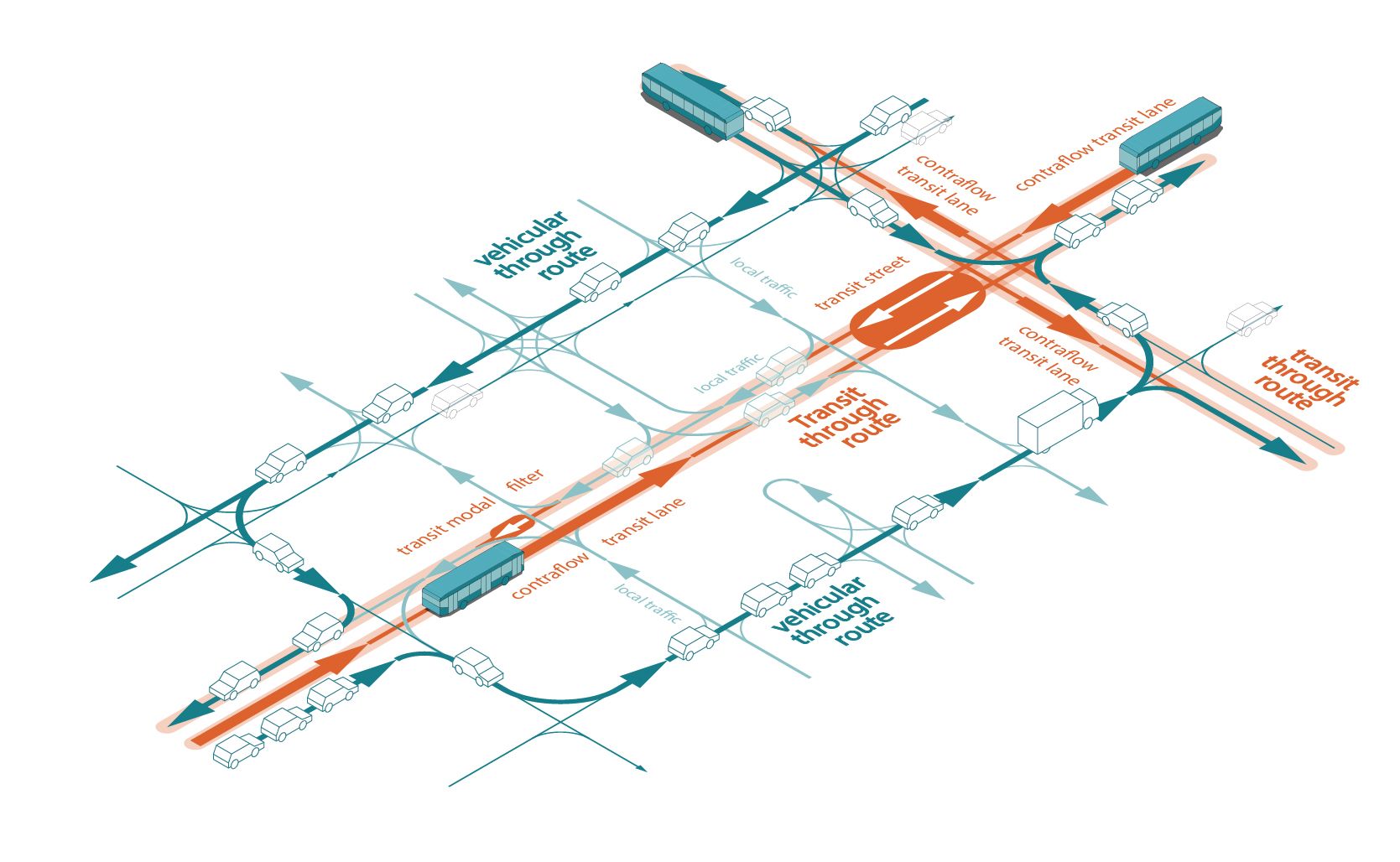
An effective strategy commonly observed in many jurisdictions is to deploy strategically located priority tools to divert private through traffic away from a transit-priority through route. Short segments of Transit Streets (A1) and Transit Ways (A2), alternating Contraflow Transit Lanes (F1 & F2), and Transit Modal Filters (M1) are combined to suppress through traffic along a transit corridor while allowing indirect access to properties via alternative paths.
Prohibiting through traffic is a common strategy used to minimize delays along corridors with narrow rights-of-way, where it’s difficult or even impossible to provide transit with its own lane alongside regular traffic. Diverting through traffic away from the transit corridor can be strategically linked to the creation of Transit-Accessible Low-Traffic Areas. The implementation of these tools requires a circulation-minded approach to traffic management, with proactive identification of preferred transit corridors that are at least partially separated from those for through private traffic.
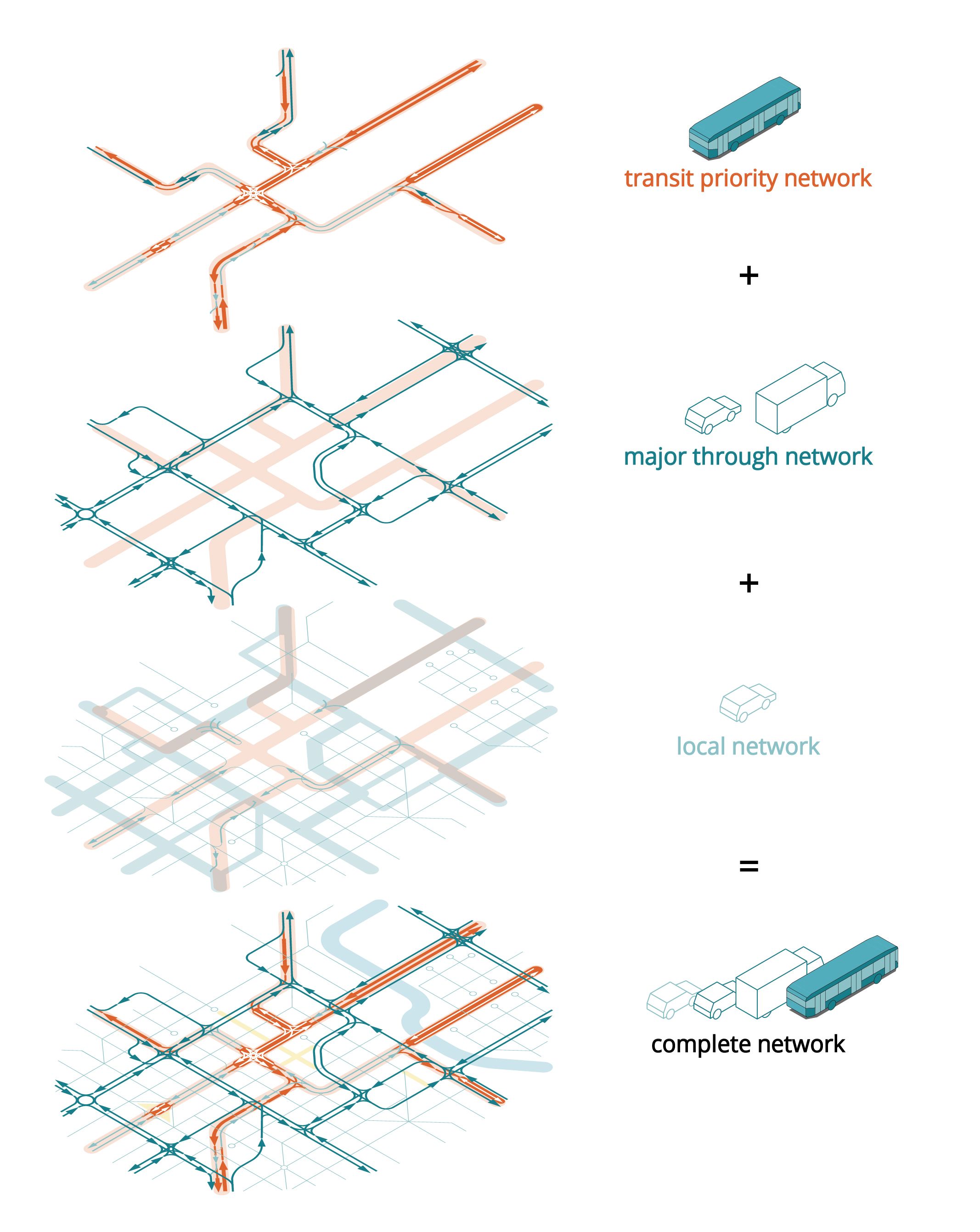
The systematic deployment of this strategy at the wider city level results in partially independent transit-priority and major through-traffic networks. This approach is similar to the one conceptualized in Dutch bike network planning as Ontvlechting, or “disentangling,” in which the trunk bike and vehicular networks do not fully overlap but rather complement each other, forming a “complete network”. The disentanglement of the main vehicular and transit networks is clearly visible in the circulation arrangements of the inner parts of cities such as Bologna, Zürich, München, Stockholm, Amsterdam, Besançon, Rennes, Lyon, and many others documented in the Atlas.