Dead-ending of Lateral Streets
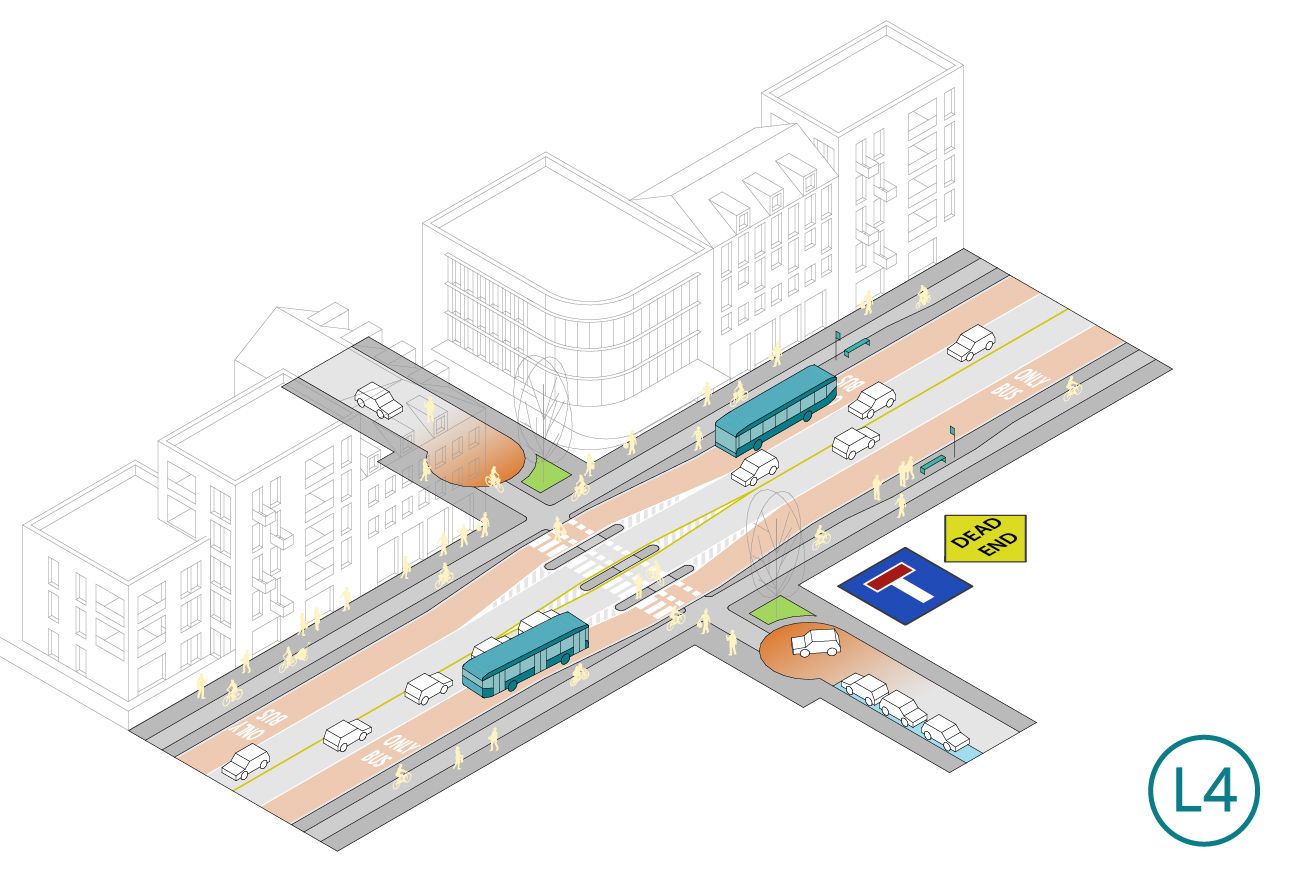
Dead-ending lateral streets is the most effective way to eliminate delays caused by intersections, as it removes the intersection for vehicular traffic. Compared to right-in/right-out (L3), it also eliminates right-turn conflicts, making it a particularly effective priority measure for transit running in mixed traffic and on lateral (C1), offset (D1), and curbside (E1) configurations. Dead-ending can be paired with filtered permeability for non-vehicular traffic, such as bikes and pedestrians, that can be managed with zebra crossings with pedestrian refuge islands and/or traffic signals.
Key Facts
- Stops
- N/A
- Left Turns
- Left turns are prevented.
- Right Turns
- Right turns are prevented.
- Parking
- N/A
- Enforcement
- Dead-ending can be enforced with simple physical barriers, such as bollards, or with a more capital intensive extension of the pavement to create pocket squares.
- Transit Signal Priority
- N/A
- Cost
- Minimal to medium, depending on the level of physical remodelling required.
Use Cases
Dead-ending lateral streets is a fundamental tool for fostering transit priority. In conjunction with RIROs (L3) and converging and diverging one-way streets, it can be used to define transit priority corridors, systematically removing delays at intersections along the corridor. Like RIROs, it’s a tool that emerged in the postwar years to create a hierarchical road network in pre-car parts of cities, while preserving full permeability for pedestrians and bikes.